
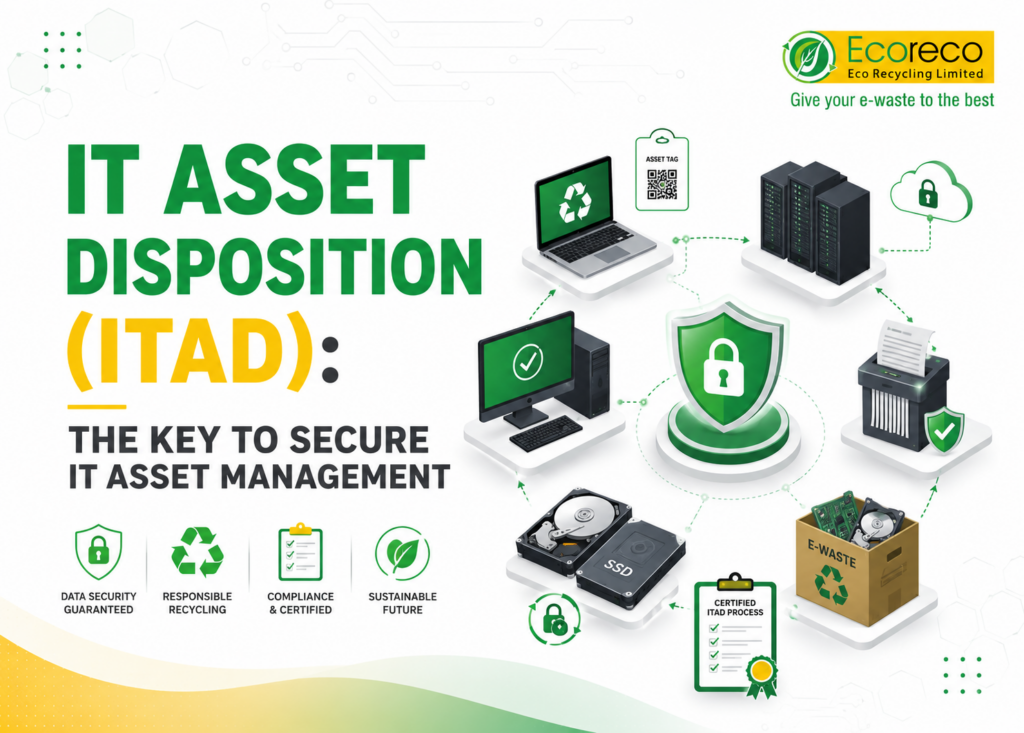
Every organisation that uses technology eventually faces the same problem: what do you do with IT equipment that’s no longer in use? Servers, laptops, desktops, mobile devices, networking hardware: these assets cycle out constantly, and the question of how to handle them isn’t just logistical. It’s a data security question, a regulatory compliance question, and increasingly, an environmental responsibility question.
This is exactly what IT Asset Disposition, ITAD, addresses. ITAD services cover the entire end-of-life process for IT equipment: secure data destruction, asset tracking, refurbishment and resale where value remains, and certified recycling for what can’t be reused. Done properly, ITAD isn’t just a disposal exercise. It’s a risk management function that most IT leaders underestimate until something goes wrong.
The Gap Between “Decommissioned” and “Secure”
There’s a common assumption in organisations that once an asset is removed from active use, wiped, stored, or handed to a vendor, the associated risk disappears. It doesn’t.
A decommissioned server sitting in a storeroom still contains data. A laptop sent to a third-party recycler without certified data destruction still contains data. Hard drives that were “formatted” using standard operating system tools still contain recoverable data. The gap between an asset being taken offline and being genuinely secure is where data breaches occur, and they happen far more often than most organisations realise or publicly disclose.
According to multiple cybersecurity research reports, a significant proportion of second-hand enterprise hard drives sold on open markets, through auction, resale channels, or informal recycling, still contain readable corporate data. This includes financial records, employee information, customer data, and in some cases, access credentials. The source of this data almost always traces back to a gap in the IT asset disposition process.
What a Rigorous ITAD Process Actually Covers
Understanding what professional IT Asset Disposition involves helps clarify why informal or in-house approaches often fall short.
Asset inventory and tracking are the starting point. Every device going through the disposition process should be catalogued with make, model, and serial number.. This creates a chain of custody that can be audited later, which matters enormously for regulatory compliance.
Data destruction is the highest-stakes step. There are three primary methods: overwriting (writing new data patterns over existing data multiple times, effective for functioning drives), degaussing (using a powerful magnetic field to render data unreadable, used for hard drives and magnetic media), and physical destruction (shredding or crushing the drive, used when other methods aren’t sufficient or when drives are non-functional). A credible ITAD provider will issue a certificate of data destruction for each asset, specifying the method used and confirming compliance with relevant standards such as NIST 800-88 or DoD 5220.22-M.
Asset recovery and remarketing follow data destruction. Many decommissioned IT assets retain significant resale value, particularly recent-generation laptops, workstations, and networking equipment. A good ITAD service will assess each asset for refurbishment potential, extending its useful life and returning value to the organisation rather than treating everything as waste.
Certified recycling handles what genuinely can’t be reused. Electronic waste contains hazardous materials, such as lead, mercury, cadmium, and beryllium, alongside valuable recoverable metals like gold, copper, and palladium. Certified e-waste recycling ensures these materials are processed through environmentally compliant channels rather than ending up in informal recycling streams where neither environmental nor data security standards apply.
Why Compliance Pressure Is Raising the Stakes for ITAD
Regulatory frameworks around data protection and e-waste management are tightening globally, and India is no exception. Organisations handling personal data under frameworks like India’s Digital Personal Data Protection Act have clear obligations around data security, obligations that don’t end when a device is decommissioned. They extend to how that device is disposed of.
For sectors with additional regulatory exposure, such as banking, healthcare, legal, and government, the requirements are more specific still. An audit that reveals gaps in IT asset disposition practices can result in penalties, reputational damage, and, in serious cases, liability for data breaches traced back to improperly handled equipment.
The practical implication is that ITAD is no longer a back-office facilities decision. It belongs in conversations about information security policy, vendor due diligence, and compliance frameworks. Choosing an ITAD provider should involve the same scrutiny as choosing any security-sensitive vendor: reviewing certifications, understanding their data destruction methodology, and confirming their environmental compliance credentials.
The Hidden Value Recovery Most Organisations Leave Behind
One angle that often gets overlooked in ITAD conversations is asset recovery value. Organisations that treat decommissioning as a cost, paying for disposal rather than extracting value, are leaving money on the table.
A three-year-old laptop fleet being replaced with newer hardware still has meaningful resale value if handled correctly. Enterprise networking equipment, rack servers, and storage arrays from major manufacturers command secondary markets, particularly in growth markets where organisations are building infrastructure with cost constraints. A structured remarketing process, run by an ITAD provider with established resale channels, can offset a significant portion of the new equipment procurement cost.
This changes the financial framing of ITAD from “disposal expense” to “asset lifecycle management with a recovery component.” For IT and finance leaders making the case for proper ITAD investment, this is often the most persuasive angle internally.
Five Questions to Ask Before Choosing an ITAD Provider
Not all ITAD services are equal. These questions separate credible providers from those who will create rather than reduce risk:
- Do they issue individual certificates of data destruction for every asset, or only summary reports? Individual certificates are the standard for serious compliance purposes.
- What data destruction standards do they work to, and can they accommodate different standards based on your data classification requirements?
- Are they certified for e-waste processing under relevant environmental regulations? In India, this means CPCB authorisation. Internationally, R2 (Responsible Recycling) and e-Stewards are the leading third-party certifications.
- How do they handle the chain of custody from collection to final processing? Can they provide tracking documentation at each stage?
- What is their policy on downstream vendors, the recyclers or resellers they use? Your liability doesn’t end with your ITAD provider if their downstream chain is non-compliant.
ITAD Is Risk Management, Not Just Recycling
The organisations that treat IT Asset Disposition as a compliance and security function, rather than a logistics one, consistently manage their IT lifecycle with less risk, better cost recovery, and cleaner environmental records than those that improvise.
The right time to think about ITAD is before a device reaches end of life, not after. Building a disposition policy, identifying a certified provider, and integrating asset tracking from procurement to disposal create a closed loop that eliminates the gaps where data exposure and regulatory non-compliance occur.
At Eco Recycling Ltd, our ITAD services are built around certified data destruction, transparent chain-of-custody documentation, and responsible e-waste processing that meets regulatory standards across sectors. If your organisation is managing an IT refresh cycle or simply hasn’t formalised its asset disposition process yet, that’s the right conversation to start before the risk gap becomes a real problem.
Secure disposition isn’t complicated. It just needs to be deliberate.
