
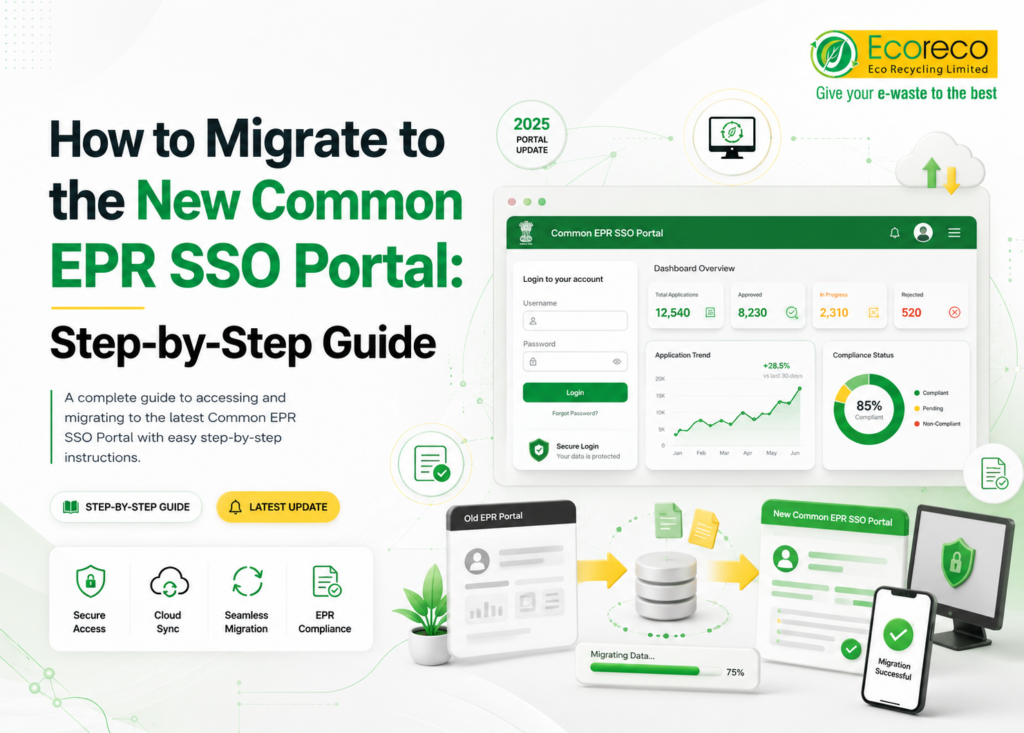
India’s Central Pollution Control Board has officially launched the Common EPR Portal, a unified digital platform that consolidates the country’s previously fragmented Extended Producer Responsibility compliance infrastructure into a single, centralized ecosystem. This is one of the most consequential regulatory developments for Producers, Importers, and Brand Owners, commonly referred to as PIBOs, in the history of India’s EPR framework.
The new portal operates on a Single Sign-On system, meaning every entity previously managing separate logins across multiple waste stream portals, including Plastic Waste, E-Waste, Battery Waste, Tyre Waste, and Used Oil, now operates from one unified dashboard at epr.cpcb.gov.in. Migration to this platform is mandatory. Access to operational functions on legacy portals is being progressively restricted for entities that have not completed the transition.
For compliance teams, business owners, and industry stakeholders working with EPR e-waste obligations or other waste streams, understanding this change and acting on it without delay is now a business-critical priority.
What Is the CPCB Common EPR SSO Portal and Why Was It Introduced?
The Problem with the Old System
Before this portal was launched, India’s EPR compliance landscape was structurally fragmented. A company managing obligations across, say, E-Waste and Battery Waste was required to maintain two entirely separate portal accounts with different logins, different document records, different reporting workflows, and different credit management systems. A larger business managing plastic packaging alongside e-waste and tyres could easily be juggling three or more separate CPCB portals simultaneously.
This fragmentation created multiple problems: overlapping documentation requirements, inconsistent data records across portals, higher risk of errors during annual return filing, and significant administrative overhead for compliance teams. It also made it harder for CPCB to maintain an accurate, consolidated view of EPR compliance performance at the entity level.
What the New System Delivers
The Common EPR Portal resolves these problems by bringing all waste streams under a single digital identity. Producers, importers, brand owners, and recyclers now register once to receive a master CEPR ID that grants access to every applicable waste stream portal through a single login.
Beyond consolidated access, the platform introduces the EPR Transaction Portal, or ETP, as a centralized marketplace where all EPR credit-related activities now take place. Buying, selling, and transferring EPR certificates across waste streams is unified within this one environment, making transaction tracking significantly more transparent than it was under the previous fragmented system.
Who Is Affected by the SSO Migration Requirement?
The migration obligation applies to all entities already registered under any EPR waste stream framework in India. Specifically:
- Producers of Electrical and Electronic Equipment: Companies manufacturing EEE for the Indian market and holding existing EPR e-waste authorizations must migrate to maintain legal compliance.
- Importers of Electrical and Electronic Equipment: Importers with prior CPCB EPR approvals are required to complete the migration to continue filing returns and fulfilling targets.
- Brand Owners Selling Under Own Label: Any organization marketing products under its own brand name that carries EPR obligations must transition to the unified system.
- Registered E-Waste Recyclers: Recyclers authorized by CPCB or State Pollution Control Boards must migrate to generate valid EPR certificates and participate in credit trading within the new environment.
- Authorized Refurbishers: Refurbishing operations that are authorized under EPR rules must also complete migration for their activities to remain legally recognized and properly mapped in the credit lifecycle tracking system.
- Entities Registered Under Plastic Waste, Battery Waste, Tyre Waste, and Used Oil frameworks are equally required to transition.
It is worth noting that this is not a voluntary update. CPCB is progressively restricting access to individual submission and transaction modules for entities that have not generated a master CEPR ID through the new portal. Delaying migration does not pause compliance obligations. It simply blocks the entity’s ability to meet them.
Step-by-Step Migration Process: How to Complete the Transition
Step 1: Register on the Common EPR SSO Portal
Begin by navigating to the unified CPCB EPR portal at epr.cpcb.gov.in and clicking on Sign Up or New Registration to initiate the master account creation process.
At this stage you will be required to enter:
- A dedicated corporate email address belonging to the company’s authorized compliance representative
- The registered mobile number of that representative
It is important to use a corporate email address that is actively monitored and belongs to a decision-maker within the organization. CPCB communications, OTPs, and system alerts will be routed to this email. Personal email addresses or shared inboxes create risk during time-sensitive compliance filings.
Complete OTP validation for both the email and mobile number to receive your new CEPR master login credentials.
Step 2: Complete Your Company Profile with Verified Details
After creating the master account, complete the corporate profile section with your company’s legal details.
Critical accuracy requirements at this stage:
- The legal name entered must match your PAN registration exactly. A discrepancy as minor as “Pvt Ltd” versus “Private Limited” can trigger automatic rejection.
- The registered address must correspond to the address on your Certificate of Incorporation or CIN documentation.
- GSTIN must be current and active.
- Any mismatches between the old portal records and new profile data will cause data reconciliation errors that require CPCB support to resolve, which is a slow process.
Before submitting, cross-check every field against your foundational corporate documents.
Step 3: Link Your Existing Legacy Portal Registrations
This is the most operationally significant step and the one where most entities encounter problems.
Within the new SSO dashboard, locate the Link Existing Portals feature. From here, select every legacy waste stream portal where your organization holds an active registration. You will be prompted to input your old portal credentials for each one.
If you no longer remember legacy portal passwords, the system provides a Forget Password function to recover access. Use this before attempting to manually enter credentials, as repeated failed login attempts can temporarily lock the legacy portal account.
Once a portal is successfully linked, its status in the dashboard changes from Link to Open, and all historical data, including prior EPR certificates, compliance records, and target history, is pulled into your unified central profile.
Step 4: Activate Access to the EPR Transaction Portal (ETP)
Registration on the SSO portal and activation on the EPR Transaction Portal are two separate steps. Many entities complete the SSO registration but overlook ETP activation, leaving their credit trading and certificate generation functions inaccessible until the oversight is identified, often at the worst possible moment in the compliance cycle.
After SSO setup is confirmed, navigate to the ETP activation section and complete the process for each applicable waste stream. This ensures continuity of your EPR credit activity without interruption.
Step 5: Link Your Recyclers to the New Portal
If your organization works with authorized recyclers to fulfil its collection and recycling targets, those recyclers must also be linked within the new portal environment.
An authorized e-waste recycler that has not yet migrated to the SSO portal cannot generate valid EPR certificates within the new system. This means any collection activity routed through an unmigrated recycler will not generate the credits your organization needs to demonstrate target fulfilment. Before the annual return filing period, confirm that every recycler in your network has completed their own migration and that the linkage is active and verified in the new dashboard.
Step 6: Monitor Credit Transactions and Verify Post-Migration Data Accuracy
Once migration is complete across all steps, actively monitor your credit status within the new portal to confirm that all previously generated EPR certificates are correctly reflected and attributed.
Under the updated e-waste EPR framework, EPR credits generated in a financial year carry a validity of two financial years. Unused credits beyond this window will lapse. Post-migration is therefore an important moment to take stock of the credit ledger, understand what is available for current year compliance, and plan collection activity accordingly.
Documents Required for SSO Portal Registration
The Common EPR SSO Portal registration is a three-stage process that includes user verification, general information, and supporting documents. Before starting, the documents should be properly available. The documents required are:
- Company GST Number
- Company PAN Card Number
- Authorized Person’s PAN Number and Date of Birth
- Registered Email ID and Mobile Number of the Authorized Person (for OTP verification)
- GST-Linked details
- Company CIN Number (if applicable)
- Supporting Document in PDF, JPG, or PNG format
All documents submitted should be clear, legible, and in accepted file formats. CPCB’s portal review process flags illegible scans for rejection without detailed error messages, which means the applicant only discovers the problem several working days later.
Benefits of the New Common EPR SSO Portal
The transition, while demanding in terms of the effort required to complete it correctly, delivers genuine operational benefits once fully implemented.
- Single digital identity across all waste streams: One master CEPR ID replaces multiple logins, reducing the administrative overhead of managing separate accounts.
- Centralized dashboard visibility: Organizations managing multiple waste streams can see all their EPR obligations, credit positions, and compliance status in one place, making oversight significantly more efficient.
- Unified credit trading environment: The EPR Transaction Portal consolidates all credit-related activity, making transaction histories cleaner and audit trails more reliable.
- Improved regulatory transparency: CPCB gains a more accurate, consolidated view of EPR performance at the entity level, which supports better enforcement and policy decisions.
- Reduced risk of filing errors: A unified system reduces the risk of data inconsistencies that frequently arose from managing the same corporate information across multiple separate portal accounts.
Common Challenges and How to Avoid Them
The migration process has produced a consistent set of problems for entities attempting it without expert guidance.
- Login errors and OTP failures: Caused by using incorrect or outdated contact details. Resolve by confirming the exact email and mobile number associated with the legacy portal before beginning.
- Data not matching after migration: Usually the result of name or address discrepancies between old portal records and new profile submissions. Audit all documents before entry.
- EPR credits not reflecting correctly post-migration: This can occur when the legacy portal linking step is incomplete or when there is a data mismatch in the credit ledger. Running the automated authentication link step for each waste stream is required to properly import the data.
- Recycler linking failures: Recyclers who have not yet completed their own SSO migration cannot be linked. Coordinate with recyclers in advance of your own migration to avoid this problem.
ETP activation is being missed: Treated as a separate step from SSO registration by the system. Missing it blocks credit transactions entirely.
Important Regulatory Updates Related to the New Portal
Several accompanying regulatory developments have taken effect alongside the portal launch that PIBOs should be aware of:
- Mandatory migration to unified SSO login: Moving to the Common EPR SSO Portal is compulsory for all existing PIBOs and recyclers, not optional. Access to individual operational sections and submission modules gets progressively blocked until a master CEPR ID is generated, which can happen if the Legacy Portal Linking step is skipped or if there’s a data mismatch between the old profile and new corporate GSTN data.
- Single Sign-On now live across all EPR streams: CPCB has launched the SSO Portal to enable access across all Extended Producer Responsibility portals, and stakeholders can log in at epr.cpcb.gov.in/login.
- ETP for certificate trading now centralized: The EPR Transaction Portal (ETP) serves as CPCB’s centralized electronic marketplace for trading, meaning all certificate generations, transfers, and final liability settlements now happen inside this single dashboard rather than off-platform.
- PWM (Amendment) Rules, 2026: This amendment, notified 31 March 2026, reshaped how certificates, audits, and shortfall handling work under the plastic packaging EPR regime, following CPCB audits that had uncovered large-scale fraudulent certificates. The updated framework now requires verification by Registered Environment Auditors along with a formalized portal-based trading mechanism.
- Annual Return deadlines under the new system: The EPR Annual Return for FY 2025-26 was due by 30 June 2026 on the CPCB Centralised EPR Portal, with penalties for missing it including prosecution under the Environment (Protection) Act. Separately, CPCB had earlier extended the FY 2024-25 return deadline to 31 January 2026 via an MoEF&CC Office Memorandum dated 20 December 2025, to give PIBOs more time given portal-related issues.
- Stronger enforcement and audit trail: Digital audit trails, invoice-level verification, and cross-linked GST data now mean certificate fraud is detected automatically, so brands relying on intermediaries for EPR certificates may need to verify their recycling partners more carefully.
How Eco Recycling Ltd (Ecoreco) Can Help
For many organizations, the combination of technical complexity, tight compliance deadlines, and the risk of data errors makes in-house migration riskier than it needs to be.
Eco Recycling Ltd has supported producers, importers, and brand owners through EPR compliance processes across multiple waste streams and is well positioned to assist with the current SSO portal transition. Whether the challenge is legacy portal linking, resolving data mismatches, coordinating recycler migration, or ensuring that ETP access is properly activated before the next filing period, Eco Recycling Ltd provides the hands-on compliance support that gets organizations through the process without disruption to their credit transactions or return filing timelines.
For organizations managing EPR e-waste obligations specifically, Eco Recycling Ltd also provides the authorized recycling services that underpin target fulfilment, ensuring that the credits your portal account needs to reflect are being generated through a compliant, documented recycling chain.
Organizations that attempt migration independently and encounter system errors often spend weeks resolving them through CPCB’s ticket-based support process, during which time compliance activities may be partially or fully blocked. Eco Recycling Ltd helps avoid that scenario entirely.
Reach out to Eco Recycling Ltd early in the migration process rather than after a problem has already developed.
Conclusion: Key Takeaways
The launch of the CPCB Common EPR SSO Portal represents the most significant structural change to India’s EPR compliance infrastructure in recent years. For PIBOs and recyclers, the transition is not optional, and the consequences of delay are concrete: blocked portal access, stalled credit transactions, and disrupted annual filings.
The key actions every regulated entity should take immediately are:
- Register on the new SSO portal at epr.cpcb.gov.in and generate your master CEPR ID.
- Gather all legacy portal credentials before beginning the linking process.
- Ensure all company details entered during registration exactly match PAN and CIN records.
- Complete ETP activation separately from SSO registration.
- Confirm that authorized recyclers in your network have also completed migration before linking them in the new system.
- Verify that all historical EPR credits are correctly reflected post-migration before the next filing deadline.
FAQ
The migration process is manageable with the right preparation and expert support. The risk lies in approaching it without that preparation and discovering a problem at a point when compliance deadlines leave no time to fix it.
The Common EPR Portal is a unified digital platform launched by CPCB that consolidates all EPR waste stream portals, including E-Waste, Plastic Waste, Battery Waste, Tyre Waste, and Used Oil, under a Single Sign-On system. Entities register once to access all applicable waste streams through one master login at epr.cpcb.gov.in.
Yes. Migration to the SSO portal is mandatory for all Producers, Importers, and Brand Owners holding existing EPR registrations under any waste stream, and for registered recyclers and authorized refurbishers. CPCB is progressively restricting access to legacy portal functions for entities that have not completed the migration.
Failure to migrate results in progressive loss of access to portal submission and transaction modules. This means an entity will be unable to file compliance returns, generate EPR certificates, buy or sell EPR credits, or demonstrate target fulfilment, effectively placing the entire compliance operation in suspension.
Yes. Successfully linking legacy portals through the SSO dashboard imports historical data, including prior EPR certificates and credit records, into the unified system. After migration, it is important to verify that all historical credits are correctly reflected in the new portal and have not lapsed.
For a single waste stream with clean, matching documentation, the technical process can be completed in a day or two. For entities managing multiple waste streams, coordinating recycler migration, or dealing with data mismatches between old and new systems, the process can take significantly longer. Starting early is strongly recommended.
Core requirements include PAN, GSTIN, CIN, Import Export Code for importers, legacy portal credentials, and State Pollution Control Board clearances (CTE and CTO) for recyclers. All documents must be current, legible, and consistent with each other.
The EPR Transaction Portal is the centralized marketplace within the new system where all EPR credit-related activities, including buying, selling, and transferring EPR certificates, take place. It requires a separate activation step after SSO registration is complete. Missing this step leaves credit transactions blocked even for entities that have otherwise completed migration.
Recyclers who have not completed SSO migration cannot be linked within the new portal and cannot generate valid EPR certificates within the system. PIBOs should proactively contact authorized recyclers in their network, including those working with Eco Recycling Ltd, to confirm migration status and complete linking before the next compliance filing period.
