
Most compliance failures aren’t caused by bad intentions. They’re caused by missing paperwork. A company disposes of fifty old laptops responsibly, through a legitimate recycler, and does everything right operationally, only to get flagged during an audit because nobody kept the certificate. The equipment is gone, the data is gone, but the proof is gone too, and to an auditor, no proof might as well mean it never happened.
This is the blind spot most businesses have around e-waste management. They focus heavily on choosing a responsible e-waste company in Mumbai or elsewhere, which is important, but they underinvest in the documentation trail that actually protects them when a regulator, client, or internal audit team comes asking questions. Good disposal without good records is only half the job.
Why Documentation Matters More Than the Disposal Itself
Here’s an uncomfortable truth: from a compliance standpoint, disposal that isn’t documented is functionally indistinguishable from disposal that never happened. Environmental regulators, data protection authorities, and even client due-diligence teams don’t take your word for it. They want evidence.
Under India’s E-Waste Management Rules and the Extended Producer Responsibility (EPR) framework, businesses generating e-waste including producers, manufacturers importers, brand owners and bulk consumers in regulatory language carry documented responsibility for how that waste is handled, right down to proving it reached an authorised recycler and wasn’t diverted into informal, unregulated channels. Without paperwork, you can’t demonstrate compliance even if you technically achieved it.
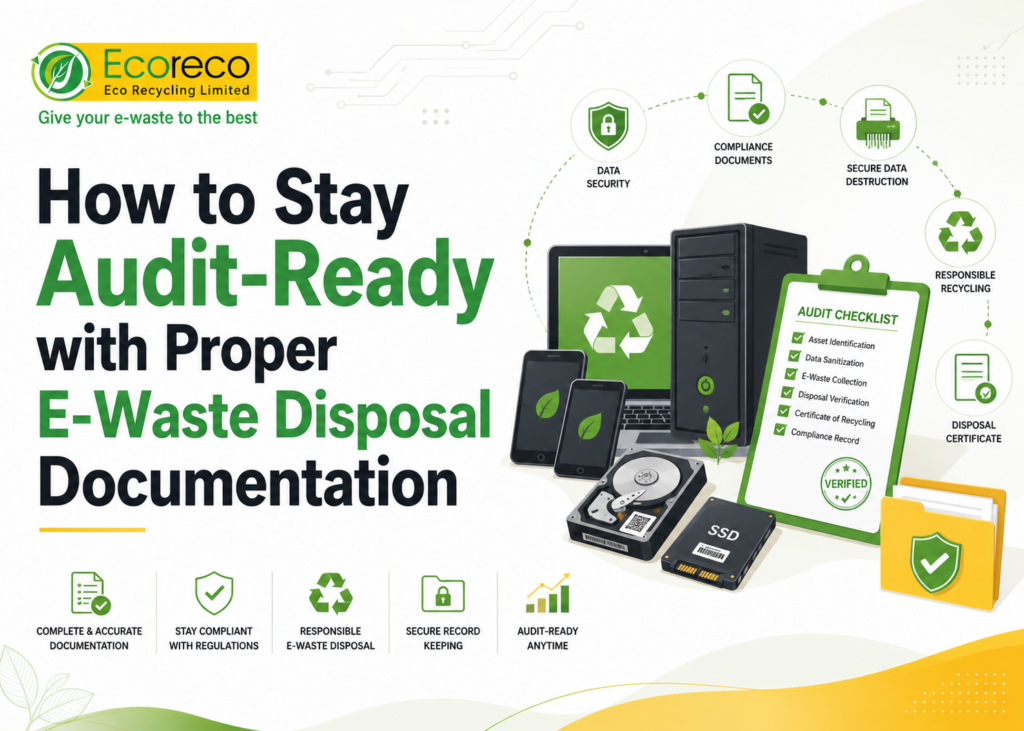
The Five Documents Every Audit-Ready Business Needs
Think of this as your minimum viable compliance file for every disposal cycle:
1. Asset Manifest A detailed inventory of every device disposed of, including make, model, serial number, and asset tag. This is your baseline record of what actually left the building.
2. Form 6 A statutory document prescribed under the E-Waste (Management) Rules for tracking movement of e-waste.
3. Certificate of Recycling Issued by the recycler, confirming the assets were processed through authorised channels. This should reference the recycler’s CPCB authorisation number.
4. Certificate of Data Destruction If any device stored data, this certificate confirms what sanitisation method was used and verifies the data is unrecoverable, separate from the recycling certificate.
5. Weighbridge or Quantity Receipt A record of the actual weight or volume processed, which matters for EPR reporting and cross-checking against your asset manifest.
6. Chain-of-Custody Log A timestamped record showing who handled the assets from pickup to final processing, useful if a question ever arises about what happened between collection and destruction.
Missing even one of these is often enough to trigger follow-up questions during a compliance review.
Common Documentation Mistakes Businesses Make
- Treating the vendor’s word as sufficient. A verbal confirmation of “yes, it’s been recycled” isn’t documentation.
- Filing certificates without cross-referencing asset lists. A certificate that doesn’t tie back to specific serial numbers is difficult to defend during an audit.
- Losing records in decentralised storage. If different departments each manage their own disposal without a central log, nobody has the full picture when it’s needed.
- Discarding records too early. Some businesses clear old files after a year or two, well short of the retention period regulators or auditors may expect.
- Assuming small disposals don’t need paperwork. Ten laptops carry the same documentation obligation as ten thousand; volume doesn’t change the compliance requirement.
Building an Internal Audit-Readiness Framework
A simple framework makes this manageable rather than overwhelming:
Step 1: Centralise the record-keeping. One system, one owner, no matter how many departments generate e-waste.
Step 2: Standardise your vendor requirements. Before any device leaves your premises, your recycler should already know exactly what documentation you require and by when.
Step 3: Reconcile quarterly. Match asset manifests against certificates received. Flag any gaps immediately rather than discovering them during an actual audit.
Step 4: Retain, don’t archive-and-forget. Store records somewhere retrievable, not buried in an inbox or a filing cabinet nobody remembers exists.
Step 5: Review vendor credentials annually. CPCB authorisations and compliance standards can change; confirm your partner is still current.
What Auditors and Regulators Actually Look For
When a regulatory body or client audit team reviews your e-waste management practices, they’re typically checking three things: whether disposal went through an authorised channel, whether documentation ties back clearly to specific assets, and whether your retention practices meet the applicable timeframe. Businesses that pass these reviews smoothly aren’t necessarily disposing of e-waste any differently than others, they’re simply able to prove it.
Choosing a Partner That Makes Audit-Readiness Easy
The right e-waste management partner should treat documentation as a core deliverable, not an afterthought you have to chase down after the fact. Eco Recycling Ltd. issues complete, traceable documentation for every batch processed, from certificates of recycling and data destruction to detailed asset-level manifests, so that businesses across Mumbai and beyond have a ready compliance file the moment an auditor asks for one. As a CPCB-authorised e-waste company in Mumbai, Eco Recycling Ltd. also keeps EPR reporting straightforward for the businesses it works with, rather than leaving them to piece together compliance evidence on their own.
Bringing It All Together
Responsible e-waste disposal is only half the compliance picture. The other half is proof: manifests that tie to certificates, certificates that tie to authorised recyclers, and records retained long enough to matter when someone asks. Businesses that build this documentation habit into their disposal process, rather than treating it as paperwork to chase after the fact, are the ones who sail through audits instead of scrambling before them.
If your current disposal records wouldn’t hold up to a surprise audit tomorrow, that’s the gap to close first. Start by auditing your last two or three disposal cycles for missing certificates, then work with a partner like Eco Recycling Ltd. who builds documentation into the process from day one, not as an afterthought once the equipment is already gone.
FAQs
At minimum, keep a certificate of recycling/disposal, a certificate of data destruction (if the assets held data), a detailed asset manifest with serial numbers, Form 6, weighbridge or quantity receipts, and proof of the recycler’s CPCB (Central Pollution Control Board) authorisation. Together, these form the paper trail an auditor or regulator will ask for.
Most companies retain these records for a minimum of five to seven years, aligning with standard financial and compliance audit cycles in India. If your industry has sector-specific data retention rules (finance, healthcare, telecom), follow whichever retention period is longer.
No, and this is one of the most common gaps businesses discover during an audit. Many smaller or informal recyclers hand over equipment without issuing proper certificates. Always confirm documentation practices before signing a contract, not after a compliance gap surfaces.
Any vendor can collect old electronics, but a certified partner operates under CPCB authorisation, follows Extended Producer Responsibility (EPR) guidelines, and issues traceable documentation for every batch processed. That distinction is exactly what protects your business during an audit or regulatory review.
