
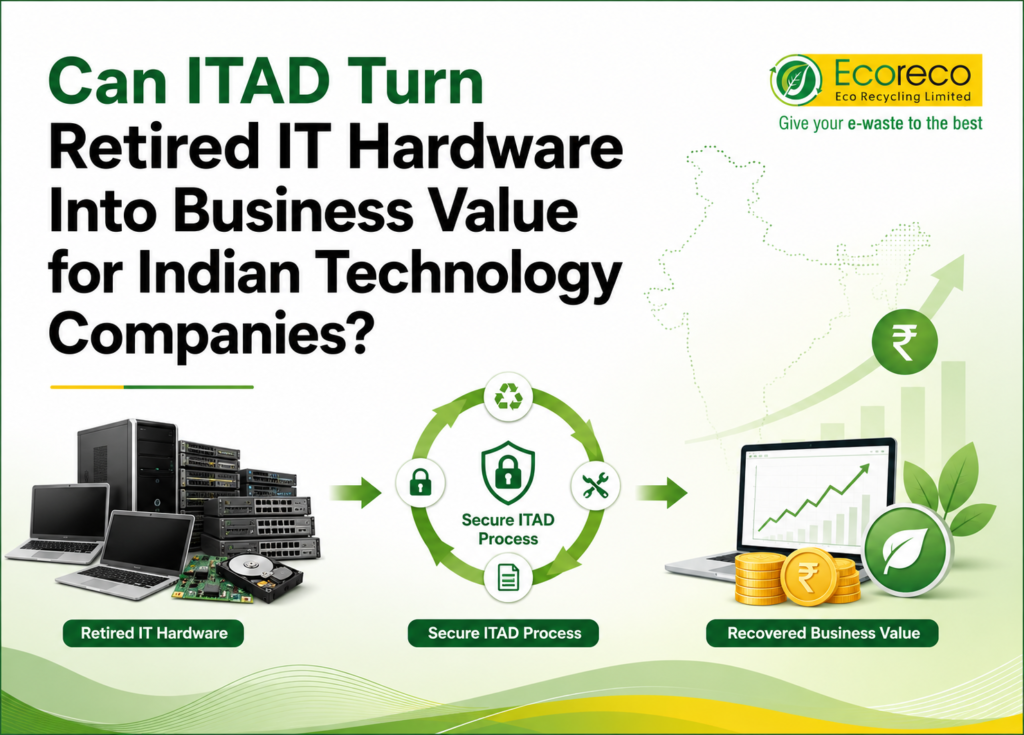
Most Indian technology companies treat end-of-life IT hardware as a cost centre. Assets get decommissioned, stored in a server room or warehouse for months, and eventually handed to a disposal vendor with no structured process, no documentation, and no expectation of return. The company absorbs the cost of storage, accepts zero recovery from the asset, and often carries unquantified data security risk through the entire process.
ITAD, IT Asset Disposition, offers a fundamentally different relationship with end-of-life IT assets. When structured correctly, ITAD services do not simply manage the removal of old equipment. They recover measurable financial value from it, reduce the liability associated with holding decommissioned hardware, and align the entire process with the compliance and sustainability frameworks that Indian technology companies increasingly need to demonstrate to clients, investors, and regulators.
The question the article title poses deserves a direct answer: yes, ITAD can and does turn retired IT hardware into business value. The more useful question is how, and what the conditions are for that value recovery to actually materialise.
What Makes Retired IT Hardware Valuable and Who Captures That Value
Technology companies in India refresh hardware on cycles that typically range from three to five years for servers and networking equipment, and two to four years for end-user devices. At the point of retirement, the hardware has residual market value that depends on its age, condition, specification, and the current demand profile in secondary markets for that asset category.
A server array retired after three years from a mid-size IT services company still contains processors, memory modules, and storage components that carry significant secondary market value. A batch of enterprise-grade laptops retired from a software firm after four years can be refurbished and resold into markets where that specification remains relevant and useful. Network switches, UPS systems, and specialised computing hardware all retain residual value that a properly structured IT Asset Disposition process can capture.
The challenge is that most organisations allow this value to be lost in three common ways. The first is delay. Hardware sitting in a storeroom for 12 to 18 months depreciates faster than hardware that is assessed and processed promptly. The secondary market for technology hardware moves quickly, and a server that is worth a particular amount today is worth meaningfully less next year as newer models arrive and demand for the older specification softens.
The second is process failure. Hardware that has not been properly sanitised cannot be sold into secondary markets because it carries data security risk that no reputable buyer will accept. If the organisation has not built data sanitisation into the decommission process, the hardware has no legitimate resale path.
The third is vendor choice. An ITAD services provider that operates primarily as a recycler will capture scrap metal and component recovery value, which is significantly lower than the residual market value available from refurbishment and resale. The distinction matters enormously to the return calculation.
The Financial Return Available from a Structured ITAD Programme
Technology companies that work with experienced ITAD services providers consistently report that their initial expectation of the financial return understates what a structured programme delivers. The gap between expectation and reality is usually explained by two factors: they had not accounted for the volume of assets that qualified for refurbishment and resale rather than recycling, and they had not previously run a process disciplined enough to capture that value.
The financial return from an ITAD programme comes from three sources. The first is direct resale revenue from refurbished assets sold into secondary markets, either directly or through remarketing channels the ITAD provider operates. The second is avoided costs: storage costs for hardware that is no longer occupying data centre space or warehouse space, and the avoided liability cost of data exposure from unsanitised hardware in indefinite storage. The third is deferred but real: the ESG reporting value and client assurance value that comes from a documented, compliant IT asset disposition process, which increasingly influences contract decisions and institutional investment.
Eco Recycling Ltd. works with Indian technology companies to model the expected return from their specific hardware retirement volumes before the programme begins, which provides CFOs and IT procurement teams with a realistic basis for the business case rather than asking them to trust a vendor’s generic projections.
Data Security as the Non-Negotiable Prerequisite for Value Recovery
The value recovery question cannot be separated from the data security question. These are not sequential issues where data security is resolved first and value recovery follows. They are simultaneously operating requirements, and the resolution of data security concerns is what creates the conditions for value recovery to happen.
An enterprise-grade server that has not been properly sanitised has no legitimate secondary market path. The liability attached to that hardware eliminates any potential buyer from the compliant market. The only remaining options are informal channels that create regulatory risk, or physical destruction that eliminates the resale value entirely along with the data.
Software-based erasure using methods aligned to NIST SP 800-88 or equivalent international standards, performed with verification reporting that documents the completion of the sanitisation process against each specific asset’s serial number, creates the documented clean state that enables resale. For assets where software erasure is not appropriate, degaussing or physical destruction is applied, and the asset is routed to materials recovery rather than resale. The appropriate method for each asset category should be pre-defined in the ITAD programme design, not decided ad hoc by the disposal vendor.
Eco Recycling Ltd. issues asset-specific Certificates of Data Destruction for every device processed under its ITAD services, providing the documentation that Indian technology companies need for their own compliance records and for the assurance requirements of their enterprise clients, many of whom impose data handling standards through contractual frameworks.
ESG and Sustainability Value That ITAD Generates for Tech Companies
Indian technology companies are increasingly operating in an environment where ESG performance is evaluated by institutional clients, investors applying ESG criteria, and increasingly by international customers who require their Indian partners to demonstrate measurable sustainability commitments.
The environmental dimension of IT Asset Disposition is directly relevant to ESG reporting. E-waste generated from improperly disposed IT hardware contributes to soil and groundwater contamination through heavy metals including lead, cadmium, and mercury. A documented ITAD programme that routes hardware through certified recycling channels keeps these materials in the formal recycling economy and out of informal disposal streams.
For Indian technology companies with GRI, BRSR, or CDP reporting commitments, an ITAD programme generates the specific metrics that sustainability disclosures require: volume of e-waste channelled through certified recycling, percentage of assets refurbished and extended in lifecycle rather than destroyed, and documentation of the recycling chain’s certifications. These are not abstract commitments. They are specific, verifiable data points that a structured programme makes possible and that an informal disposal process cannot produce.
Eco Recycling Ltd. provides reporting data specifically formatted for BRSR and GRI disclosures, which reduces the administrative burden on sustainability teams and ensures that the environmental value generated by the ITAD programme appears in the organisation’s reporting rather than being lost in documentation gaps.
Building an ITAD Programme That Actually Delivers Value
Technology companies that recover the most value from their retired hardware share a consistent programme design. The value is built in at the design stage, not extracted from a poorly designed process after the fact.
The programme design begins with an asset inventory that categorises hardware by age, specification, and condition. This inventory is the basis for the resale versus recycling determination, and it is also the basis for the data security method assignment. Doing this systematically at the point of decommission, rather than when an asset arrives at the disposal facility, captures significantly more value because it allows the resale timeline to be managed appropriately.
Vendor selection is the second critical design decision. The IT Asset Disposition vendor needs to have active secondary market relationships or in-house remarketing capability, certified data destruction processes with asset-level documentation, and experience with the specific hardware categories the technology company is retiring. A vendor whose primary business is bulk recycling will not optimise for resale value. A vendor with active remarketing operations will.
The programme also needs a feedback loop: a regular reporting cycle that shows the company what was recovered, how, and at what value, so that the business case can be validated against actual performance and the programme can be refined over time.
Conclusion
ITAD is not a compliance checkbox or a convenient way to get old equipment out of the server room. For Indian technology companies that approach it correctly, IT asset disposition is a source of financial return, a risk mitigation mechanism, a compliance enabler, and an ESG reporting resource simultaneously.
The assets sitting in storage at most technology companies right now represent value that is depreciating daily. The data on those assets represents liability that is not diminishing. Both problems have the same solution: a structured, documented ITAD programme delivered by a certified partner.
Eco Recycling Ltd. works with Indian technology companies to design and execute ITAD programmes that recover maximum value from retired hardware, document every step of the process for compliance and ESG reporting, and provide the certified data destruction evidence that enterprise clients and regulators increasingly require. The most useful first step for any technology company that has not reviewed its current end-of-life hardware process is an asset inventory and an honest assessment of what the current approach is costing in lost value and retained risk.
ITAD, IT Asset Disposition, is a structured process that manages the end-of-life handling of IT equipment through certified data destruction, asset valuation, refurbishment for resale where applicable, and environmentally compliant recycling. Standard e-waste disposal typically focuses only on the recycling or disposal stage without the data security, chain of custody, and value recovery components that a structured ITAD programme delivers.
The return depends on the age, condition, and specification of the hardware being retired, and on how quickly it is processed after decommission. Enterprise-grade servers, networking equipment, and business laptops retired within three to four years of manufacture typically carry meaningful secondary market value. The best way to estimate the return for a specific asset mix is through a pre-programme asset valuation with a qualified ITAD services provider.
Look for vendors holding ISO 27001 for information security management, ISO 14001 for environmental management, and CPCB authorization for e-waste handling and recycling under India’s E-Waste Management Rules 2022. Asset-specific Certificates of Data Destruction with documented sanitisation methods are a basic expectation rather than an optional add-on.
A structured ITAD programme generates specific, verifiable metrics: volume of e-waste channelled through certified recycling, percentage of assets refurbished and reused, and documentation of certified destruction. These metrics directly support the environmental disclosures required under India’s Business Responsibility and Sustainability Reporting framework and under international standards like GRI and CDP.
India’s E-Waste Management Rules 2022 impose obligations on bulk consumers of IT equipment to channel end-of-life electronics through authorised collection and recycling channels. The DPDP Act 2023 imposes obligations to erase personal data that is no longer needed, which extends to data held on decommissioned IT assets. Together, these create a regulatory requirement for a documented, compliant end-of-life IT asset management process that a properly structured ITAD programme satisfies.
Yes. A well-designed ITAD programme accommodates multi-site collection, providing documented chain of custody from each collection point through to the sanitisation and disposition facility. This is particularly relevant for technology companies operating across multiple cities, where the volume and diversity of assets being retired can vary significantly between locations.
