
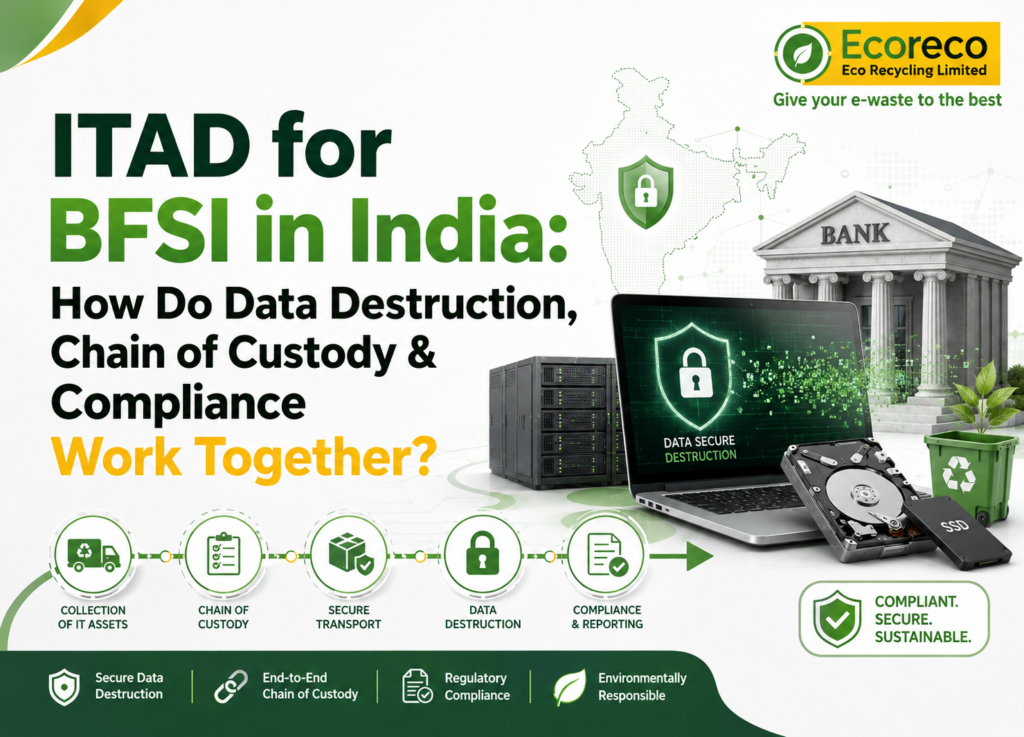
When a bank retires a batch of laptops, decommissions storage arrays from a data centre, or phases out ATM hardware, the transaction is not simply a disposal exercise. Every one of those assets holds customer data, transaction records, or system credentials that are governed by India’s Digital Personal Data Protection Act 2023, RBI’s Master Directions on IT governance, IRDAI’s information security frameworks, and potentially SEBI’s operational risk guidelines if the organization manages investment functions. Getting the retirement of those assets wrong does not just create operational friction. It creates regulatory exposure, reputational risk, and, in some cases, direct liability.
ITAD, IT Asset Disposition, is the structured discipline that governs how end-of-life IT equipment is identified, collected, sanitised, documented, and either resold, recycled, or destroyed. For BFSI organisations in India, ITAD services are not an optional vendor relationship. They are a compliance function that should be integrated into IT lifecycle management and information security governance from the point of asset acquisition, not as an afterthought when hardware starts failing.
Why BFSI Organisations Face a Different ITAD Risk Profile Than Other Industries
Every organisation that handles IT equipment faces some version of the ITAD challenge. BFSI organisations face a more demanding version of it for reasons that are specific to the sector.
The density of sensitive data per device is higher in financial services than in most other industries. A laptop used by a relationship manager contains customer PAN details, account information, loan documentation, and communication records. A server that processes core banking transactions holds transaction logs, authentication data, and account state information across potentially millions of records. A storage array decommissioned from a data centre may contain years of archived financial data in multiple database formats.
The regulatory environment is also more demanding. RBI’s Master Direction on Information Technology Framework for BFSI organisations explicitly requires that decommissioned IT assets be sanitised before disposal using methods appropriate to the classification of the data they held. SEBI’s cybersecurity circulars impose similar requirements on registered intermediaries. IRDAI’s guidelines on information and cyber security for insurers cover data destruction in the context of end-of-life asset management. Non-compliance with these requirements can result in regulatory action against the organisation and its key management personnel, not just a standard fine.
The audit and documentation expectations are correspondingly stricter. A BFSI organisation that cannot produce evidence of how a specific device was sanitised, who handled it from decommission to final disposition, and what the outcome of the sanitisation process was is not in a defensible position in the event of a regulatory inquiry or a data breach incident.
What Chain of Custody Actually Means in a BFSI ITAD Context
Chain of custody is a term that appears frequently in ITAD discussions but is often understood imprecisely. In the BFSI context, it means a documented, unbroken record of who held physical control of a device from the moment it was identified for decommissioning to the moment its data was verified as destroyed and its physical disposition was confirmed.
This matters for two related reasons. The first is evidentiary: in the event of a data breach investigation or a regulatory inspection, the chain of custody documentation is the primary evidence that the organisation handled end-of-life assets in a controlled manner. Without it, the organisation cannot demonstrate that data did not exit the controlled environment during the disposal process.
The second reason is operational control. A device that leaves the custody of the internal IT team without a documented handover creates a gap in the custody chain, even if it was handed to a reputable ITAD vendor. That gap means the organisation cannot verify what happened to the device between the handover and the point at which data destruction was completed.
A proper chain of custody in BFSI ITAD begins with an asset register entry at decommissioning, includes a signed transfer record at every point of handover, requires documented verification of data destruction completion by the sanitisation technician, and ends with a Certificate of Data Destruction that references the specific device by serial number and records the sanitisation method applied.
Eco Recycling Ltd. builds chain of custody documentation into every stage of its ITAD services, producing the complete audit trail that BFSI organisations need to demonstrate compliance in regulatory examinations and to respond credibly to any future inquiry about how specific decommissioned assets were handled.
The Data Destruction Methods That BFSI Compliance Demands
Not all data destruction methods are appropriate for all BFSI asset categories, and the appropriate method depends on the classification of the data held and whether the hardware can be reused or resold after sanitisation.
Software-based overwriting using NIST SP 800-88-compliant erasure tools is appropriate for storage media that will be reused or resold. The process overwrites all addressable sectors with verification passes that confirm overwriting completion. For hard drives, this is a well-established and auditable method. For solid-state drives, ATA Secure Erase commands through the device firmware are typically required because standard sector-by-sector overwriting does not reach all data locations on the physical media due to wear-levelling algorithms.
Degaussing destroys the magnetic field encoding on traditional hard drives and magnetic tape, rendering data unrecoverable. It also destroys the drive mechanism, making the media unusable after the process. For highly sensitive data categories, including anything classified as sensitive personal data under the DPDP Act 2023 or under RBI’s data classification frameworks, degaussing followed by physical destruction provides a defence-in-depth approach.
Physical destruction through industrial shredding to certified particle sizes is the appropriate method for crypto-module components, HSMs, and any media where software-based sanitisation cannot be confirmed. BFSI organisations retiring HSMs or specialised cryptographic hardware should require destruction certificates that specify the destruction method and resulting particle size, not just a general statement of destruction.
The selection of the appropriate method for each asset category should be documented in the organisation’s ITAD policy and mapped to its information classification framework. Eco Recycling Ltd. works with BFSI clients to develop this mapping during the ITAD programme design phase, ensuring the right method is applied to the right asset category rather than applying a single method across a heterogeneous asset mix.
Building an ITAD Programme That Passes a Regulatory Examination
Most BFSI organisations have some version of an ITAD process. Fewer have an ITAD programme that is documented, consistently executed, and capable of surviving a regulatory examination. The difference between the two is significant in practice.
A documented ITAD policy establishes the organisational requirements: which assets are in scope, what classification governs each asset type, what sanitisation method is required at each classification level, what documentation must be produced at each stage, which vendors are authorised to handle BFSI IT assets, and what the review and audit cycle for the programme is. This policy should be reviewed annually and updated whenever the regulatory environment changes.
Vendor qualification is a critical component that many organisations underinvest in. The ITAD vendor handling a bank’s end-of-life assets needs to demonstrate current certifications under applicable standards, maintain a chain of custody capability that matches the bank’s documentation requirements, carry adequate insurance for the assets they are holding, and be able to produce documented sanitisation reports that are specific to individual assets rather than general batch confirmations.
The audit cycle for the ITAD programme should include periodic reconciliation of decommissioned assets against received certificates of data destruction, verification that asset serial numbers on destruction certificates match the organisation’s asset register, and review of chain of custody documentation for a sample of recent disposals. This internal audit function is what converts an ITAD policy on paper into a defensible compliance programme in practice.
The Compliance Gap That Creates the Most Regulatory Risk
Across BFSI organisations of varying sizes and sophistication, the compliance gap that creates the most regulatory risk in ITAD is not usually a failure to have a policy or a vendor. It is the gap between the policy and the practice.
An organisation may have an ITAD policy that requires certified data destruction for all decommissioned assets. But if assets are accumulating in a storeroom waiting for an annual disposal exercise, if the internal handover process does not produce a documented custody record, or if destruction certificates are filed without being verified against the asset register, the policy exists on paper, but the compliance controls are absent in practice.
This gap is most likely to be exposed by a regulatory inspection, an internal audit, or an incident investigation following a data breach. At that point, the existence of the policy without the practice is worse than having no policy at all, because it demonstrates that the organisation knew what it was supposed to do and did not do it.
Eco Recycling Ltd. provides BFSI clients with an ITAD service model that generates the specific documentation, custody records, and verification reports that close this gap, supporting not just the vendor relationship but the compliance programme that the organisation needs to demonstrate regulatory conformance.
Conclusion
ITAD for BFSI in India is a compliance function that sits at the intersection of data security, regulatory governance, and environmental responsibility. Data destruction, chain of custody, and compliance documentation are not three separate requirements. They are three dimensions of a single integrated programme, and the absence of any one of them creates a gap that the other two cannot compensate for.
BFSI organisations that treat IT Asset Disposition as a routine vendor service rather than as a compliance programme will consistently find that their documentation cannot support a regulatory examination and their risk management frameworks do not account for the data exposure created by inadequate end-of-life asset handling.
Eco Recycling Ltd. works with banks, NBFCs, insurance companies, and SEBI-registered entities across India to build ITAD programmes that are appropriately documented, consistently executed, and designed to meet the specific compliance requirements of the BFSI sector. The practical first step for any organisation that has not reviewed its ITAD programme against current regulatory expectations is a structured gap assessment, which produces a clear picture of where current practice departs from what regulators and auditors will expect.
Related FAQs
ITAD stands for IT Asset Disposition. It is the structured process of decommissioning, sanitising, and disposing of end-of-life IT equipment in a way that protects sensitive data and meets regulatory requirements. For BFSI organisations in India, ITAD is a compliance obligation under RBI, IRDAI, and SEBI frameworks and under the Digital Personal Data Protection Act 2023.
Data erasure uses software to overwrite all addressable sectors of a storage device, making data unrecoverable while leaving the hardware functional. Degaussing uses a magnetic field to destroy data on magnetic storage media, but it also destroys the device. Physical destruction involves shredding or crushing the media to a certified particle size, making both data and hardware permanently unusable. The appropriate method depends on the sensitivity of the data and whether the hardware can be reused.
Chain of custody is a documented, unbroken record of who had physical control of a decommissioned IT asset at every stage from decommissioning to final disposition. For BFSI organisations, it is critical because it is the evidence that data did not exit the controlled environment during the disposal process. Without it, the organisation cannot demonstrate compliance in a regulatory examination or breach investigation.
A Certificate of Data Destruction for each device, referencing the specific serial number, destruction method applied, date of destruction, and technician details. For software erasure, a verification report showing the number of overwriting passes and confirmation of completion should accompany the certificate. These documents should be retained and reconciled against the organisation’s asset register.
Yes. RBI’s Master Direction on IT Framework for banks and NBFCs requires proper sanitisation of decommissioned assets. IRDAI’s information security guidelines for insurers cover data destruction in end-of-life asset management. SEBI’s cybersecurity framework imposes similar requirements on registered intermediaries. The DPDP Act 2023 requires that personal data be erased when no longer needed, which directly covers data held on decommissioned IT assets.
At minimum annually, and additionally whenever there is a significant change in the regulatory environment, a change in the approved ITAD vendor, or a change in the types of assets being decommissioned. The audit should include reconciliation of destruction certificates against the asset register, review of chain of custody documentation for a sample of recent disposals, and verification that the ITAD policy reflects current regulatory requirements.
