
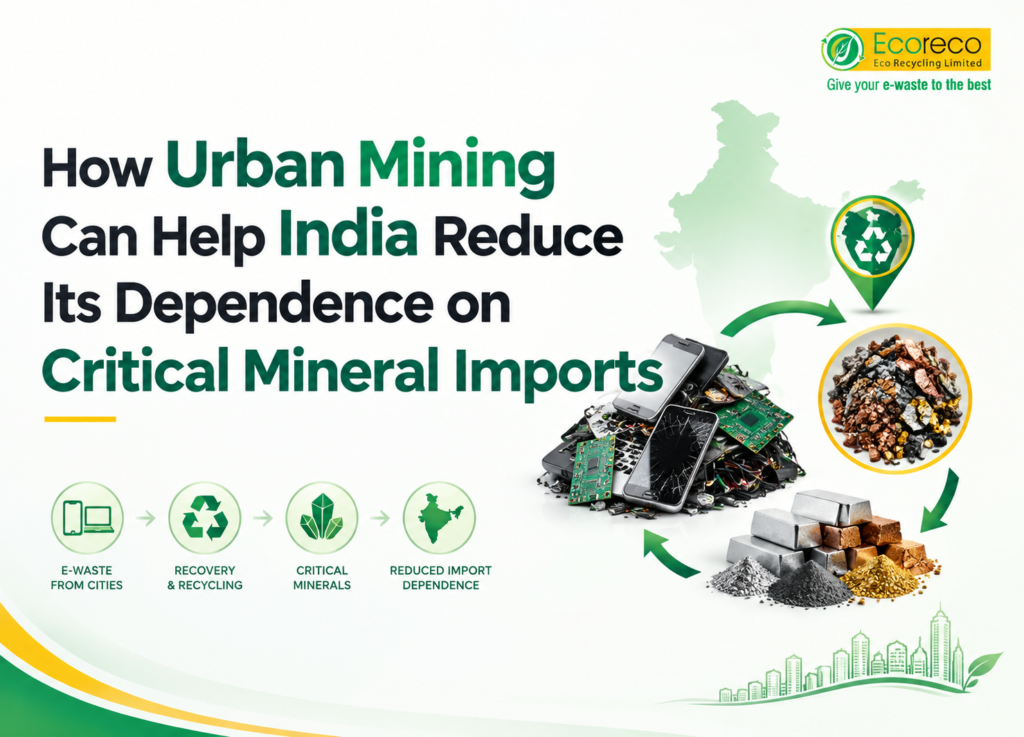
Somewhere in a drawer in nearly every Indian household sits a small graveyard of old phones, dead power banks, and laptop chargers nobody’s gotten around to throwing away. Multiply that across 1.4 billion people, and you’re looking at an enormous, largely untapped reserve of the exact materials India spends billions of dollars importing every year, lithium, cobalt, nickel, copper, and a handful of rare earth elements that power everything from smartphones to electric vehicles.
This is the core idea behind urban mining, and it’s a far more practical solution to India’s critical mineral dependency than most policy conversations give it credit for. Rather than treating mineral security as purely a mining and import problem, urban mining in India reframes the question entirely: what if a meaningful share of the materials we need are already sitting inside the electronics we’ve already bought, used, and discarded?
Why India’s Critical Mineral Dependence Is a Genuine Strategic Problem
India currently imports the overwhelming majority of the critical minerals needed for its electronics, renewable energy, and electric vehicle industries. Lithium, cobalt, and several rare earth elements are concentrated in a small number of countries globally, and India has limited domestic reserves of most of them. That concentration creates real vulnerability: supply chain disruptions, geopolitical tensions, and price volatility in these materials can directly affect the cost and availability of everything from EV batteries to consumer electronics manufactured domestically.
This dependency isn’t a distant, abstract risk either. As India scales up its electric vehicle ambitions and renewable energy infrastructure, demand for these exact materials is only going to grow, and every unit sourced through import carries cost and supply risk that a country of India’s manufacturing ambition can’t fully absorb indefinitely. Urban mining offers a way to reduce that exposure without waiting for new mineral deposits to be discovered and developed, a process that typically takes years or decades even under ideal conditions.
What Urban Mining Actually Means in Practice
Urban mining refers to the process of recovering valuable materials from products that have already been manufactured and used, rather than extracting them from the earth. In practical terms, this means processing discarded electronics, retired batteries, and end-of-life IT equipment to extract the metals and minerals embedded inside them, then feeding those recovered materials back into manufacturing supply chains.
A single tonne of discarded smartphones, for example, can contain a concentration of gold, copper, and other valuable materials far higher than what’s typically found in a tonne of mined ore. The same logic applies to lithium-ion battery disposal at scale, retired EV batteries, laptop batteries, and power banks all contain lithium, cobalt, and nickel that can be recovered through proper processing rather than lost entirely once a device reaches the end of its usable life.
This is where the connection to e waste recycling and formal ITAD services becomes critical. Urban mining doesn’t happen by accident, it requires a functioning ecosystem of collection, sorting, and processing infrastructure capable of extracting these materials safely and efficiently at meaningful scale.
The Materials Hiding in India’s E-Waste Stream
India generates one of the largest volumes of electronic waste globally, and that volume is growing rapidly as electronics adoption continues to expand across the country. Within that waste stream sits a genuinely significant reserve of recoverable material:
- Lithium, cobalt, and nickel from retired laptop batteries, power banks, and increasingly, electric vehicle battery packs as India’s EV fleet ages into its first replacement cycle.
- Copper and gold from circuit boards, connectors, and wiring found in virtually every electronic device, often in higher concentration than raw ore.
- Rare earth elements used in speakers, motors, and display components across smartphones, laptops, and appliances.
- Aluminum and various rare metals from device casings, connectors, and internal components across the broader electronics category.
The challenge isn’t that these materials don’t exist in usable quantity, it’s that most of India’s e-waste still flows through informal channels rather than certified recovery processes, meaning these materials are frequently lost, contaminated, or extracted through unsafe, environmentally damaging methods rather than recovered properly.
Why Formal ITAD Services Are the Missing Link
This is where a genuinely underexplored angle comes in: enterprise IT asset disposition is one of the most efficient entry points for urban mining at scale, and it’s largely underutilized as a national mineral recovery strategy. Corporate IT refresh cycles generate a steady, predictable, and relatively concentrated stream of laptops, servers, networking equipment, and mobile devices, all of which are far easier to process systematically than fragmented, unpredictable household e-waste.
Organizations working with certified ITAD services aren’t just protecting data security and meeting compliance obligations, they’re also feeding a formal recovery pipeline that recaptures material value most businesses never think about beyond the immediate disposal transaction. Scaling formal ITAD adoption across India’s rapidly growing enterprise and government IT sectors could meaningfully increase the volume of critical minerals recovered domestically each year, without requiring a single new mining permit.
What Needs to Happen for Urban Mining to Scale in India
Realizing urban mining’s full potential in India depends on a few structural pieces coming together:
- Expanding formal collection infrastructure. A large share of India’s e-waste still ends up with informal scrap dealers rather than certified recyclers, simply because formal collection points aren’t accessible or well known enough in many areas.
- Strengthening enforcement of existing regulations. India already has e-waste management rules and Extended Producer Responsibility frameworks in place, the gap is largely in consistent enforcement and monitoring across the informal sector.
- Investing in advanced recovery technology. Recovering materials like lithium and rare earth elements efficiently requires hydrometallurgical and other advanced processing techniques that not every domestic recycler currently has access to.
- Building corporate awareness around ITAD as a resource strategy. Many businesses still treat IT asset disposal as a compliance checkbox rather than recognizing its role in a genuinely valuable materials recovery chain.
- Creating stronger market incentives for recovered materials. Domestic manufacturers need reliable pricing and supply confidence in recovered minerals to justify shifting some sourcing away from imports.
Common Misconceptions That Slow Urban Mining Adoption
- Assuming recycled materials are lower quality than newly mined ones. Properly recovered metals through certified processing meet the same purity standards required for manufacturing, quality depends on the recovery method, not the source.
- Treating e-waste recycling as purely an environmental initiative. While the environmental benefit is real, framing urban mining only as sustainability messaging undersells its actual strategic and economic value to India’s manufacturing base.
- Believing informal recyclers can eventually formalize on their own. Informal e-waste processing often uses methods that damage recoverable materials and expose workers to serious health risks, formal infrastructure investment is necessary, not just time.
- Overlooking enterprise e-waste as a major opportunity. Household electronics get most of the public attention, but enterprise IT asset streams offer a more concentrated, easier-to-manage source of recoverable material.
The Strategic Opportunity Ahead
India’s growing electronics and EV manufacturing ambitions and its critical mineral import dependency are pulling in opposite directions, and urban mining is one of the clearest paths to closing that gap without waiting on new mineral discoveries or shifting geopolitical alliances. Every properly processed device, whether it’s a retired laptop fleet from a corporate IT refresh or a batch of end-of-life EV batteries, represents materials that no longer need to be imported.
Eco Recycling Ltd has approached this opportunity by building certified recovery processes across e waste recycling, lithium ion battery disposal, and enterprise ITAD services, treating each retired device not as waste to be disposed of, but as a source of materials India genuinely needs. That shift in framing, from disposal obligation to resource recovery, is exactly what needs to scale nationally if urban mining is going to make a meaningful dent in India’s mineral import dependence.
Key Takeaways
Urban mining in India isn’t a futuristic concept, it’s a practical, immediately available strategy for recovering the exact critical minerals the country currently imports at scale. The materials already exist within India’s growing e-waste stream, what’s missing is formal infrastructure, stronger enforcement, and broader corporate adoption of certified recovery channels like ITAD services and proper lithium ion battery disposal.
If your organization generates retired IT equipment on any meaningful scale, that equipment represents more than a disposal decision, it’s a resource recovery opportunity most businesses haven’t fully considered. Eco Recycling Ltd works with organizations across India to recover value from e-waste responsibly, turning what most companies treat as a compliance task into a genuine contribution toward reducing the country’s dependence on imported critical minerals.
Frequently Asked Questions
Urban mining is the process of recovering valuable metals and minerals from discarded electronics, batteries, and IT equipment, rather than extracting them from natural ore deposits. It treats existing e-waste as a resource rather than simply waste to be disposed of.
Depending on the device, recoverable materials include lithium, cobalt, nickel, copper, gold, aluminum, and various rare earth elements found in batteries, circuit boards, and electronic components.
Corporate IT asset disposition generates a steady, predictable stream of laptops, servers, and networking equipment that’s easier to process systematically than scattered household e-waste, making it an efficient entry point for large-scale material recovery.
Yes, when processed through certified recovery methods, recovered metals meet the same purity standards required for manufacturing use. Quality depends on the processing method used, not on whether the source was mined or recycled.
Limited awareness of certified collection points, inconsistent enforcement of existing e-waste regulations, and the immediate cash offered by informal scrap dealers all contribute to this gap, which is exactly why expanding formal infrastructure and awareness remains a priority for scaling urban mining nationally.
