
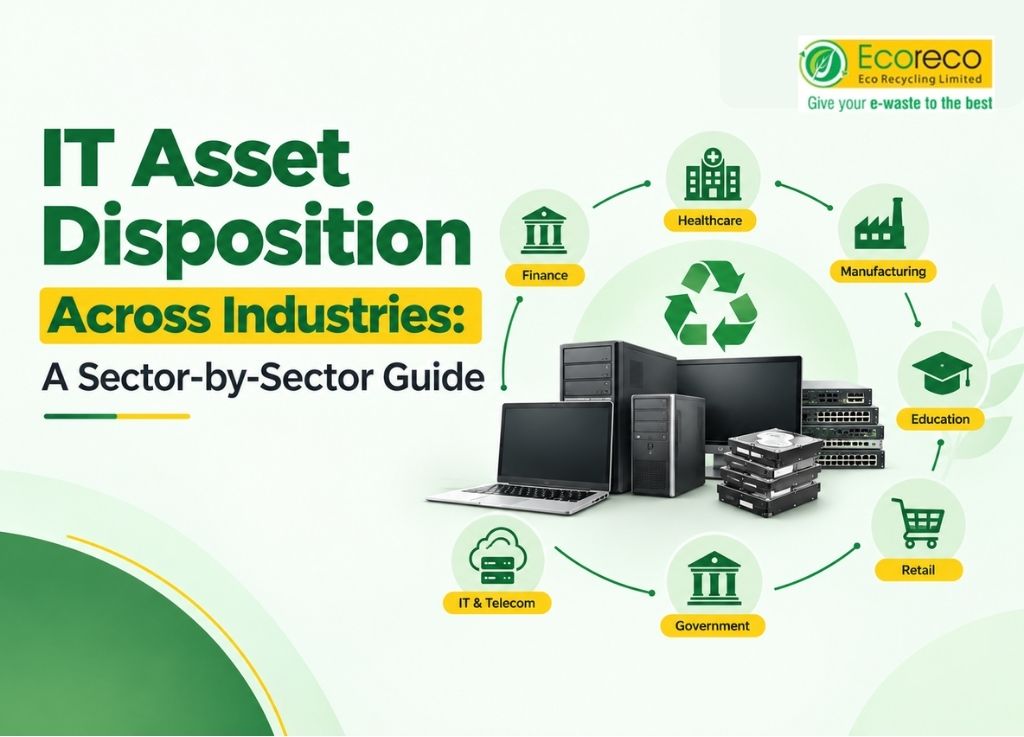
Ask a hospital administrator, a bank’s compliance officer, and a warehouse manager what “getting rid of old IT equipment” actually involves, and you’ll get three completely different answers. One is thinking about protected health information sitting on a decommissioned server. Another is thinking about regulatory audit trails and customer financial records. The third is mostly worried about a fleet of handheld scanners scattered across multiple warehouse locations.
This is exactly why treating IT Asset Disposition as a single, generic process is one of the more costly assumptions an organization can make. ITAD isn’t just “recycling old computers.” It’s a structured, auditable process for retiring hardware safely, and what “safely” actually requires changes significantly depending on the industry doing the retiring. A sector handling patient records has a very different risk profile than one managing point-of-sale terminals across retail locations, even though both are technically disposing of IT assets.
Understanding these sector-specific differences matters whether you’re evaluating your current approach or choosing ITAD services for the first time, because a provider who understands your industry’s actual pressure points will structure the process very differently from one applying a one-size-fits-all checklist. This is precisely the perspective Eco Recycling Ltd. brings to each of the sectors covered below.
Sectors Where Data Sensitivity Drives Every Decision
For certain industries, the primary concern in IT Asset Disposition isn’t the hardware at all. It’s what’s stored on it and the legal consequences of getting that part wrong.
Banking, financial services and insurance organizations operate under some of the strictest data-handling expectations of any sector. Retired servers, endpoints, and storage media routinely contain customer financial histories, so certified destruction and a fully documented chain of custody aren’t optional extras, they’re the baseline regulators expect to see during an audit.
Healthcare and hospital systems carry a similar burden with electronic protected health information. A computer or piece of diagnostic equipment retired without proper data sanitization can expose patient records in ways that trigger serious regulatory consequences, which is why healthcare ITAD needs to be treated with the same rigor as clinical data handling itself.
Government and public sector bodies deal with both citizen data and, in many cases, classified or sensitive administrative records, often at a scale that requires large, coordinated asset retirement projects rather than one-off pickups.
Pharmaceutical and life sciences companies face a slightly different version of the same problem: confidential research data and proprietary formulations stored on laboratory IT equipment, where a leak isn’t just a compliance issue but a direct threat to years of intellectual property investment.
Media and entertainment organizations often overlook this category, but unreleased content, production files, and confidential digital assets sitting on retired storage systems and workstations carry real commercial risk if they end up anywhere they shouldn’t.
Across each of these data-sensitive sectors, Eco Recycling Ltd. builds its process around the specific compliance expectations the industry is actually held to, rather than a generic destruction certificate that doesn’t reflect the regulatory language a bank, hospital, or government body needs to see.
Sectors Where Scale and Infrastructure Complexity Take Priority
A different group of industries deals with IT Asset Disposition less as a data-risk issue and more as a logistics and infrastructure challenge, simply because of how much equipment is involved and how it’s configured.
IT and ITES or software companies typically run structured laptop refresh cycles and manage a constant churn of employee devices, alongside decommissioned data center assets that need to be remarketed or destroyed depending on their condition and remaining value.
Data centers and cloud infrastructure providers operate at a scale where server decommissioning, storage media destruction, and asset recovery need to happen continuously, not as occasional events, and the volume alone demands a provider capable of handling enterprise-level throughput without creating bottlenecks.
Telecom companies retire network equipment, routers, and switches that are often highly specialized, meaning disposal has to account for both data security and the specific handling requirements of enterprise-grade networking hardware.
Manufacturing businesses combine industrial IT equipment with standard corporate devices across plant floors and offices, which means an ITAD process built only around office laptops misses a significant part of what actually needs retiring.
Energy, power, and utilities organizations often operate critical infrastructure where enterprise IT systems are tightly integrated with operational technology, making both data sensitivity and physical security considerations at asset retirement particularly high-stakes
For these infrastructure-heavy sectors, Eco Recycling Ltd. focuses on throughput and reliable scheduling just as much as on data security, since a provider that can’t handle volume consistently becomes a bottleneck in its own right.
Sectors Where Distributed, Customer-Facing Assets Create Their Own Challenge
The third category involves industries where IT assets aren’t sitting neatly in a data center or office but are scattered across many physical locations, often in customer-facing roles.
Retail and e-commerce businesses manage point-of-sale systems, handheld inventory devices, and warehouse technology spread across dozens or hundreds of locations, each one a potential data exposure point if retired without a consistent process.
Educational institutions and universities face a similar distribution problem at scale, with computer labs, institutional laptops, and periodic bulk device replacements that can involve thousands of units at once, often on tight academic-year timelines.
Logistics and transportation companies rely on handheld scanners, laptops, and fleet-connected IT systems distributed across vehicles and depots, which makes tracking and retrieving assets for proper disposition genuinely harder than in a single-site business.
Hospitality businesses combine guest-facing technology, point-of-sale systems, and property management servers, where guest data protection adds a layer of sensitivity that’s easy to underestimate in an industry more commonly associated with service than data security.
Corporate enterprises and multinational organizations often deal with a mix of everything above: employee laptops, desktops, and phones spread across multiple offices and countries, requiring an ITAD partner capable of managing the complete IT lifecycle consistently across every location rather than handling each site as a separate project.
For sectors dealing with this kind of geographic and device spread, Eco Recycling Ltd. structures pickups and reporting around each location individually, so nothing gets missed simply because it wasn’t sitting in the head office.
What Actually Changes Between These Sectors
Looking across all of this, three variables consistently separate one industry’s ITAD needs from another’s: the sensitivity of the data involved, the specific compliance framework that applies, and the physical scale or distribution of the equipment itself. A provider offering genuine ITAD services should be able to speak specifically to which of these variables matters most for your sector, rather than offering the same generic assurances regardless of who’s asking.
This is also where a lot of organizations get caught out. They assume that because a provider handles IT Asset Disposition well for one type of client, the same process automatically transfers to their own industry. In practice, the certified destruction method appropriate for a bank’s servers, the documentation trail a hospital needs, and the logistics required to retrieve scanners from forty retail locations are meaningfully different exercises, even if they all fall under the same umbrella term.
Choosing an ITAD Partner That Understands Your Sector
Before selecting a provider, it’s worth asking directly whether they have documented experience with organizations like yours, not just general IT Asset Disposition experience. Ask what compliance frameworks they routinely work within, how they handle distributed pickups if your assets are spread across multiple sites, and what their process looks like when equipment carries genuinely sensitive data versus standard corporate hardware.
Eco Recycling Ltd. works across this full spectrum of sectors, from BFSI and healthcare through to retail, education, logistics, and enterprise IT environments, precisely because each one requires a slightly different combination of compliance rigor, data destruction protocol, and logistical handling. Rather than applying one standard process to every client, the right approach starts with understanding which of the pressures above, data sensitivity, infrastructure scale, or distributed assets, actually defines your organization’s risk.
If you’re evaluating your own IT Asset Disposition process, the most useful starting point isn’t a generic checklist. It’s an honest look at which of these three categories your organization actually falls into, and a conversation with a provider who can demonstrate real experience solving for exactly that.
