
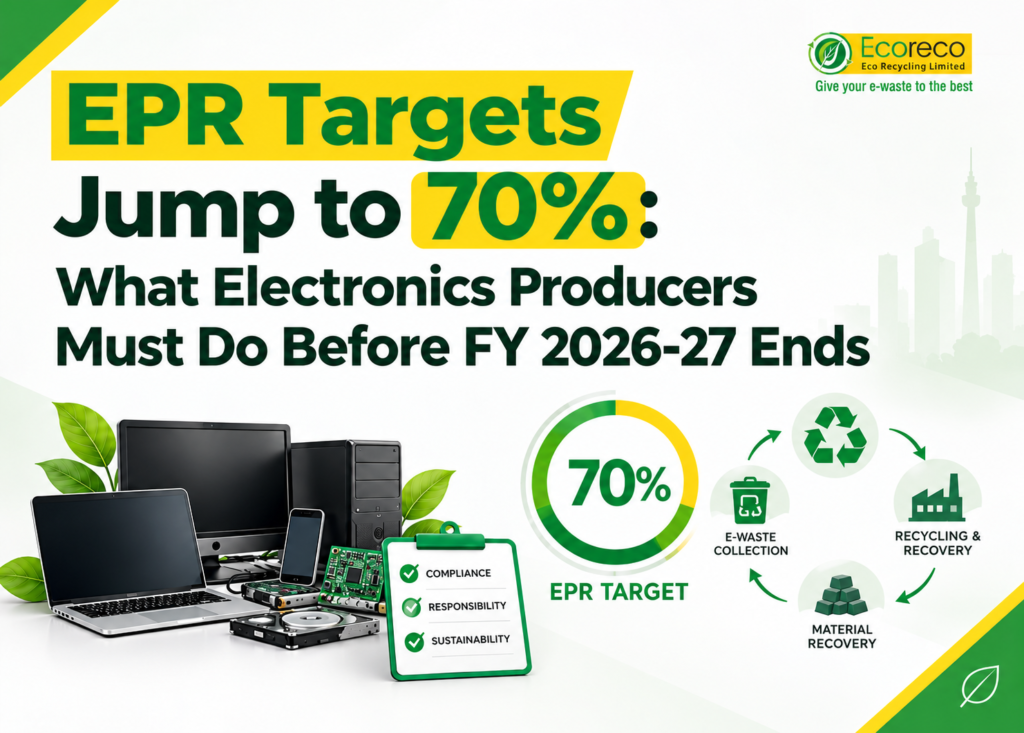
If you sell or import electronics in India, about five months remain in this financial year, and your compliance file may not be as ready as it should be. The 70% recycling target is already in force, and the next step to 80% arrives in April 2027. The rules reward early planning and punish last-minute buying because obligations are met with physical recycling and portal-backed certificates, not paperwork alone. Here is what is required, how the math works, and a practical plan for the months ahead.
The target timeline at a glance
Under the E-Waste (Management) Rules, 2022, the recycling target rises in stages. CPCB’s own FAQ confirms 70% for FY 2025-26 and FY 2026-27, and 80% from FY 2027-28 onwards.
| Financial year | Recycling target |
| 2023-24 and 2024-25 | 60% |
| 2025-26 and 2026-27 | 70% |
| 2027-28 onwards | 80% |
A small correction to the common headline: the jump to 70% took effect in April 2025. What changes in April 2027 are the move to 80%? That makes March 2027 your last chance to close this year cleanly before the bar rises again.
How your obligation is actually calculated
The target is not a percentage of what you sold this year. It is applied to the electronics you placed on the market in an earlier year, linked to the average life of that product category. The portal uses a “Y minus X” logic, where X is the average life.
Here is an illustration (check the rules for your category’s actual average life). If a product has an average life of five years, your FY 2026-27 obligation is based on sales from 2021-22. If you sold 10,000 kg, then 70% means 7,000 kg of recycling backed by certificates. At 80%, the same base would require 8,000 kg. That is why producers with fast-growing sales should model future years now, not just the current one.
EPR for importers: why the overseas brand’s compliance does not count
A common misunderstanding is that the foreign manufacturer carries the duty. Under the Indian rules, importers fall within the definition of producers and carry the same registration and target obligations. EPR for importers is not a lighter version of the manufacturer’s process, and the overseas brand’s compliance elsewhere does not discharge yours.
Three practical points apply:
- Register on the CPCB EPR portal under the right categories before placing products on the market.
- Keep import and sales records consistent. Targets rely on the quantities you declare, so discrepancies create problems at audit.
- Plan for categories separately. A single shipment of mixed devices may fall under several categories with different average lives.
What you are actually buying: EPR certificates
Producers meet their obligation by purchasing EPR certificates, generated on the portal, from registered recyclers. Each certificate represents tonnage that was genuinely recycled. Responsibility stays with the producer even if a third party helps, so choose carefully.
Supplier quality matters here. CPCB told the National Green Tribunal that, as of 1 July 2025, 374 recyclers were registered on the EPR portal, and the same proceedings raised concerns about registrations that rely on documents without real processing capacity. A certificate from a recycler that cannot actually process the volume is a compliance risk, not a solution.
A month-by-month plan from now to March 2027
October to November: audit.
- Reconcile your sales and import data by category.
- Recalculate your FY 2026-27 obligation at 70%.
- Check your portal registration for missing categories or outdated details.
December: source.
- Shortlist registered recyclers and verify each one on the portal.
- Request their capacity, certificate availability, and pricing in writing.
January to February: buy and verify.
- Place certificate orders in tranches rather than all at once.
- Confirm that each certificate appears in your portal account.
March: close and prepare.
- Reconcile certificates against the obligation and top up any gap.
- Start the 80% model for FY 2027-28.
- Prepare data for your annual return, which CPCB timelines require by 30 June after year-end.
Demand for certificates tends to bunch up near the financial year-end, so leaving purchases to the last fortnight limits your choices.
How to judge an EPR service provider
If you decide to work with an EPR service provider for registration, target calculation, or certificate sourcing, use this checklist:
- Verified registration of every recycling partner on the CPCB portal.
- Real capacity. Ask for plant details, not just a list of clients.
- Transparent pricing with no hidden fees for registration support or returns.
- Portal expertise. Can they help with category mapping, target calculation, and filing?
- Documentation. You should get certificates, receipts, and reports that you can show an auditor.
- Clarity about responsibility. The provider should help you comply, not imply that the liability moves to them.
Eco Recycling Ltd. recommends asking every candidate to walk you through one live example of a certificate, from pickup to portal entry. The answer shows how mature their process is.
What “best EPR company” should really mean for you
Searches for the best EPR company usually end in a ranking, but there is no universal winner. The right partner is the one that fits your product mix, volumes, and risk. An importer of a few categories needs different support from a manufacturer with dozens of SKUs. Judge by proof: verifiable recyclers, transparent records, and a track record you can check with existing clients, not on claims or the lowest quote.
Mistakes that cost producers money
- Using the wrong year’s sales as the base. This inflates or understates your obligation.
- Missing product categories in registration, so some sales are not covered.
- Buying certificates without verification, then discovering they do not match processed tonnage.
- Treating compliance as a March task. Environmental compensation applies to unmet obligations, and last-minute buying limits your options.
- Ignoring the next step. An obligation at 80% is a materially larger number.
The takeaway
The e-waste EPR target is 70% for FY 2026-27 and moves to 80% from FY 2027-28. Your obligation is based on earlier sales; it is met through verified certificates from registered recyclers, and importers carry the same duty as manufacturers. The way to avoid a year-end scramble is to audit your data now, verify suppliers early, and buy certificates in stages.
Your next step is simple: pull your category-wise sales and import data this week and calculate your FY 2026-27 shortfall. If you would like help interpreting the numbers or checking a recycler’s credentials, the Eco Recycling Ltd. team can review your position and outline the steps to close the year in compliance.
