
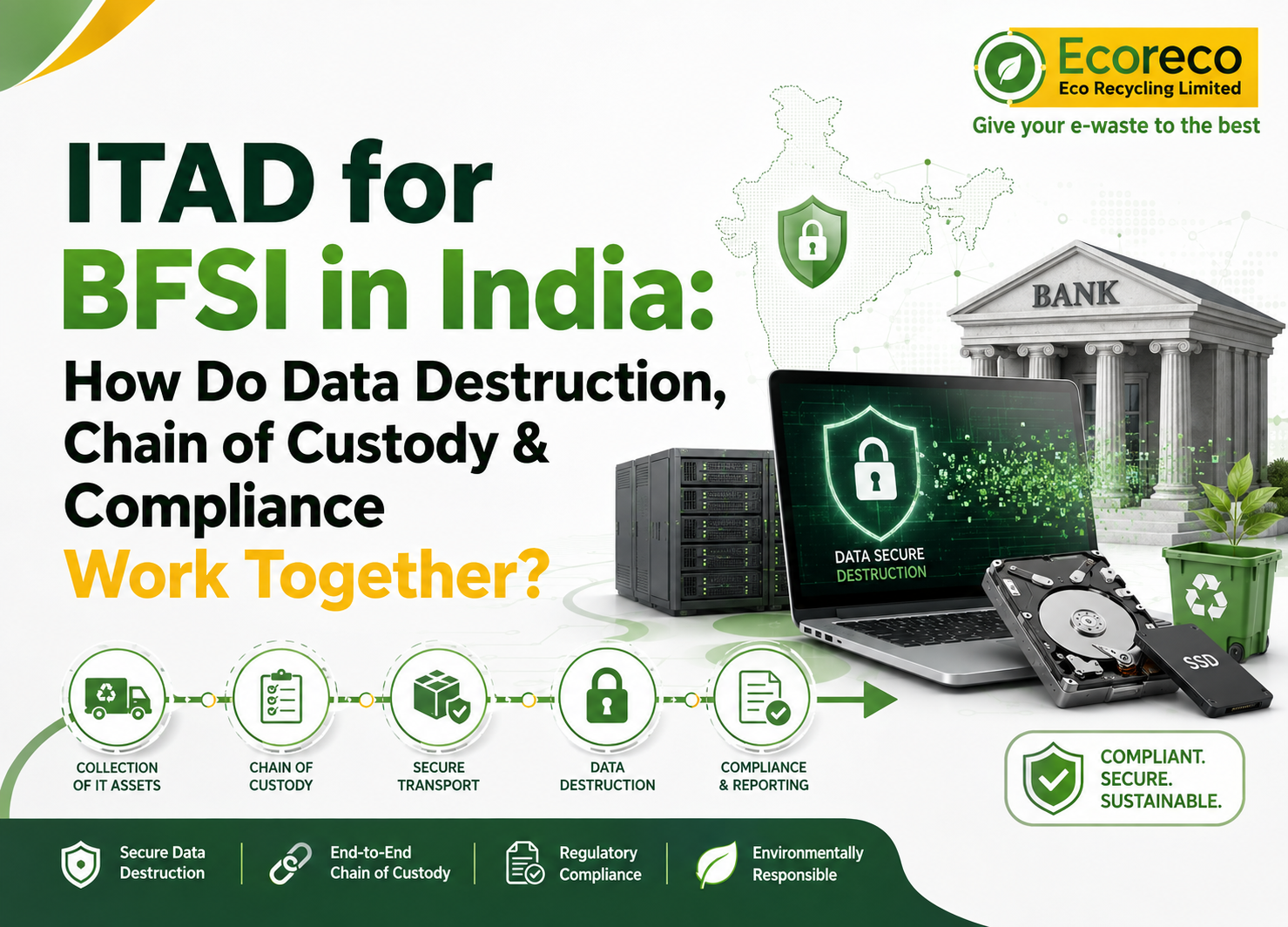
When a bank retires a batch of laptops, decommissions storage arrays from a data centre, or phases out ATM hardware, the transaction is not simply a disposal exercise. Every one of those assets holds customer data, transaction records, or system credentials that are governed by India’s Digital Personal Data Protection Act 2023, RBI’s Master Directions on IT governance, IRDAI’s information security frameworks, and potentially SEBI’s operational risk guidelines if the organization manages investment functions. Getting the retirement of those assets wrong does not just create operational friction. It creates regulatory exposure, reputational risk, and, in some cases, direct liability.
ITAD, IT Asset Disposition, is the structured discipline that governs how end-of-life IT equipment is identified, collected, sanitised, documented, and either resold, recycled, or destroyed. For BFSI organisations in India, ITAD services are not an optional vendor relationship. They are a compliance function that should be integrated into IT lifecycle management and information security governance from the point of asset acquisition, not as an afterthought when hardware starts failing.
Every organisation that handles IT equipment faces some version of the ITAD challenge. BFSI organisations face a more demanding version of it for reasons that are specific to the sector.
The density of sensitive data per device is higher in financial services than in most other industries. A laptop used by a relationship manager contains customer PAN details, account information, loan documentation, and communication records. A server that processes core banking transactions holds transaction logs, authentication data, and account state information across potentially millions of records. A storage array decommissioned from a data centre may contain years of archived financial data in multiple database formats.
The regulatory environment is also more demanding. RBI’s Master Direction on Information Technology Framework for BFSI organisations explicitly requires that decommissioned IT assets be sanitised before disposal using methods appropriate to the classification of the data they held. SEBI’s cybersecurity circulars impose similar requirements on registered intermediaries. IRDAI’s guidelines on information and cyber security for insurers cover data destruction in the context of end-of-life asset management. Non-compliance with these requirements can result in regulatory action against the organisation and its key management personnel, not just a standard fine.
The audit and documentation expectations are correspondingly stricter. A BFSI organisation that cannot produce evidence of how a specific device was sanitised, who handled it from decommission to final disposition, and what the outcome of the sanitisation process was is not in a defensible position in the event of a regulatory inquiry or a data breach incident.
Chain of custody is a term that appears frequently in ITAD discussions but is often understood imprecisely. In the BFSI context, it means a documented, unbroken record of who held physical control of a device from the moment it was identified for decommissioning to the moment its data was verified as destroyed and its physical disposition was confirmed.
This matters for two related reasons. The first is evidentiary: in the event of a data breach investigation or a regulatory inspection, the chain of custody documentation is the primary evidence that the organisation handled end-of-life assets in a controlled manner. Without it, the organisation cannot demonstrate that data did not exit the controlled environment during the disposal process.
The second reason is operational control. A device that leaves the custody of the internal IT team without a documented handover creates a gap in the custody chain, even if it was handed to a reputable ITAD vendor. That gap means the organisation cannot verify what happened to the device between the handover and the point at which data destruction was completed.
A proper chain of custody in BFSI ITAD begins with an asset register entry at decommissioning, includes a signed transfer record at every point of handover, requires documented verification of data destruction completion by the sanitisation technician, and ends with a Certificate of Data Destruction that references the specific device by serial number and records the sanitisation method applied.
Eco Recycling Ltd. builds chain of custody documentation into every stage of its ITAD services, producing the complete audit trail that BFSI organisations need to demonstrate compliance in regulatory examinations and to respond credibly to any future inquiry about how specific decommissioned assets were handled.
Not all data destruction methods are appropriate for all BFSI asset categories, and the appropriate method depends on the classification of the data held and whether the hardware can be reused or resold after sanitisation.
Software-based overwriting using NIST SP 800-88-compliant erasure tools is appropriate for storage media that will be reused or resold. The process overwrites all addressable sectors with verification passes that confirm overwriting completion. For hard drives, this is a well-established and auditable method. For solid-state drives, ATA Secure Erase commands through the device firmware are typically required because standard sector-by-sector overwriting does not reach all data locations on the physical media due to wear-levelling algorithms.
Degaussing destroys the magnetic field encoding on traditional hard drives and magnetic tape, rendering data unrecoverable. It also destroys the drive mechanism, making the media unusable after the process. For highly sensitive data categories, including anything classified as sensitive personal data under the DPDP Act 2023 or under RBI’s data classification frameworks, degaussing followed by physical destruction provides a defence-in-depth approach.
Physical destruction through industrial shredding to certified particle sizes is the appropriate method for crypto-module components, HSMs, and any media where software-based sanitisation cannot be confirmed. BFSI organisations retiring HSMs or specialised cryptographic hardware should require destruction certificates that specify the destruction method and resulting particle size, not just a general statement of destruction.
The selection of the appropriate method for each asset category should be documented in the organisation’s ITAD policy and mapped to its information classification framework. Eco Recycling Ltd. works with BFSI clients to develop this mapping during the ITAD programme design phase, ensuring the right method is applied to the right asset category rather than applying a single method across a heterogeneous asset mix.
Most BFSI organisations have some version of an ITAD process. Fewer have an ITAD programme that is documented, consistently executed, and capable of surviving a regulatory examination. The difference between the two is significant in practice.
A documented ITAD policy establishes the organisational requirements: which assets are in scope, what classification governs each asset type, what sanitisation method is required at each classification level, what documentation must be produced at each stage, which vendors are authorised to handle BFSI IT assets, and what the review and audit cycle for the programme is. This policy should be reviewed annually and updated whenever the regulatory environment changes.
Vendor qualification is a critical component that many organisations underinvest in. The ITAD vendor handling a bank’s end-of-life assets needs to demonstrate current certifications under applicable standards, maintain a chain of custody capability that matches the bank’s documentation requirements, carry adequate insurance for the assets they are holding, and be able to produce documented sanitisation reports that are specific to individual assets rather than general batch confirmations.
The audit cycle for the ITAD programme should include periodic reconciliation of decommissioned assets against received certificates of data destruction, verification that asset serial numbers on destruction certificates match the organisation’s asset register, and review of chain of custody documentation for a sample of recent disposals. This internal audit function is what converts an ITAD policy on paper into a defensible compliance programme in practice.
Across BFSI organisations of varying sizes and sophistication, the compliance gap that creates the most regulatory risk in ITAD is not usually a failure to have a policy or a vendor. It is the gap between the policy and the practice.
An organisation may have an ITAD policy that requires certified data destruction for all decommissioned assets. But if assets are accumulating in a storeroom waiting for an annual disposal exercise, if the internal handover process does not produce a documented custody record, or if destruction certificates are filed without being verified against the asset register, the policy exists on paper, but the compliance controls are absent in practice.
This gap is most likely to be exposed by a regulatory inspection, an internal audit, or an incident investigation following a data breach. At that point, the existence of the policy without the practice is worse than having no policy at all, because it demonstrates that the organisation knew what it was supposed to do and did not do it.
Eco Recycling Ltd. provides BFSI clients with an ITAD service model that generates the specific documentation, custody records, and verification reports that close this gap, supporting not just the vendor relationship but the compliance programme that the organisation needs to demonstrate regulatory conformance.
ITAD for BFSI in India is a compliance function that sits at the intersection of data security, regulatory governance, and environmental responsibility. Data destruction, chain of custody, and compliance documentation are not three separate requirements. They are three dimensions of a single integrated programme, and the absence of any one of them creates a gap that the other two cannot compensate for.
BFSI organisations that treat IT Asset Disposition as a routine vendor service rather than as a compliance programme will consistently find that their documentation cannot support a regulatory examination and their risk management frameworks do not account for the data exposure created by inadequate end-of-life asset handling.
Eco Recycling Ltd. works with banks, NBFCs, insurance companies, and SEBI-registered entities across India to build ITAD programmes that are appropriately documented, consistently executed, and designed to meet the specific compliance requirements of the BFSI sector. The practical first step for any organisation that has not reviewed its ITAD programme against current regulatory expectations is a structured gap assessment, which produces a clear picture of where current practice departs from what regulators and auditors will expect.
ITAD stands for IT Asset Disposition. It is the structured process of decommissioning, sanitising, and disposing of end-of-life IT equipment in a way that protects sensitive data and meets regulatory requirements. For BFSI organisations in India, ITAD is a compliance obligation under RBI, IRDAI, and SEBI frameworks and under the Digital Personal Data Protection Act 2023.
Data erasure uses software to overwrite all addressable sectors of a storage device, making data unrecoverable while leaving the hardware functional. Degaussing uses a magnetic field to destroy data on magnetic storage media, but it also destroys the device. Physical destruction involves shredding or crushing the media to a certified particle size, making both data and hardware permanently unusable. The appropriate method depends on the sensitivity of the data and whether the hardware can be reused.
Chain of custody is a documented, unbroken record of who had physical control of a decommissioned IT asset at every stage from decommissioning to final disposition. For BFSI organisations, it is critical because it is the evidence that data did not exit the controlled environment during the disposal process. Without it, the organisation cannot demonstrate compliance in a regulatory examination or breach investigation.
A Certificate of Data Destruction for each device, referencing the specific serial number, destruction method applied, date of destruction, and technician details. For software erasure, a verification report showing the number of overwriting passes and confirmation of completion should accompany the certificate. These documents should be retained and reconciled against the organisation’s asset register.
Yes. RBI’s Master Direction on IT Framework for banks and NBFCs requires proper sanitisation of decommissioned assets. IRDAI’s information security guidelines for insurers cover data destruction in end-of-life asset management. SEBI’s cybersecurity framework imposes similar requirements on registered intermediaries. The DPDP Act 2023 requires that personal data be erased when no longer needed, which directly covers data held on decommissioned IT assets.
At minimum annually, and additionally whenever there is a significant change in the regulatory environment, a change in the approved ITAD vendor, or a change in the types of assets being decommissioned. The audit should include reconciliation of destruction certificates against the asset register, review of chain of custody documentation for a sample of recent disposals, and verification that the ITAD policy reflects current regulatory requirements.
Most Indian technology companies treat end-of-life IT hardware as a cost centre. Assets get decommissioned, stored in a server room or warehouse for months, and eventually handed to a disposal vendor with no structured process, no documentation, and no expectation of return. The company absorbs the cost of storage, accepts zero recovery from the asset, and often carries unquantified data security risk through the entire process.
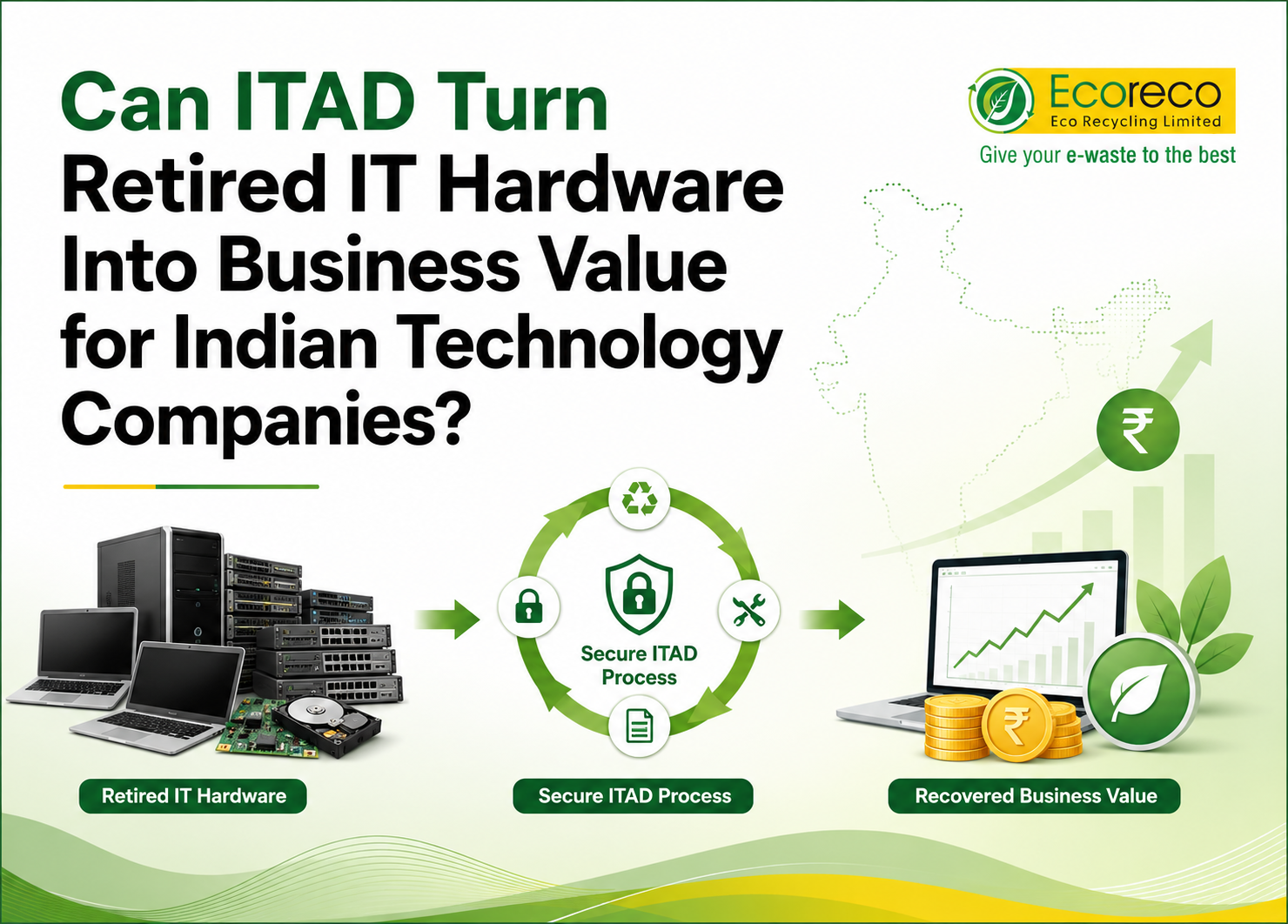
ITAD, IT Asset Disposition, offers a fundamentally different relationship with end-of-life IT assets. When structured correctly, ITAD services do not simply manage the removal of old equipment. They recover measurable financial value from it, reduce the liability associated with holding decommissioned hardware, and align the entire process with the compliance and sustainability frameworks that Indian technology companies increasingly need to demonstrate to clients, investors, and regulators.
The question the article title poses deserves a direct answer: yes, ITAD can and does turn retired IT hardware into business value. The more useful question is how, and what the conditions are for that value recovery to actually materialise.
Technology companies in India refresh hardware on cycles that typically range from three to five years for servers and networking equipment, and two to four years for end-user devices. At the point of retirement, the hardware has residual market value that depends on its age, condition, specification, and the current demand profile in secondary markets for that asset category.
A server array retired after three years from a mid-size IT services company still contains processors, memory modules, and storage components that carry significant secondary market value. A batch of enterprise-grade laptops retired from a software firm after four years can be refurbished and resold into markets where that specification remains relevant and useful. Network switches, UPS systems, and specialised computing hardware all retain residual value that a properly structured IT Asset Disposition process can capture.
The challenge is that most organisations allow this value to be lost in three common ways. The first is delay. Hardware sitting in a storeroom for 12 to 18 months depreciates faster than hardware that is assessed and processed promptly. The secondary market for technology hardware moves quickly, and a server that is worth a particular amount today is worth meaningfully less next year as newer models arrive and demand for the older specification softens.
The second is process failure. Hardware that has not been properly sanitised cannot be sold into secondary markets because it carries data security risk that no reputable buyer will accept. If the organisation has not built data sanitisation into the decommission process, the hardware has no legitimate resale path.
The third is vendor choice. An ITAD services provider that operates primarily as a recycler will capture scrap metal and component recovery value, which is significantly lower than the residual market value available from refurbishment and resale. The distinction matters enormously to the return calculation.
Technology companies that work with experienced ITAD services providers consistently report that their initial expectation of the financial return understates what a structured programme delivers. The gap between expectation and reality is usually explained by two factors: they had not accounted for the volume of assets that qualified for refurbishment and resale rather than recycling, and they had not previously run a process disciplined enough to capture that value.
The financial return from an ITAD programme comes from three sources. The first is direct resale revenue from refurbished assets sold into secondary markets, either directly or through remarketing channels the ITAD provider operates. The second is avoided costs: storage costs for hardware that is no longer occupying data centre space or warehouse space, and the avoided liability cost of data exposure from unsanitised hardware in indefinite storage. The third is deferred but real: the ESG reporting value and client assurance value that comes from a documented, compliant IT asset disposition process, which increasingly influences contract decisions and institutional investment.
Eco Recycling Ltd. works with Indian technology companies to model the expected return from their specific hardware retirement volumes before the programme begins, which provides CFOs and IT procurement teams with a realistic basis for the business case rather than asking them to trust a vendor’s generic projections.
The value recovery question cannot be separated from the data security question. These are not sequential issues where data security is resolved first and value recovery follows. They are simultaneously operating requirements, and the resolution of data security concerns is what creates the conditions for value recovery to happen.
An enterprise-grade server that has not been properly sanitised has no legitimate secondary market path. The liability attached to that hardware eliminates any potential buyer from the compliant market. The only remaining options are informal channels that create regulatory risk, or physical destruction that eliminates the resale value entirely along with the data.
Software-based erasure using methods aligned to NIST SP 800-88 or equivalent international standards, performed with verification reporting that documents the completion of the sanitisation process against each specific asset’s serial number, creates the documented clean state that enables resale. For assets where software erasure is not appropriate, degaussing or physical destruction is applied, and the asset is routed to materials recovery rather than resale. The appropriate method for each asset category should be pre-defined in the ITAD programme design, not decided ad hoc by the disposal vendor.
Eco Recycling Ltd. issues asset-specific Certificates of Data Destruction for every device processed under its ITAD services, providing the documentation that Indian technology companies need for their own compliance records and for the assurance requirements of their enterprise clients, many of whom impose data handling standards through contractual frameworks.
Indian technology companies are increasingly operating in an environment where ESG performance is evaluated by institutional clients, investors applying ESG criteria, and increasingly by international customers who require their Indian partners to demonstrate measurable sustainability commitments.
The environmental dimension of IT Asset Disposition is directly relevant to ESG reporting. E-waste generated from improperly disposed IT hardware contributes to soil and groundwater contamination through heavy metals including lead, cadmium, and mercury. A documented ITAD programme that routes hardware through certified recycling channels keeps these materials in the formal recycling economy and out of informal disposal streams.
For Indian technology companies with GRI, BRSR, or CDP reporting commitments, an ITAD programme generates the specific metrics that sustainability disclosures require: volume of e-waste channelled through certified recycling, percentage of assets refurbished and extended in lifecycle rather than destroyed, and documentation of the recycling chain’s certifications. These are not abstract commitments. They are specific, verifiable data points that a structured programme makes possible and that an informal disposal process cannot produce.
Eco Recycling Ltd. provides reporting data specifically formatted for BRSR and GRI disclosures, which reduces the administrative burden on sustainability teams and ensures that the environmental value generated by the ITAD programme appears in the organisation’s reporting rather than being lost in documentation gaps.
Technology companies that recover the most value from their retired hardware share a consistent programme design. The value is built in at the design stage, not extracted from a poorly designed process after the fact.
The programme design begins with an asset inventory that categorises hardware by age, specification, and condition. This inventory is the basis for the resale versus recycling determination, and it is also the basis for the data security method assignment. Doing this systematically at the point of decommission, rather than when an asset arrives at the disposal facility, captures significantly more value because it allows the resale timeline to be managed appropriately.
Vendor selection is the second critical design decision. The IT Asset Disposition vendor needs to have active secondary market relationships or in-house remarketing capability, certified data destruction processes with asset-level documentation, and experience with the specific hardware categories the technology company is retiring. A vendor whose primary business is bulk recycling will not optimise for resale value. A vendor with active remarketing operations will.
The programme also needs a feedback loop: a regular reporting cycle that shows the company what was recovered, how, and at what value, so that the business case can be validated against actual performance and the programme can be refined over time.
ITAD is not a compliance checkbox or a convenient way to get old equipment out of the server room. For Indian technology companies that approach it correctly, IT asset disposition is a source of financial return, a risk mitigation mechanism, a compliance enabler, and an ESG reporting resource simultaneously.
The assets sitting in storage at most technology companies right now represent value that is depreciating daily. The data on those assets represents liability that is not diminishing. Both problems have the same solution: a structured, documented ITAD programme delivered by a certified partner.
Eco Recycling Ltd. works with Indian technology companies to design and execute ITAD programmes that recover maximum value from retired hardware, document every step of the process for compliance and ESG reporting, and provide the certified data destruction evidence that enterprise clients and regulators increasingly require. The most useful first step for any technology company that has not reviewed its current end-of-life hardware process is an asset inventory and an honest assessment of what the current approach is costing in lost value and retained risk.
ITAD, IT Asset Disposition, is a structured process that manages the end-of-life handling of IT equipment through certified data destruction, asset valuation, refurbishment for resale where applicable, and environmentally compliant recycling. Standard e-waste disposal typically focuses only on the recycling or disposal stage without the data security, chain of custody, and value recovery components that a structured ITAD programme delivers.
The return depends on the age, condition, and specification of the hardware being retired, and on how quickly it is processed after decommission. Enterprise-grade servers, networking equipment, and business laptops retired within three to four years of manufacture typically carry meaningful secondary market value. The best way to estimate the return for a specific asset mix is through a pre-programme asset valuation with a qualified ITAD services provider.
Look for vendors holding ISO 27001 for information security management, ISO 14001 for environmental management, and CPCB authorization for e-waste handling and recycling under India’s E-Waste Management Rules 2022. Asset-specific Certificates of Data Destruction with documented sanitisation methods are a basic expectation rather than an optional add-on.
A structured ITAD programme generates specific, verifiable metrics: volume of e-waste channelled through certified recycling, percentage of assets refurbished and reused, and documentation of certified destruction. These metrics directly support the environmental disclosures required under India’s Business Responsibility and Sustainability Reporting framework and under international standards like GRI and CDP.
India’s E-Waste Management Rules 2022 impose obligations on bulk consumers of IT equipment to channel end-of-life electronics through authorised collection and recycling channels. The DPDP Act 2023 imposes obligations to erase personal data that is no longer needed, which extends to data held on decommissioned IT assets. Together, these create a regulatory requirement for a documented, compliant end-of-life IT asset management process that a properly structured ITAD programme satisfies.
Yes. A well-designed ITAD programme accommodates multi-site collection, providing documented chain of custody from each collection point through to the sanitisation and disposition facility. This is particularly relevant for technology companies operating across multiple cities, where the volume and diversity of assets being retired can vary significantly between locations.
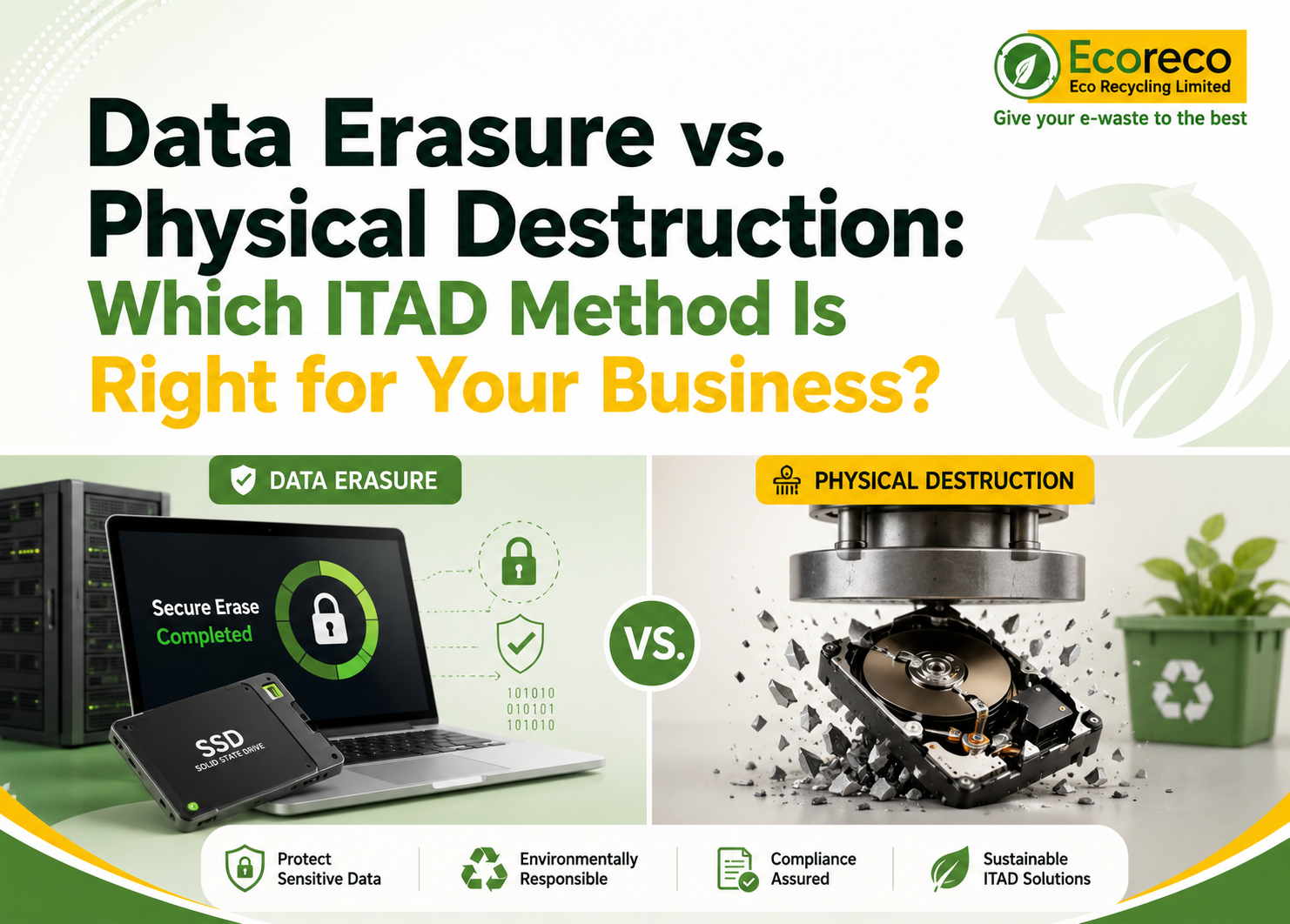
When it’s time to retire old laptops, servers, or storage drives, most organizations eventually run into the same question: should the data be wiped, or should the device itself be destroyed? It sounds like a small operational detail, but the answer actually shapes your risk exposure, your compliance posture, and even how much value you can recover from equipment you’re no longer using.
The confusion here is understandable. Both methods fall under the umbrella of data sanitisation, and both are legitimate approaches used by data destruction services in India every day. But they solve different problems, and choosing the wrong one for your situation can either leave you needlessly destroying equipment that still has resale value or, worse, relying on a method that wasn’t rigorous enough for the sensitivity of what was on that drive. Eco Recycling Ltd. gets asked to walk clients through this exact decision constantly, so let’s break down what actually separates data erasure from physical destruction and how to know which one fits your business.
Data erasure is a software-based process that overwrites every sector of a storage device with new data, repeatedly, until the original information is no longer recoverable through any known forensic method. Done properly, certified data erasure follows recognized international standards and produces a verifiable report confirming the wipe was successful, device by device.
The advantage here is significant: erasure doesn’t destroy the physical hardware, which means the device can be resold, redeployed internally, or donated once the wipe is confirmed. For organizations managing large fleets of laptops or servers on a refresh cycle, this preserves real financial value that would otherwise be lost.
Data erasure is generally the right fit when devices are functioning normally, when there’s a genuine possibility of resale or reuse, and when the sensitivity of the data doesn’t demand irreversible physical destruction. It’s also typically faster to execute at scale than physical destruction, since multiple devices can often be processed simultaneously through automated erasure software.
Physical destruction takes a different approach entirely: rather than removing the data, it destroys the storage medium itself, through shredding, crushing, or degaussing, so that data recovery becomes physically impossible regardless of the tools or techniques someone might use.
This method makes sense in situations where the device has failed and can no longer be reliably wiped through software, where regulatory or contractual requirements demand irreversible destruction, or where the data involved is sensitive enough that no risk of recovery is acceptable, even a theoretical one. Financial institutions, healthcare organizations, and government-adjacent businesses frequently default to physical destruction for exactly this reason.
The tradeoff is straightforward: destroyed hardware has no resale value, and depending on the volume involved, this can represent a real financial loss when compared to a properly erased and resold device.
| Consideration | Data Erasure | Physical Destruction |
| Device usability after the process | Reusable, resalable | Destroyed, no reuse |
| Speed at scale | Faster for large batches | Slower, more resource-intensive |
| Best suited for | Functioning devices, resale-eligible equipment | Failed drives, highly sensitive data, strict compliance needs |
| Residual value recovery | High | None |
| Verification method | Digital erasure certificate | Physical destruction certificate |
| Recoverability risk | Effectively zero when properly certified | Zero, by physical impossibility |
Rather than defaulting to one method across your entire organization, the right approach usually depends on a few practical factors:
A working drive is a candidate for erasure. A failed or damaged drive generally isn’t reliably erasable and should go straight to physical destruction.
Routine business data on a standard office laptop is a reasonable fit for certified erasure. Highly regulated data, financial records, health information, and classified material often warrant the added certainty of physical destruction regardless of cost.
If devices are being refreshed on a cycle and there’s a market or internal use for them afterward, erasure protects that value. If the equipment has no further use case, destruction removes the question entirely.
Some industries and contracts specify a particular method outright. Always check before defaulting to whichever is more convenient.
Large batches on a tight deadline often favor erasure for speed, while smaller volumes of highly sensitive drives can absorb the slower pace of physical destruction.
A standard reset doesn’t overwrite underlying data and isn’t equivalent to certified data sanitisation.
Not every situation calls for physical destruction, and defaulting to it out of caution wastes recoverable value unnecessarily.
Whichever method you choose, always request documented proof, an erasure certificate or destruction certificate, tied to a specific device or serial number.
A blanket policy ignores the reality that failed drives and functioning drives call for genuinely different approaches.
Both data erasure and physical destruction are legitimate, secure methods when executed correctly, but execution is exactly where things go wrong most often. A rushed or improperly verified erasure can leave recoverable fragments behind. A destruction process without proper documentation leaves no audit trail if a compliance question ever arises later.
Eco Recycling Ltd. approaches this by assessing each batch of equipment individually rather than applying one method across the board, matching functional devices to certified data erasure where resale value can be preserved, and reserving physical destruction for failed drives or genuinely high-sensitivity situations where nothing less than irreversible destruction will do. That device-by-device judgment, backed by documented certificates for every unit, is what separates dependable data destruction services in India from a one-size-fits-all approach that either wastes value or takes on unnecessary risk.
Data erasure and physical destruction aren’t competing methods, they’re two tools suited to different situations. Erasure preserves value on functioning equipment through verified, standards-based data sanitisation. Physical destruction removes all risk entirely on devices that have failed or carry data sensitive enough to demand it. The right choice depends on your equipment’s condition, your data’s sensitivity, and your actual compliance requirements, not a blanket policy applied without exception.
If your organization hasn’t reviewed how these decisions get made internally, that’s a good place to start. Eco Recycling Ltd. works with businesses across India to assess retired equipment individually and apply the right data destruction method for each situation, rather than defaulting to whichever is easiest.
Frequently Asked Questions
When performed to a recognized data sanitisation standard and verified with a certificate, data erasure is considered secure enough that recovery becomes practically impossible. Physical destruction removes even the theoretical possibility, but properly certified erasure is trusted across most industries for non-critical data.
Yes. That’s one of the main advantages of erasure over destruction. Once a certified wipe is confirmed, the device can be resold, redeployed within the organization, or donated, provided it’s still functioning correctly.
A damaged or failed drive often can’t be reliably wiped through software, since the erasure process depends on the drive being readable and writable. In these cases, physical destruction is generally the safer and more practical option.
This depends on sector-specific regulations and any data handling clauses in your contracts. Financial services, healthcare, and government-linked organizations often have stricter requirements, so it’s worth confirming directly rather than assuming either method is automatically acceptable.
Always ask for a certificate tied to the specific device, either an erasure certificate confirming the wipe method and standard used, or a destruction certificate confirming the device was physically destroyed. This documentation is your audit trail if a compliance question ever comes up later.
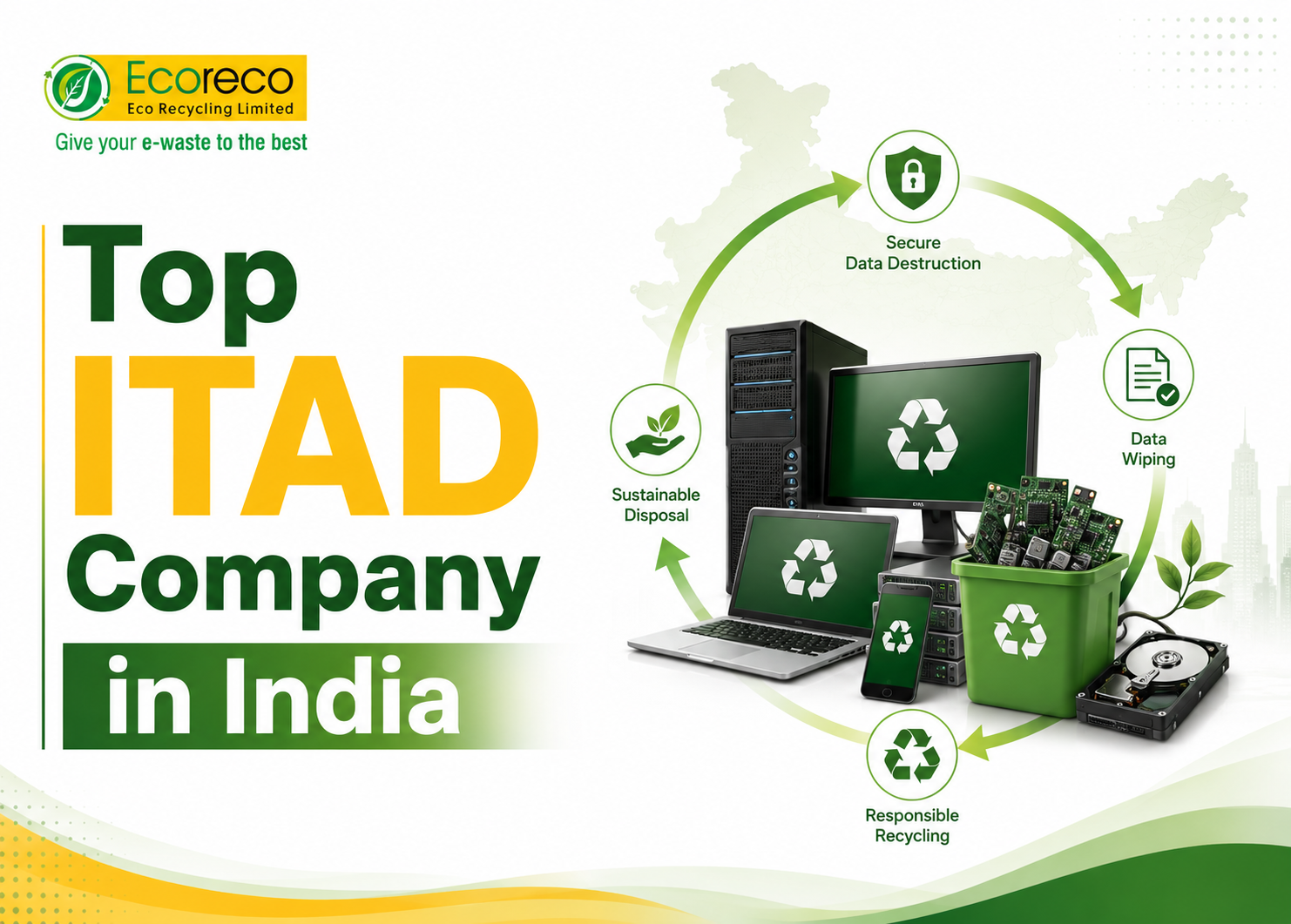
Most organizations don’t think much about what happens to a laptop after it’s decommissioned, until something goes wrong. A hard drive turns up improperly wiped. A batch of old servers ends up with an unregistered scrap dealer instead of a certified recycler. A compliance audit asks for documentation that nobody thought to keep. That’s the moment ITAD stops being a back-office task and becomes a genuine business risk, and it’s exactly the gap that a serious ITAD services provider is supposed to close before it ever becomes a problem.
IT Asset Disposition covers the entire lifecycle of a device once it’s retired: secure data destruction, environmentally sound recycling, and, where possible, responsible value recovery. Done properly, ITAD protects an organization from data exposure and regulatory liability. Done carelessly, it creates exactly the risks it’s supposed to prevent. Eco Recycling Ltd. has spent years building its approach to ITAD around closing that gap completely, and understanding how it reveals a lot about what separates a genuinely dependable ITAD company from one that simply says the right things on its website.
The uncomfortable truth about India’s ITAD sector is that the barrier to calling yourself a “recycler” is lower than most businesses assume. Plenty of operators handle e-waste informally, without proper authorization, without documented data destruction processes, and without any real accountability once a truckload of old IT equipment leaves a client’s premises. For the client, that equipment disappears from view the moment it’s picked up, and whatever happens next is essentially a matter of trust.
That’s the fundamental weakness in how a lot of organizations approach ITAD services today: they treat vendor selection as a logistics decision, who can pick up the equipment fastest or cheapest, rather than a data security and compliance decision. Eco Recycling Ltd. was built on the opposite premise: that ITAD only works if every stage of the process is documented, verifiable, and handled with the same rigor an organization would apply to any other sensitive data process.
Data destruction happens where the risk actually lives, not after it’s already been taken elsewhere. A lot of ITAD companies transport devices off-site before any data destruction takes place, which means sensitive hardware spends hours or days in transit still carrying live data. Eco Recycling Ltd. brings mobile shredding and degaussing capability directly to a client’s premises, meaning data is irreversibly destroyed before a device ever leaves the building. That single difference removes the entire window of exposure that most ITAD processes simply accept as unavoidable.
Every asset is tracked individually, not processed as a bulk lot. It’s common in the industry for devices to be collected in bulk and processed as a batch, with little individual accountability for what happened to any specific machine. Eco Recycling Ltd. maintains device-level tracking and documentation, so if a compliance question ever comes up about a specific asset, there’s an actual record to point to, not a general assurance that “everything was handled properly.”
Recovery and disposal decisions are made transparently, not left as a black box. Retired IT equipment often still has residual value, whether through refurbishment, resale, or material recovery. Many providers don’t disclose what actually happens to an asset once it’s collected. Eco Recycling Ltd. reports back on outcomes, whether a device was refurbished, its materials recovered, or it was safely destroyed, so clients aren’t left guessing what became of their equipment.
Compliance is treated as an ongoing discipline, not a one-time certificate. Regulatory requirements around e-waste handling in India have tightened significantly, and staying compliant means more than holding an authorization certificate once. Eco Recycling Ltd. maintains active compliance across its operations rather than treating certification as a box checked years ago and never revisited.
National scale without losing consistency. Serving clients across multiple states usually means quality varies by region, since many providers rely on subcontracted regional partners with different standards. Eco Recycling Ltd. operates with pan-India reach while maintaining the same process standards regardless of location, which matters enormously for organizations with distributed offices that need one consistent partner rather than a patchwork of regional vendors.
For an IT manager or compliance officer, these differences translate into something concrete: fewer unanswered questions if a data security audit happens, a shorter chain-of-custody gap where equipment is vulnerable, and actual documentation to show regulators or customers when asked how retired equipment was handled. That’s the real measure of whether an ITAD company is doing its job well, not marketing language, but whether the process holds up under scrutiny after the fact.
This is also where a lot of organizations underestimate their own exposure. It’s easy to assume that once equipment is picked up by any ITAD services provider, the risk is gone. In reality, the risk simply shifts from “in our hands” to “in someone else’s hands,” and if that someone else can’t produce documentation when it matters, the organization that handed over the equipment is still the one left explaining what happened.
Even organizations already working with Eco Recycling Ltd. should know what to ask any ITAD provider, since understanding these questions is exactly what makes the difference visible:
A top ITAD company in India isn’t defined by how it markets itself, it’s defined by what happens after the truck leaves with your old equipment. Eco Recycling Ltd. has built its entire approach to ITAD services around removing the blind spots that most providers leave unaddressed: destroying data before it’s ever in transit, tracking every device individually, and reporting transparently on outcomes instead of leaving clients to assume the best.
If your organization is evaluating how retired IT equipment gets handled, the right question isn’t which provider is fastest or cheapest, it’s which one can show you exactly what happens at every step. Eco Recycling Ltd. has built its reputation on being able to answer that question directly, and that’s ultimately what separates a genuinely trustworthy ITAD partner from one that simply says the right things.
The gap isn’t equipment or paperwork, it’s accountability once devices leave your premises. A top ITAD company destroys data on-site before transport, tracks every device individually rather than as a bulk lot, and reports back on what actually happened to each asset. Most operators skip one or more of these steps, which is where risk creeps in.
With a properly equipped provider, yes, mobile shredding and degaussing units come to your premises so data is irreversibly destroyed before any device is transported. This closes the exposure window that exists when hardware travels off-site still carrying live data, which is one of the most overlooked risks in the ITAD process.
Devices should be logged and tracked individually, not processed as an anonymous batch. That means if a compliance audit ever asks about one specific laptop or server, there’s an actual per-unit record and certificate of destruction to point to, not a general assurance that “everything was handled properly.”
A transparent provider tells you exactly which path each asset took: refurbishment and resale, material recovery, or secure destruction. If a vendor can’t or won’t disclose outcomes, that’s a sign the equipment’s fate is effectively a black box to you.
Regulatory requirements around e-waste in India have tightened, so look for a provider that treats CPCB authorization and compliance as an ongoing discipline, actively maintained, rather than a certificate earned once and never revisited. Ask to see authorization directly, not just referenced in marketing material.
Most organizations don’t give a second thought to where a depleted battery ends up once it leaves the building. It gets logged as general e-waste, handed to whichever vendor is cheapest or nearest, and treated as a closed matter the moment it’s off the premises. That casual approach is quietly contributing to thousands of documented fires at waste and recycling facilities every year, and it’s forfeiting materials that carried significant environmental and financial cost to produce in the first place.
Battery recycling is no longer a peripheral sustainability initiative. It has become a genuine operational risk and a resource-management issue at the same time, and the gap between how most organizations assume batteries should be handled and how they actually need to be managed is wider than most compliance teams realize. Whether your organization is retiring device fleets, decommissioning backup power systems, or managing warehouse and logistics equipment, understanding what proper lithium ion battery disposal actually requires is a matter of operational due diligence, not just environmental goodwill.
Here’s what a lot of standard disposal guidance fails to flag: a lithium battery doesn’t need to be in active use to pose a hazard. A unit your facilities team logs as “depleted” can still retain a meaningful charge, and if it’s crushed, punctured, or exposed to heat during handling, collection, or transport, that stored energy can trigger thermal runaway, a self-sustaining chain reaction that generates intense heat and, frequently, fire.
This is not a low-probability edge case worth deprioritizing in a risk matrix. Waste and recycling operators have documented hundreds of incidents directly traced to batteries entering general waste or unsorted recycling streams, and industry reporting suggests the true figure is higher, since a meaningful share of incidents go unrecorded or unattributed. Collection vehicles, sorting facilities, and landfill operations have all experienced this firsthand, in some cases with damage running into the millions and, more seriously, injuries to personnel who had no visibility into the fact that a compromised battery was the underlying cause.
The operational reality is straightforward: a single mishandled battery entering the wrong waste stream can generate liability, property damage, and safety exposure disproportionate to the size of the item itself. That’s precisely why lithium ion battery disposal carries handling requirements that go well beyond standard e-waste protocols, and why it deserves a specific line item in any organization’s waste-management policy.
Fire and safety exposure tend to dominate the conversation, but there’s an equally important commercial dimension: what these batteries actually contain. Lithium, cobalt, nickel, and manganese are the core materials powering rechargeable batteries, and each is sourced through mining operations that carry substantial environmental and geopolitical cost.
When a battery is processed through a proper recycling pathway, those materials are recovered and reintroduced into new battery production instead of being landfilled or incinerated. When it isn’t, that material is permanently lost, and manufacturers are forced to extract additional raw material to replace it. Scaled across the volume of batteries retired annually across enterprise device fleets, industrial equipment, e-mobility programs, and backup power infrastructure, the resource impact of getting this wrong becomes significant quickly, and increasingly relevant to ESG reporting and supply-chain accountability commitments.
Framed this way, battery recycling shifts from a sustainability talking point to a genuine component of responsible resource governance, one that stakeholders, auditors, and regulators are increasingly expecting organizations to demonstrate.
Even well-run operations get this wrong regularly, usually because the failure points look minor on the surface. These are the ones we encounter most often when working with organizations, and why each represents a genuine liability rather than a procedural technicality.
Sound disposal outcomes start well before a vendor is involved. A few procedural steps, built into standard operating procedure, materially reduce risk during internal storage and handoff:
Procurement and compliance teams should treat any collection vendor that isn’t transparent about its process with appropriate scrutiny. You don’t need specialized technical expertise to find by your own whether a provider is legitimate, just a structured verification process.
Start by requesting certification documentation rather than accepting a logo on a proposal or website, then verify that certification independently through the relevant regulatory authority. Ask specifically what happens after collection: is material processed on-site, or shipped to a third party, and where do recovered lithium, cobalt, and nickel ultimately go. A credible vendor should answer without hesitation or vague deflection. For organizational compliance records, request formal documentation, such as a certificate of recycling or destruction, for every collection cycle. If responses feel evasive or inconsistent, that’s sufficient grounds to evaluate alternative providers before committing to a long-term contract.
Eco Recycling Ltd. was built on the premise that battery recycling should be evaluated by what happens after collection, not by how convenient the pickup process appears on paper. That means documented, auditable handling procedures from the point of receipt, proper isolation and storage protocols to mitigate the fire risks outlined above, and a recovery process focused on returning usable materials to circulation rather than simply removing liability from your premises.
For any organization evaluating disposal partners, whether managing a single facility or a multi-site operation, the standard should be consistent: verifiable accountability for lithium ion battery disposal from collection through final material recovery, backed by documentation your compliance team can actually rely on.
Sustainable battery disposal comes down to two operational commitments: handling batteries correctly before they leave your facility, and partnering with a recycler that can document, not just claim, where those materials ultimately go. Start by formalizing the storage and handling steps outlined above into standard procedure, apply the verification questions before finalizing any vendor relationship, and treat every battery, regardless of size, as a compliance and safety item rather than routine waste. Eco Recycling Ltd. is structured to meet that standard, and the appropriate next step is straightforward: put these questions to your current or prospective provider and evaluate how clearly, and how completely, they can answer.
No. Standard sorting equipment can crush or puncture batteries, creating a serious fire risk within the facility. Lithium batteries require a dedicated collection process specifically configured for battery recycling and should be addressed as a distinct line item in any waste-management contract.
Isolate it immediately in a cool, dry, non-flammable storage area, insulate any exposed terminals, and schedule collection through a certified disposal partner as soon as possible. The unit should not remain in general storage or continue in service.
Yes. Small lithium cells account for a disproportionate share of facility fires, largely because organizations assume their handling requirements are less strict. They contain the same recoverable materials as larger units and require equivalent care.
Request certification documentation and verify it independently with the relevant regulatory body, ask what happens to material after collection, and require formal documentation, such as certificates of recycling or destruction, for every collection cycle.
Yes. Recovered lithium, cobalt, nickel, and manganese can be reintroduced into new battery production, reducing dependence on newly mined material. At the scale organizations retire batteries across device fleets and equipment, this materially reduces environmental impact and increasingly supports ESG and supply-chain reporting requirements.
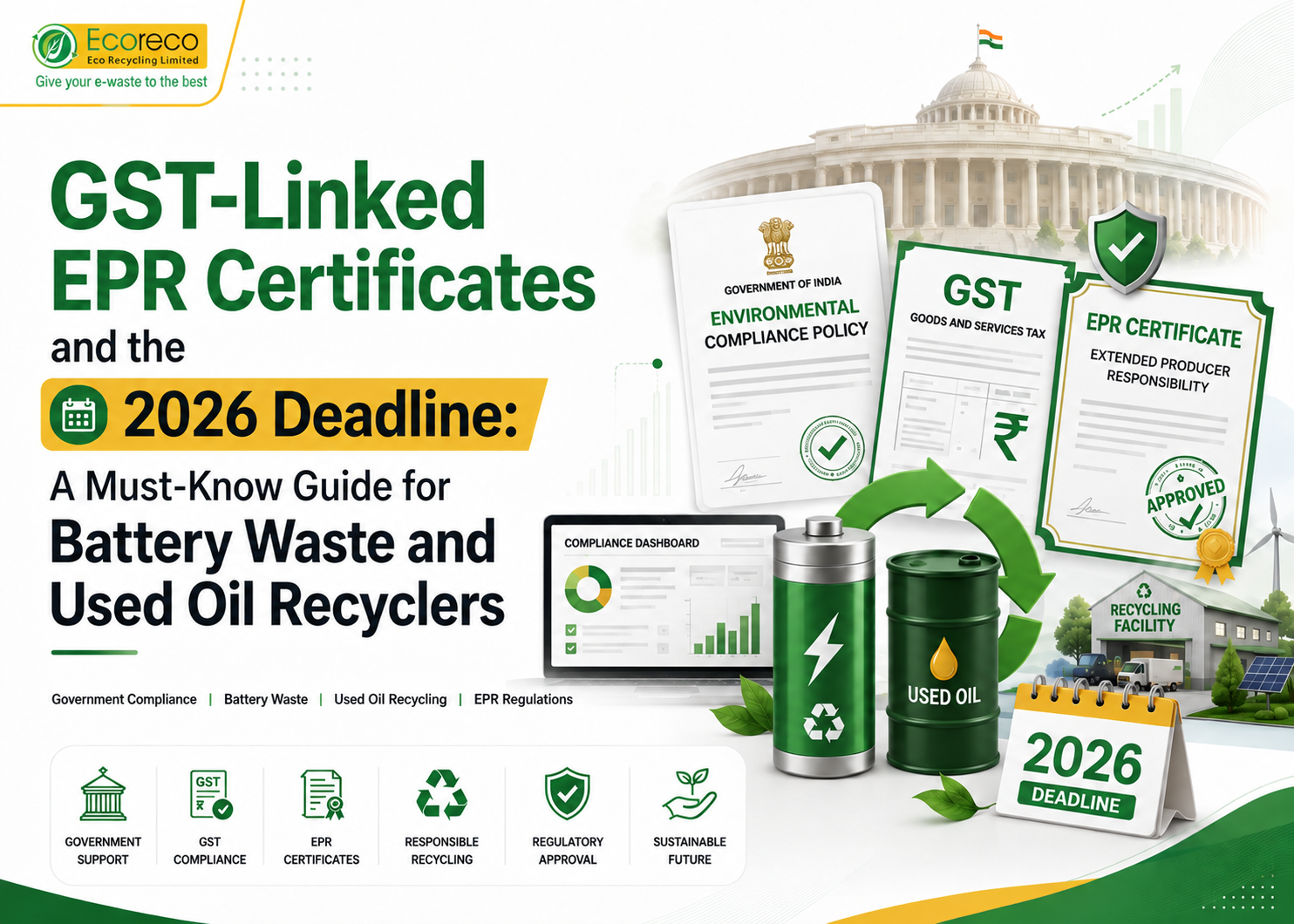
Extended Producer Responsibility (EPR) has quietly become one of the most closely audited compliance systems in India’s environmental framework. For years, recyclers generated EPR Certificates based on processing records, and producers purchased those certificates to meet their obligations. It worked, but it also left a gap: there was no reliable way to confirm that a recycler’s claimed sales of recovered material had actually happened.
The Central Pollution Control Board (CPCB) has now closed that gap. Under a new directive covering both the Battery Waste EPR Portal and the Used Oil EPR Portal, every EPR Certificate must be backed by a GST-linked e-invoice. From 1 July 2026, certificates generated without valid GST-linked documentation will not be treated as authentic, and businesses relying on them could find themselves on the wrong side of a compliance audit.
At Eco Recycling Ltd., we work with producers, recyclers, and importers across e-waste, battery waste, plastic waste, and used oil categories every day, so this shift is one we’re tracking closely on behalf of our clients. Here’s a clear, practical breakdown of what has changed, who it affects, and how to prepare.
Under the Battery Waste Management (BWM) Rules, 2022, recyclers earn EPR Certificates by processing collected batteries and selling the recovered materials, metals, plastics, and other reusable components. Producers then purchase these certificates to meet their own recycling obligations.
In simple terms: an EPR Certificate is now only as credible as the invoice trail behind it. Recyclers who sell recovered battery materials or reprocessed used oil must issue that sale through a GST-compliant e-invoice, and the CPCB portal cross-checks this data against GSTN records before a certificate is generated.
This applies to two separate but related compliance streams:
Both frameworks now require the same underlying discipline: no verifiable GST invoice, no valid certificate.
CPCB now requires that EPR Certificates for battery waste and used oil recycling be backed by GST e-invoices. From 1 July 2026, certificates issued without a matching, verifiable GST invoice will be treated as invalid and may be flagged as non-compliant under applicable hazardous waste and battery rules.
The reasoning is straightforward. EPR credits carry real commercial value, and producers pay recyclers to acquire them. Without a way to independently verify that the underlying material sale actually occurred, the system was exposed to inflated or fabricated recycling claims. Linking every certificate to a GST e-invoice gives CPCB a digital, traceable audit trail that is far harder to manipulate, and it strengthens confidence in India’s broader circular economy goals.
Recyclers of battery waste and used oil are directly responsible for ensuring their sales invoices are GST-linked before certificates are generated. If GST e-invoicing isn’t set up correctly, the portal may simply reject certificate generation after the deadline.
Producers and brand owners who purchase EPR Certificates to meet their own recycling obligations now carry a shared burden. Buying a certificate that turns out to be backed by a non-compliant invoice doesn’t shift the risk away from you; it exposes your business too. Due diligence on your recycler partners is no longer optional.
Battery waste, especially lithium-ion battery waste from EVs, electronics, and energy storage, carries real recovery value in metals like cobalt, nickel, and lithium. That value creates an incentive to overstate recycling volumes if no independent check exists.
By requiring GST e-invoicing, CPCB gains a digital audit trail that’s difficult to falsify. Every invoice is tied to a GSTIN, timestamped, and reportable, which means recycling claims can be matched against actual commercial transactions rather than self-reported paperwork alone.
| Details | Provision |
| Environment (Protection) Act, 1986 | Sections 6, 8, and 25 |
| Battery Waste Management Rules, 2022 | Para 2, 3, 4 |
This process is relevant for all recyclers registered under the Battery Waste Management Rules, 2022.
1. Create the GST e-Invoice
2. Access the CPCB Portal
3. Fill in the Sales Information
4. Submit the Documentation
5. Get Your Credits and Transfer Them
| Milestone | Date |
| EPR framework operational (used oil) | 1 April 2024 |
| Deadline to complete GST e-invoicing alignment | 30 June 2026 |
| Non-GST-linked certificates lose validity | From 1 July 2026 |
Businesses that haven’t yet reviewed their invoicing setup have very little runway left.
Non-compliant certificates generated after the deadline may be classified as false or invalid under the relevant hazardous waste and battery management rules. Depending on the category and severity, this can lead to:
For producers, accepting a flawed certificate can mean falling short of your own annual compliance targets without realizing it until it’s too late.
While the immediate reaction to new paperwork requirements is rarely enthusiastic, this rule genuinely strengthens the battery recycling ecosystem. It:
If you’re a recycler:
If you’re a producer:
EPR compliance regulations are continuously evolving, making it difficult for businesses to understand and meet all the latest CPCB requirements. Eco Recycling Ltd. helps producers, importers, brand owners, and recyclers stay compliant by providing expert guidance and end-to-end support throughout the compliance process.
Our Services:
Our goal isn’t just to help you avoid penalties; it’s to make sure your compliance record actually reflects the responsible recycling practices you’re investing in.
GST-linked EPR Certificates mark a meaningful step toward tighter, more transparent environmental compliance in India. For recyclers and producers who already maintain clean documentation, this is a low-friction change. For those with gaps, the time to act is now, not after 30 June 2026. Eco Recycling Ltd. is ready to help your business review its current standing and build a compliance process that holds up under scrutiny.
Under CPCB’s latest guidelines, generating a Battery Waste EPR Certificate now requires a GST e-invoice, effective 1st July 2026. A regular sales invoice is no longer sufficient for this purpose. Recyclers must submit the GST e-invoice through the Battery Waste EPR Portal. This step has been introduced to strengthen the credibility of EPR certificates and bring greater transparency to the system.
The requirement took effect on 1st July 2026. Before this date, recyclers could rely on standard sales invoices, but that provision ended on 30th June 2026. From 1st July onward, only GST e-invoices are accepted, meaning all recyclers seeking EPR certification must align with the updated process.
The responsibility falls on battery recyclers registered with CPCB. It applies specifically to those selling recovered metals or metal compounds from batteries and applying for an EPR Certificate. Since the certificate cannot be issued without a valid GST e-invoice, affected recyclers should get their processes ready ahead of time.
Yes, it does. Any recycler intending to generate and sell battery waste EPR certificates falls under this rule, regardless of business size. The GST e-invoice must be used according to CPCB’s specifications when applying for certification, so smaller operations should plan accordingly in advance.
Starting 1st July 2026, an EPR Certificate application backed only by a general sales invoice risks rejection. CPCB may treat such a submission as an invalid or false certificate, which could lead to compliance troubles and disrupt business operations. To avoid this, recyclers are strongly advised to use GST e-invoices consistently.
Yes. EPR credits generated before this date, in line with the earlier rules, remain valid for purchase by a Producer, Importer, or Brand Owner (PIBO). However, any EPR credit created after 1st July 2026 must comply with the GST e-invoice requirement — older invoices cannot be used to generate new certificates.
The CPCB Portal cross-checks the GST e-invoice details by linking with the GST Network (GSTN). It primarily reviews the Invoice Reference Number (IRN) along with other relevant data. Once verified as accurate, the application moves forward — a system that significantly cuts down the possibility of fraudulent or incorrect invoices being used.
According to the Battery Waste Management Rules, a GST e-invoice is needed for recovered battery materials linked to EPR credit. This typically covers Lead, Lithium, Cobalt, Nickel, and their respective compounds. Accuracy in preparing the GST e-invoice is essential when selling these recovered materials.
This measure was introduced to make the Battery Waste EPR framework more dependable and transparent. GST e-invoices allow transactions to be verified easily, lowering the risk of fraudulent certificates. They also make it simpler to trace the origin and destination of recovered battery materials throughout the supply chain.
During verification, the CPCB Portal typically matches the IRN, invoice details, and GSTN records. If everything aligns correctly, the EPR Certificate process continues smoothly. Any mismatch, however, can cause delays in the application, so it’s important to ensure invoice details are accurate from the start.
Eco Recycling Ltd. supports businesses through the entire battery waste EPR compliance journey — from registration to CPCB documentation. Our team offers guidance on interpreting the latest notifications, reviewing compliance status, and aligning operations with the Battery Waste Management Rules, 2022. This support helps businesses adapt to the new requirements smoothly while minimizing the risk of non-compliance.
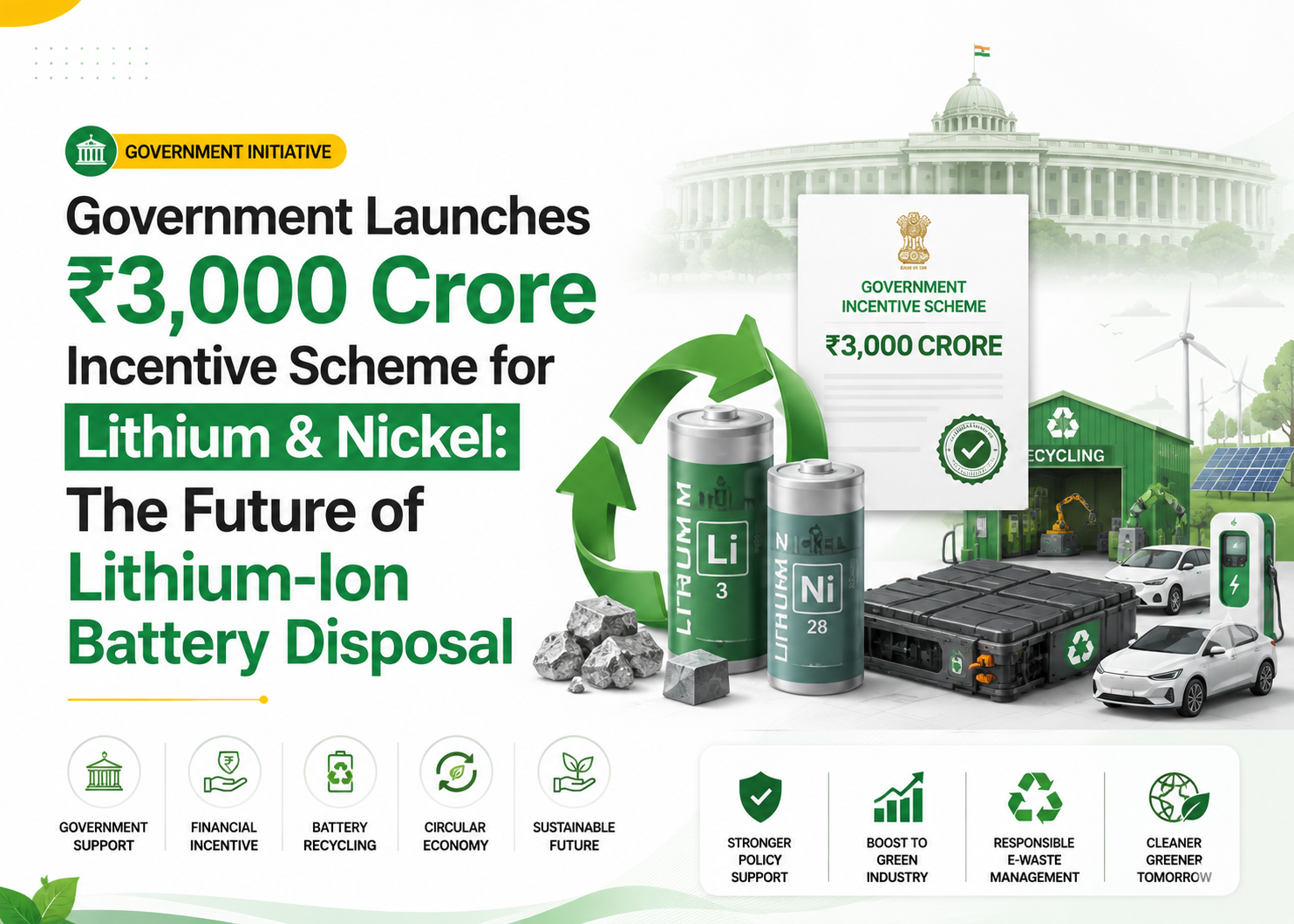
India’s Ministry of Mines is set to roll out a landmark ₹3,000 crore incentive scheme to develop domestic lithium and nickel processing capacity. For those tracking the recycling and clean energy landscape, this is not simply an industrial policy announcement. It signals that the government recognises the full lifecycle of battery materials as a strategic national priority, from extraction and processing through to end-of-life recovery.
For the battery recycling sector, the implications are significant. India’s approach to lithium-ion battery disposal is entering a new phase, one where domestic processing capacity and formal battery recycling infrastructure become mutually reinforcing pillars of the country’s EV ambitions.
The Ministry of Mines is set to introduce a ₹3,000 crore incentive scheme aimed at strengthening domestic lithium and nickel processing capacity, a key step in reducing import dependence and supporting the country’s rapidly expanding electric vehicle ecosystem. The proposed policy is expected to be implemented for investments made on or after April 1, 2026, providing financial incentives over a five-year period.
Under the scheme, companies establishing new lithium and nickel processing facilities will be eligible for a 15 percent capital subsidy on approved investments, with incentive payouts linked to plant performance and released in phases upon achieving prescribed utilisation benchmarks.
Companies seeking benefits under the programme will need to establish processing facilities with significant production capacities, with lithium processing plants likely requiring a minimum annual capacity of 30,000 metric tonnes and nickel processing plants a capacity of at least 50,000 metric tonnes.
This is not a scheme designed for small operators. It is designed to attract serious industrial investment and create the kind of scale that can actually move the needle on India’s current import dependency for battery-grade materials.
India imported over 70 percent of its lithium requirements in recent years, creating supply concentration risk for domestic battery manufacturers as EV penetration scales across two-wheelers, three-wheelers, and passenger vehicles.
This dependency becomes more acute when viewed against the government’s own ambitions. India targets 30 percent electric car penetration and 80 percent electric two-wheeler penetration by 2030, up from 6 percent and 9 percent respectively at present. Reaching those targets while continuing to source processed lithium and nickel primarily from overseas exposes the entire EV programme to price volatility, supply chain disruption, and geopolitical risk.
The incentive scheme is the government’s recognition that securing the material inputs for batteries is as important as building the factories that assemble them.
Here is where the scheme becomes particularly relevant for the recycling sector. Domestic lithium and nickel processing capacity does not only serve freshly mined or imported raw materials. It also creates the industrial infrastructure needed to reprocess materials recovered from end-of-life batteries.
India currently recycles only around 1 percent of its end-of-life lithium-ion batteries into reusable materials. However, with effective policy interventions, the country could develop a lithium-ion battery recycling industry worth approximately Rs. 31,150 crore by 2030.
Processing and recycling capacity are fundamentally linked. The black mass recovered from end-of-life lithium-ion batteries contains lithium, cobalt, nickel, and manganese. Those recovered materials must be refined to battery-grade quality before they can re-enter manufacturing. Without domestic refining infrastructure, that black mass is exported or processed informally at low recovery efficiency. The ₹3,000 crore scheme creates the industrial scaffolding that formal battery recycling in India needs to close the loop.
India’s regulatory framework for battery waste is already tightening independently of this scheme. The amendments to the Battery Waste Management Rules 2025 represent a decisive tightening of India’s approach to battery lifecycle accountability, introducing stricter recovery targets, mandatory recycled-content requirements from FY 2027-28 onwards, and enhanced digital traceability obligations through barcode and QR code tracking on all battery packs.
From FY 2027-28, batteries manufactured in India must incorporate minimum percentages of recycled lithium, cobalt, and nickel recovered from domestically processed end-of-life batteries.
This is a pivotal regulatory shift. It transforms lithium-ion battery disposal from a compliance obligation into a supply chain input. A battery manufacturer that needs recycled lithium content in its cells from 2027 onward has a direct commercial interest in ensuring that end-of-life batteries are collected and processed through formal, high-recovery-rate channels rather than the informal sector.
Industry estimates suggest India will need to scale recycling capacity by 50 to 60 times relative to current levels to manage the battery packs sold today once they reach end-of-life in the early 2030s. The combination of the incentive scheme for processing infrastructure and the BWMR recycled content mandate creates a policy environment where this scaling is both commercially incentivized and legally required.
The ₹3,000 crore scheme is an investment signal, not an overnight transformation. The processing facilities it incentivizes will take years to build and commission. The recycled content mandates arriving in FY 2027-28 are closer. For recyclers and producers operating under EPR obligations today, the most important actions are practical and immediate.
Registering on the CPCB portal as an authorized recycler or producer is the starting point. Building documented collection channels with OEM return programmes, fleet operators, and consumer-facing take-back points creates the supply of end-of-life batteries that any recycling operation depends on. Investing in hydrometallurgical processing capability, or partnering with recyclers who have it, ensures that the materials recovered meet the battery-grade quality standards that will be required once domestic recycled content obligations take effect.
As of December 2025, the portal includes 4,022 registered producers and 487 registered recyclers, with 58.26 lakh tonnes of battery waste processed through formal recycling pathways, signalling rapid ecosystem formalisation. The infrastructure is being built. The question for businesses in the recycling and battery sectors is whether they are part of that formalisation or outside it.
The ₹3,000 crore incentive scheme for lithium and nickel processing is one of the most consequential policy developments for India’s battery sector in recent years. It addresses the supply chain vulnerability at the front end of the battery lifecycle while, indirectly but critically, creating the conditions for formal battery recycling to scale at the back end.
India’s EV ambitions and its battery recycling obligations are converging, and organizations that understand both dimensions will be better positioned for what comes next.
Eco Recycling Ltd. has been working at the intersection of these regulatory and industrial shifts, providing authorized lithium-ion battery disposal and battery recycling services that meet current BWMR requirements while building the capacity that upcoming recycled content mandates will demand. For businesses navigating EPR compliance, collection infrastructure, or material recovery partnerships, now is the time to engage seriously rather than reactively.
Eco Recycling Ltd: Among India’s 58 Approved Leaders Driving the Critical Mineral Recycling Revolution
As the government rolls out its ₹3,000 crore incentive push for lithium and nickel processing, a parallel milestone has already been achieved on the recycling front. The Ministry of Mines has completed its eligibility assessment under the ₹1,500 crore Incentive Scheme for Promotion of Critical Mineral Recycling, part of the National Critical Mineral Mission, approving 58 companies with a combined pledged capacity of about 850 KTPA and pledged investments of roughly ₹5,000 crore, spanning battery recycling, e-waste processing, and mineral recovery from scrap.
This sets the stage for the next phase: capacity development and production-linked financial support for eligible entities, directly complementing the government’s broader lithium and nickel strategy and shaping the future of responsible lithium-ion battery disposal in India.
Eco Recycling Ltd (Ecoreco) is proud to be among the entities eligible under this Scheme.
The Indian government has proposed a ₹3,000 crore incentive scheme through the Ministry of Mines to boost domestic processing of lithium and nickel, two minerals critical to EV battery manufacturing. The scheme offers a capital subsidy on approved investments, payable in phases as processing plants hit performance milestones. It’s designed to reduce India’s import dependence and strengthen the local battery supply chain, which directly ties into how the entire lithium-ion battery lifecycle, including disposal and recycling, is managed within the country.
While the ₹3,000 crore scheme focuses on processing raw lithium and nickel, it works hand-in-hand with the government’s broader push on recycling, including the earlier ₹1,500 crore Critical Mineral Recycling Incentive Scheme aimed at recovering lithium, nickel, and other minerals from e-waste and spent batteries. Together, these initiatives create a closed-loop system: minerals mined or imported, used in batteries, and then recovered again through proper disposal and recycling, an area where companies like Eco Recycling Ltd already play an active role.
Improperly discarded lithium-ion batteries pose fire risks, soil and water contamination, and a waste of recoverable materials like lithium, cobalt, and nickel. As India targets 30% EV penetration by 2030, the volume of end-of-life batteries will rise sharply. Scientific disposal and recycling, the kind of work companies like Eco Recycling Ltd specialize in, ensures these materials are safely recovered and reintroduced into the supply chain instead of ending up in landfills.
Based on available details, the scheme is expected to support companies setting up new lithium and nickel processing facilities, with incentives tied to plant utilization and output benchmarks. It’s aimed at both domestic and international investors looking to enter India’s critical minerals space. Recycling-focused companies such as Eco Recycling Ltd, which help recover these same minerals from battery scrap and e-waste, stand to benefit indirectly as demand for recovered material and compliant disposal infrastructure grows.
Eco Recycling Ltd focuses on the environmentally sound collection, dismantling, and recycling of lithium-ion batteries and e-waste, helping recover valuable metals like lithium, nickel, and cobalt for reuse. As government policy increasingly supports both critical mineral processing and recycling infrastructure, Eco Recycling Ltd’s role becomes more significant, bridging the gap between raw material scarcity and sustainable, circular battery disposal practices.
Industry watchers point to a few hurdles: limited domestic lithium reserves, the need for advanced refining technology, and building sufficient recycling capacity to complement raw processing. Scaling up battery collection and disposal networks, the kind Eco Recycling Ltd operates, will be just as important as the processing incentives themselves, since a steady stream of recoverable material from used batteries can ease pressure on new mineral extraction.
Most compliance failures aren’t caused by bad intentions. They’re caused by missing paperwork. A company disposes of fifty old laptops responsibly, through a legitimate recycler, and does everything right operationally, only to get flagged during an audit because nobody kept the certificate. The equipment is gone, the data is gone, but the proof is gone too, and to an auditor, no proof might as well mean it never happened.
This is the blind spot most businesses have around e-waste management. They focus heavily on choosing a responsible e-waste company in Mumbai or elsewhere, which is important, but they underinvest in the documentation trail that actually protects them when a regulator, client, or internal audit team comes asking questions. Good disposal without good records is only half the job.
Here’s an uncomfortable truth: from a compliance standpoint, disposal that isn’t documented is functionally indistinguishable from disposal that never happened. Environmental regulators, data protection authorities, and even client due-diligence teams don’t take your word for it. They want evidence.
Under India’s E-Waste Management Rules and the Extended Producer Responsibility (EPR) framework, businesses generating e-waste including producers, manufacturers importers, brand owners and bulk consumers in regulatory language carry documented responsibility for how that waste is handled, right down to proving it reached an authorised recycler and wasn’t diverted into informal, unregulated channels. Without paperwork, you can’t demonstrate compliance even if you technically achieved it.
Think of this as your minimum viable compliance file for every disposal cycle:
1. Asset Manifest A detailed inventory of every device disposed of, including make, model, serial number, and asset tag. This is your baseline record of what actually left the building.
2. Form 6 A statutory document prescribed under the E-Waste (Management) Rules for tracking movement of e-waste.
3. Certificate of Recycling Issued by the recycler, confirming the assets were processed through authorised channels. This should reference the recycler’s CPCB authorisation number.
4. Certificate of Data Destruction If any device stored data, this certificate confirms what sanitisation method was used and verifies the data is unrecoverable, separate from the recycling certificate.
5. Weighbridge or Quantity Receipt A record of the actual weight or volume processed, which matters for EPR reporting and cross-checking against your asset manifest.
6. Chain-of-Custody Log A timestamped record showing who handled the assets from pickup to final processing, useful if a question ever arises about what happened between collection and destruction.
Missing even one of these is often enough to trigger follow-up questions during a compliance review.
A simple framework makes this manageable rather than overwhelming:
Step 1: Centralise the record-keeping. One system, one owner, no matter how many departments generate e-waste.
Step 2: Standardise your vendor requirements. Before any device leaves your premises, your recycler should already know exactly what documentation you require and by when.
Step 3: Reconcile quarterly. Match asset manifests against certificates received. Flag any gaps immediately rather than discovering them during an actual audit.
Step 4: Retain, don’t archive-and-forget. Store records somewhere retrievable, not buried in an inbox or a filing cabinet nobody remembers exists.
Step 5: Review vendor credentials annually. CPCB authorisations and compliance standards can change; confirm your partner is still current.
When a regulatory body or client audit team reviews your e-waste management practices, they’re typically checking three things: whether disposal went through an authorised channel, whether documentation ties back clearly to specific assets, and whether your retention practices meet the applicable timeframe. Businesses that pass these reviews smoothly aren’t necessarily disposing of e-waste any differently than others, they’re simply able to prove it.
The right e-waste management partner should treat documentation as a core deliverable, not an afterthought you have to chase down after the fact. Eco Recycling Ltd. issues complete, traceable documentation for every batch processed, from certificates of recycling and data destruction to detailed asset-level manifests, so that businesses across Mumbai and beyond have a ready compliance file the moment an auditor asks for one. As a CPCB-authorised e-waste company in Mumbai, Eco Recycling Ltd. also keeps EPR reporting straightforward for the businesses it works with, rather than leaving them to piece together compliance evidence on their own.
Responsible e-waste disposal is only half the compliance picture. The other half is proof: manifests that tie to certificates, certificates that tie to authorised recyclers, and records retained long enough to matter when someone asks. Businesses that build this documentation habit into their disposal process, rather than treating it as paperwork to chase after the fact, are the ones who sail through audits instead of scrambling before them.
If your current disposal records wouldn’t hold up to a surprise audit tomorrow, that’s the gap to close first. Start by auditing your last two or three disposal cycles for missing certificates, then work with a partner like Eco Recycling Ltd. who builds documentation into the process from day one, not as an afterthought once the equipment is already gone.
At minimum, keep a certificate of recycling/disposal, a certificate of data destruction (if the assets held data), a detailed asset manifest with serial numbers, Form 6, weighbridge or quantity receipts, and proof of the recycler’s CPCB (Central Pollution Control Board) authorisation. Together, these form the paper trail an auditor or regulator will ask for.
Most companies retain these records for a minimum of five to seven years, aligning with standard financial and compliance audit cycles in India. If your industry has sector-specific data retention rules (finance, healthcare, telecom), follow whichever retention period is longer.
No, and this is one of the most common gaps businesses discover during an audit. Many smaller or informal recyclers hand over equipment without issuing proper certificates. Always confirm documentation practices before signing a contract, not after a compliance gap surfaces.
Any vendor can collect old electronics, but a certified partner operates under CPCB authorisation, follows Extended Producer Responsibility (EPR) guidelines, and issues traceable documentation for every batch processed. That distinction is exactly what protects your business during an audit or regulatory review.
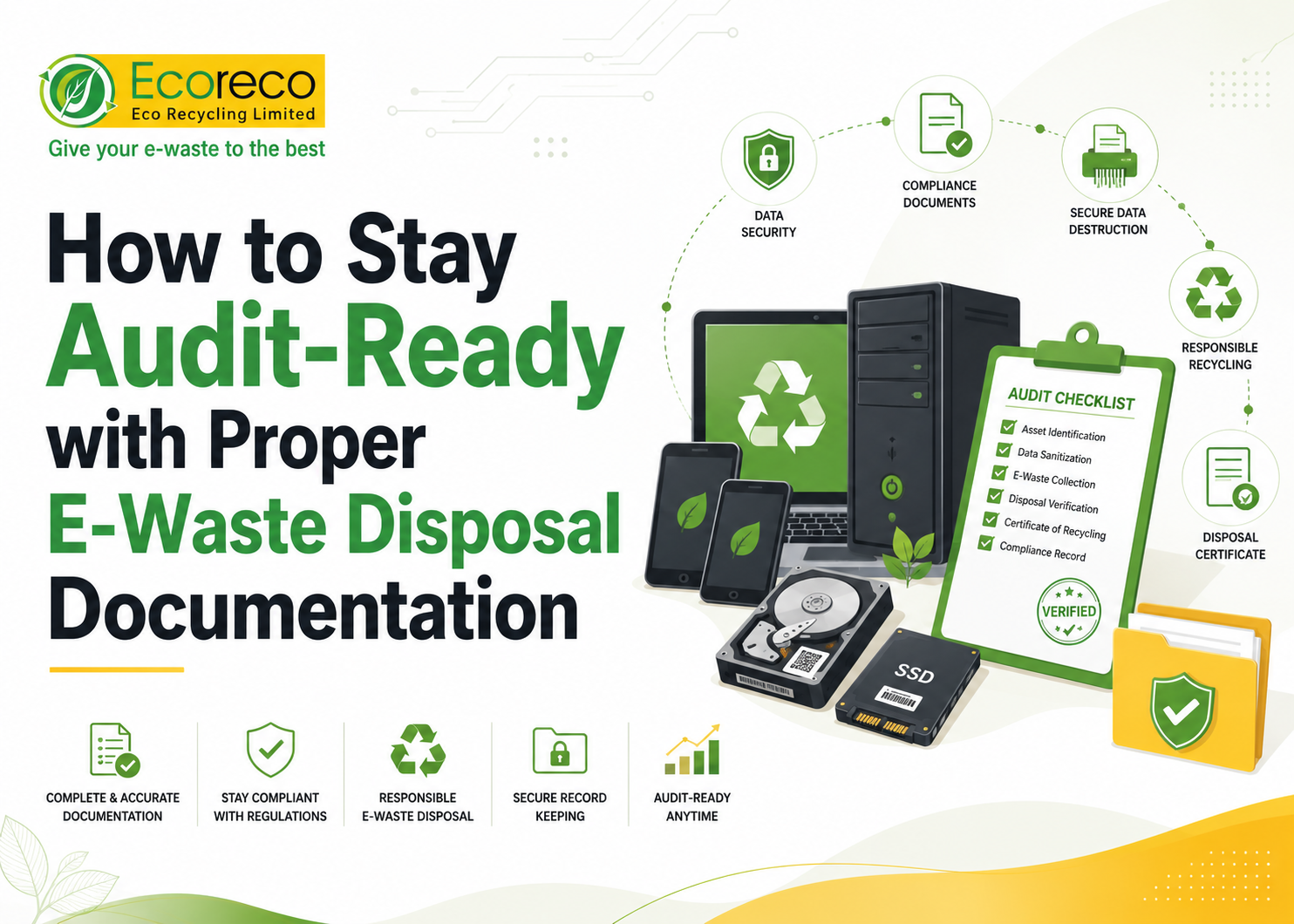
Every laptop, server, and hard drive that leaves your office carries more than just hardware value. It carries customer records, financial data, employee files, and sometimes years of proprietary business intelligence. Most companies plan carefully for how they buy and deploy IT equipment, but far fewer plan for how that equipment exits the organisation. That gap is exactly where data breaches quietly happen.
This is why data destruction services in India have moved from being a compliance afterthought to a boardroom priority. With tightening data protection expectations under India’s Digital Personal Data Protection Act and growing scrutiny from clients and auditors, businesses can no longer treat old hardware as scrap. They need proper data sanitisation before any device leaves their custody, whether it’s being resold, donated, or recycled.
Ask any IT manager how many old laptops are sitting in a storage room “waiting to be dealt with,” and you’ll rarely get a small number. That storage room is a liability. Every device in it is a potential leak point until its data has been properly destroyed.
The risk isn’t hypothetical. Investigators and researchers have repeatedly shown that drives bought second-hand from open markets often still contain recoverable files, from spreadsheets to scanned identity documents, because the previous owner assumed a factory reset or reformat was enough. It isn’t. Deleting a file removes the shortcut to it, not the data itself.
For businesses, the consequences of this oversight go beyond embarrassment. A single recovered file containing customer PII, contract terms, or internal financials can trigger regulatory penalties, client lawsuits, and reputational damage that takes years to repair.
Understanding this is the first step toward taking disposal seriously. When you delete a file or format a drive, the operating system simply marks that storage space as available for new data. The original bits often remain physically intact until something overwrites them, which could be days, weeks, or never, depending on how the drive is used afterward.
This is precisely why proper data sanitisation exists as a discipline of its own. It doesn’t rely on the OS’s cooperation. It actively overwrites, degausses, or physically destroys the storage medium so there is nothing left to recover, regardless of what forensic tools someone throws at it.
Not every device needs the same treatment. A smart disposal strategy matches the method to the asset’s future.
A capable vendor doesn’t default to one method across the board. They assess your asset inventory, your compliance obligations, and your resale or recycling goals, then recommend a mix that makes financial and security sense.
Before a single device leaves your premises, run through this:
Skipping even one of these steps is how “we thought it was handled” turns into a very uncomfortable conversation with regulators.
Even well-intentioned companies fall into predictable traps:
Some IT teams try to handle sanitisation internally using free wiping software. For a handful of devices, this can work. But at the scale most mid-size and large businesses operate, it introduces real gaps: inconsistent verification, no chain-of-custody documentation, no environmentally compliant disposal of the hardware afterward, and no independent certification if a regulator or client ever asks for proof.
Professional data destruction services in India exist precisely to close these gaps. A specialised partner brings standardised processes, audit trails, and certified reporting that an internal team, however capable, usually isn’t set up to replicate consistently.
When evaluating a provider, look past the sales pitch and ask direct questions: Which sanitisation standards do they follow? Can they show sample certificates of destruction? Do they offer on-site destruction for highly sensitive data, or only off-site? What’s their environmental recycling process for the hardware afterward?
Eco Recycling Ltd. approaches IT asset disposal as a two-part responsibility: securing the data first, and recycling the hardware responsibly second. Every device processed goes through certified data sanitisation methods matched to its type and sensitivity, backed by verifiable destruction records, before the material enters an environmentally compliant recycling stream. That combination, data security paired with genuine environmental accountability, is what separates a serious ITAD partner from a vendor that simply hauls equipment away.
Confidential data doesn’t stop being confidential just because a device is old. The businesses that avoid breaches and compliance headaches are the ones that treat IT asset disposal with the same rigour they apply to procurement and cybersecurity, not as a last-minute cleanup task.
Start by auditing what’s currently sitting unprocessed in your storage rooms. Classify the data on those devices, decide on the right sanitisation method for each, and partner with a provider who can prove, not just promise, that your data is unrecoverable and your hardware is recycled responsibly. Eco Recycling Ltd. works with businesses across India to make that entire process straightforward, documented, and audit-ready, so retiring old equipment never becomes tomorrow’s data breach.
FAQs
Deleting a file only removes its reference in the operating system’s file table; the underlying data usually remains recoverable with basic forensic tools. Data sanitisation uses verified overwriting, degaussing, or physical destruction methods that make the original data permanently unrecoverable, which is why it’s the standard for regulated data destruction services in India.
Not necessarily. Software-based wiping (using standards like NIST 800-88) is ideal for drives that will be reused or resold, since it destroys the data while keeping the hardware functional. Physical destruction is better suited for damaged drives or extremely sensitive data where zero risk of recovery is required. A good vendor will recommend the right method based on your asset condition and compliance needs, not push one method for every case.
A credible certificate of data destruction should include the asset’s serial number, the method used, the date and location of destruction, and a reference to the standard followed (such as NIST 800-88 or DoD 5220.22-M). Ask the vendor whether they can also provide a video or photographic destruction log, and whether their process has been audited or certified by a recognised body.
Reputable ITAD (IT Asset Disposition) partners don’t just destroy data; they also recycle the underlying hardware responsibly. Metals, plastics, and rare earth elements are extracted and channelled into certified recycling streams, which is why choosing a provider with strong environmental compliance, not just data security compliance, matters.
India’s Central Pollution Control Board has officially launched the Common EPR Portal, a unified digital platform that consolidates the country’s previously fragmented Extended Producer Responsibility compliance infrastructure into a single, centralized ecosystem. This is one of the most consequential regulatory developments for Producers, Importers, and Brand Owners, commonly referred to as PIBOs, in the history of India’s EPR framework.
The new portal operates on a Single Sign-On system, meaning every entity previously managing separate logins across multiple waste stream portals, including Plastic Waste, E-Waste, Battery Waste, Tyre Waste, and Used Oil, now operates from one unified dashboard at epr.cpcb.gov.in. Migration to this platform is mandatory. Access to operational functions on legacy portals is being progressively restricted for entities that have not completed the transition.
For compliance teams, business owners, and industry stakeholders working with EPR e-waste obligations or other waste streams, understanding this change and acting on it without delay is now a business-critical priority.
Before this portal was launched, India’s EPR compliance landscape was structurally fragmented. A company managing obligations across, say, E-Waste and Battery Waste was required to maintain two entirely separate portal accounts with different logins, different document records, different reporting workflows, and different credit management systems. A larger business managing plastic packaging alongside e-waste and tyres could easily be juggling three or more separate CPCB portals simultaneously.
This fragmentation created multiple problems: overlapping documentation requirements, inconsistent data records across portals, higher risk of errors during annual return filing, and significant administrative overhead for compliance teams. It also made it harder for CPCB to maintain an accurate, consolidated view of EPR compliance performance at the entity level.
The Common EPR Portal resolves these problems by bringing all waste streams under a single digital identity. Producers, importers, brand owners, and recyclers now register once to receive a master CEPR ID that grants access to every applicable waste stream portal through a single login.
Beyond consolidated access, the platform introduces the EPR Transaction Portal, or ETP, as a centralized marketplace where all EPR credit-related activities now take place. Buying, selling, and transferring EPR certificates across waste streams is unified within this one environment, making transaction tracking significantly more transparent than it was under the previous fragmented system.
The migration obligation applies to all entities already registered under any EPR waste stream framework in India. Specifically:
It is worth noting that this is not a voluntary update. CPCB is progressively restricting access to individual submission and transaction modules for entities that have not generated a master CEPR ID through the new portal. Delaying migration does not pause compliance obligations. It simply blocks the entity’s ability to meet them.
Begin by navigating to the unified CPCB EPR portal at epr.cpcb.gov.in and clicking on Sign Up or New Registration to initiate the master account creation process.
At this stage you will be required to enter:
It is important to use a corporate email address that is actively monitored and belongs to a decision-maker within the organization. CPCB communications, OTPs, and system alerts will be routed to this email. Personal email addresses or shared inboxes create risk during time-sensitive compliance filings.
Complete OTP validation for both the email and mobile number to receive your new CEPR master login credentials.
After creating the master account, complete the corporate profile section with your company’s legal details.
Critical accuracy requirements at this stage:
Before submitting, cross-check every field against your foundational corporate documents.
This is the most operationally significant step and the one where most entities encounter problems.
Within the new SSO dashboard, locate the Link Existing Portals feature. From here, select every legacy waste stream portal where your organization holds an active registration. You will be prompted to input your old portal credentials for each one.
If you no longer remember legacy portal passwords, the system provides a Forget Password function to recover access. Use this before attempting to manually enter credentials, as repeated failed login attempts can temporarily lock the legacy portal account.
Once a portal is successfully linked, its status in the dashboard changes from Link to Open, and all historical data, including prior EPR certificates, compliance records, and target history, is pulled into your unified central profile.
Registration on the SSO portal and activation on the EPR Transaction Portal are two separate steps. Many entities complete the SSO registration but overlook ETP activation, leaving their credit trading and certificate generation functions inaccessible until the oversight is identified, often at the worst possible moment in the compliance cycle.
After SSO setup is confirmed, navigate to the ETP activation section and complete the process for each applicable waste stream. This ensures continuity of your EPR credit activity without interruption.
If your organization works with authorized recyclers to fulfil its collection and recycling targets, those recyclers must also be linked within the new portal environment.
An authorized e-waste recycler that has not yet migrated to the SSO portal cannot generate valid EPR certificates within the new system. This means any collection activity routed through an unmigrated recycler will not generate the credits your organization needs to demonstrate target fulfilment. Before the annual return filing period, confirm that every recycler in your network has completed their own migration and that the linkage is active and verified in the new dashboard.
Once migration is complete across all steps, actively monitor your credit status within the new portal to confirm that all previously generated EPR certificates are correctly reflected and attributed.
Under the updated e-waste EPR framework, EPR credits generated in a financial year carry a validity of two financial years. Unused credits beyond this window will lapse. Post-migration is therefore an important moment to take stock of the credit ledger, understand what is available for current year compliance, and plan collection activity accordingly.
The Common EPR SSO Portal registration is a three-stage process that includes user verification, general information, and supporting documents. Before starting, the documents should be properly available. The documents required are:
All documents submitted should be clear, legible, and in accepted file formats. CPCB’s portal review process flags illegible scans for rejection without detailed error messages, which means the applicant only discovers the problem several working days later.
The transition, while demanding in terms of the effort required to complete it correctly, delivers genuine operational benefits once fully implemented.
The migration process has produced a consistent set of problems for entities attempting it without expert guidance.
ETP activation is being missed: Treated as a separate step from SSO registration by the system. Missing it blocks credit transactions entirely.
Several accompanying regulatory developments have taken effect alongside the portal launch that PIBOs should be aware of:
For many organizations, the combination of technical complexity, tight compliance deadlines, and the risk of data errors makes in-house migration riskier than it needs to be.
Eco Recycling Ltd has supported producers, importers, and brand owners through EPR compliance processes across multiple waste streams and is well positioned to assist with the current SSO portal transition. Whether the challenge is legacy portal linking, resolving data mismatches, coordinating recycler migration, or ensuring that ETP access is properly activated before the next filing period, Eco Recycling Ltd provides the hands-on compliance support that gets organizations through the process without disruption to their credit transactions or return filing timelines.
For organizations managing EPR e-waste obligations specifically, Eco Recycling Ltd also provides the authorized recycling services that underpin target fulfilment, ensuring that the credits your portal account needs to reflect are being generated through a compliant, documented recycling chain.
Organizations that attempt migration independently and encounter system errors often spend weeks resolving them through CPCB’s ticket-based support process, during which time compliance activities may be partially or fully blocked. Eco Recycling Ltd helps avoid that scenario entirely.
Reach out to Eco Recycling Ltd early in the migration process rather than after a problem has already developed.
The launch of the CPCB Common EPR SSO Portal represents the most significant structural change to India’s EPR compliance infrastructure in recent years. For PIBOs and recyclers, the transition is not optional, and the consequences of delay are concrete: blocked portal access, stalled credit transactions, and disrupted annual filings.
The key actions every regulated entity should take immediately are:
The migration process is manageable with the right preparation and expert support. The risk lies in approaching it without that preparation and discovering a problem at a point when compliance deadlines leave no time to fix it.
The Common EPR Portal is a unified digital platform launched by CPCB that consolidates all EPR waste stream portals, including E-Waste, Plastic Waste, Battery Waste, Tyre Waste, and Used Oil, under a Single Sign-On system. Entities register once to access all applicable waste streams through one master login at epr.cpcb.gov.in.
Yes. Migration to the SSO portal is mandatory for all Producers, Importers, and Brand Owners holding existing EPR registrations under any waste stream, and for registered recyclers and authorized refurbishers. CPCB is progressively restricting access to legacy portal functions for entities that have not completed the migration.
Failure to migrate results in progressive loss of access to portal submission and transaction modules. This means an entity will be unable to file compliance returns, generate EPR certificates, buy or sell EPR credits, or demonstrate target fulfilment, effectively placing the entire compliance operation in suspension.
Yes. Successfully linking legacy portals through the SSO dashboard imports historical data, including prior EPR certificates and credit records, into the unified system. After migration, it is important to verify that all historical credits are correctly reflected in the new portal and have not lapsed.
For a single waste stream with clean, matching documentation, the technical process can be completed in a day or two. For entities managing multiple waste streams, coordinating recycler migration, or dealing with data mismatches between old and new systems, the process can take significantly longer. Starting early is strongly recommended.
Core requirements include PAN, GSTIN, CIN, Import Export Code for importers, legacy portal credentials, and State Pollution Control Board clearances (CTE and CTO) for recyclers. All documents must be current, legible, and consistent with each other.
The EPR Transaction Portal is the centralized marketplace within the new system where all EPR credit-related activities, including buying, selling, and transferring EPR certificates, take place. It requires a separate activation step after SSO registration is complete. Missing this step leaves credit transactions blocked even for entities that have otherwise completed migration.
Recyclers who have not completed SSO migration cannot be linked within the new portal and cannot generate valid EPR certificates within the system. PIBOs should proactively contact authorized recyclers in their network, including those working with Eco Recycling Ltd, to confirm migration status and complete linking before the next compliance filing period.
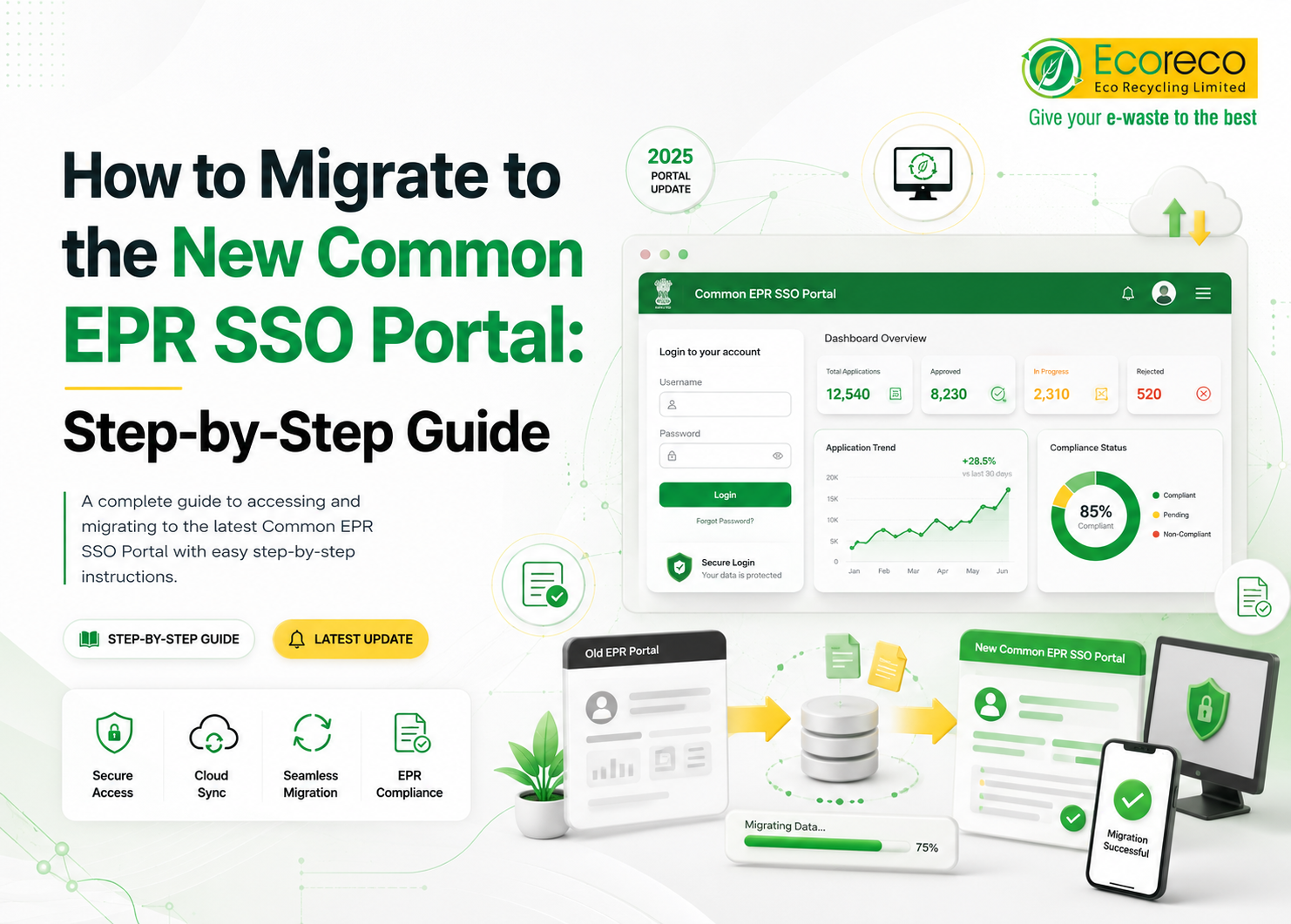
The issue of e-waste in India is critical. The government’s response has also been significant. India is among the largest E-waste generators in the world, as the country’s E-waste volume has grown by 73% in the last five years. The E-Waste (Management) Rules, 2022, which came into effect on April 1st in, 2023, put into place an even more stringent and comprehensive system of Extended Producer Responsibility (EPR) E-waste obligations, which now covers more businesses than the majority of companies are aware of.
Many Indian companies are making mistakes in compliance that could lead to fines and registration cancellations. In more serious instances, the disruption of their operation. Most of the time, these errors aren’t intentionally made. These mistakes usually happen because people get confused about three things: which rules apply to their situation, how electronic waste recycling targets are calculated, and what counts as proper documentation. This article covers some of the most common mistakes and how to avoid them.
It is by far the most common mistake, and is catching business owners off guard at all scales. EPR Compliance applies to all companies that manufacture electronic and electrical devices that are listed in Schedule I, and companies that design and manufacture or build electronics with their own brand name within India, or importers and brand owners of these products.
Defining “framework” is more expensive than most companies think. The importer of laptop bags equipped with USB ports, the importer of LED lighting, or a company that makes smart home gadgets within India could all fall within the CPCB framework. There are at present 106 classifications in Electrical and Electronic Equipment under the CPCB. Companies often get confused about how products are classified, and this confusion can lead to big differences in how they need to be recycled.
The very first thing a business should undertake is an objective review of its product range in relation to Schedule I. A lot of firms discover there are compliance obligations that they did not know about.
Every manufacturer, producer and recyclers, refurbishers and manufacturers have to sign-up via the web portal created by CPCB. The entity cannot conduct any activity without registration. You should not interact with an unregistered entity.
People often fail to consider this dual responsibility. An entity may register properly, but not be aware of transacting with an unregistered recycler or refurbisher. This is an infraction. The business must not offer or sell electronic waste to unregistered junk dealers, kabadiwalas, or any other unregistered company.
The unorganized recycling market in India is vast, easy to access, and often more affordable in the short run. Around 85% of electronic waste produced in India is processed in an unorganized industry. The decision to choose to use registered channels instead of convenience is among the biggest compliance lapses and one that the CPCB website’s blockchain-linked verification system is able to identify.
Even duly registered compliant companies often underestimate their recycling obligations. This can cause insufficient funding to be set aside for recycling, which may eventually lead to environmental compensation fees (penalties).
For FY 2023-24 and 2024-25, the recycling goal was 60%. For FY 2025-26 and 2026-27, the recycling goal will be 70% of the amount of waste generated. The target is then increased to 80% in FY 2027-28 and onwards. These goals are not based on sales for the year they are in. They are calculated based on the typical life of the item and the amount of sales in previous financial years. Therefore, the amount of electronic waste recycling a company is accountable for currently is correlated to the amount they sold in the past.
Incorrect calculation in this figure and failing to report the correct numbers in the CPCB portal can cause a risk of liability.
The EPR certification system established under the 2022 rules is a real market mechanism that is not merely an administrative document. Recycling companies registered with CPCB issue EPR certificates for each kg of e-waste they handle. Bulk consumers and producers can take back e-waste generated at their own premises and give it to licensed recyclers and earn EPR certificates from registered recyclers for meeting their mandatory targets.
A common mistake that businesses make is to treat the acquisition of certificates as a one-time event, rather than a continuous procedure. If a company realizes its certificates don’t cover its annual requirements only after the financial year has ended, it’s already too late to fix things; the deadline for environmental compensation has already started ticking.
The trustworthiness of an accredited Electronic waste recycling organization that has quarterly or monthly certificates is far better than an annual scramble.
Producers have to submit regular, quarterly, and annual returns via the CPCB portal. The returns must detail the amount of waste they generate, their production, and EPR certificates that they’ve bought from a registered recycler. It is an essential and frequently overlooked requirement.
File errors on return forms can be a frequent secondary violation of compliance, and this is even more prevalent among companies that manage their EPR compliance obligations properly. Incorrect production numbers and using incorrect product category codes, or not having a quarterly filing window, create divergences within the CPCB portal, which could trigger sanctions and audits without the knowledge of the compliance situation at hand.
A first default carries penalties of up to the amount of Rs 20,000 for producers. Recycling companies are charged Rs 15,000. Subsequent defaults result in higher penalties, which could be as high as an amount equivalent to Rs 80,000 for producers, as well as recycling companies at Rs 60,000. If the non-compliance continues with the CPCB, the CPCB might take further action, including the cancellation of registration and the shutdown of operations.
The process of filing requires the cross-referencing of GST information with sales records, sales data, and EPR certificates. Firms that do this with no dedicated compliance program or skilled support are more likely to commit mistakes that are avoidable.
Every entity, whether public or private, educational or non-educational, that has employed at least 1000 units of electronic or electrical equipment during the financial year is a bulk consumer. They are legally obliged to transfer electronic waste to only registered recyclers.
Large businesses, highly technical companies, educational institutions, and government departments often qualify as ‘IT-intensive’ organizations without even realizing it. Compliance requirements for bulk users are simpler than those for producers. The use of informal means for disposing of old IT equipment constitutes a clear breach that comes with its own consequences.
EPR E-waste compliance in India is not a concern for the future. The regulatory framework remains in force; CPCB is now operational. CPCB EPR portal is being connected more closely with customs and GST systems, and enforcement is getting stricter every year. Businesses that are subject to the highest penalties aren’t necessarily the ones with the best plans, but the ones that are delayed in fulfilling their responsibilities.
Eco Recycling Ltd collaborates with producers, importers, brand owners,s and companies across India to make sure that they meet their Electronic waste recycling obligations in a timely and accurate manner. From CPCB registration right through EPR certification management and return filing. Being in compliance in the first attempt is cheaper than resolving the issue through penalty procedures.
Many businesses assume that simply obtaining an EPR authorization is enough to remain compliant. In reality, common mistakes include incorrect documentation, inaccurate e-waste reporting, partnering with unauthorized recyclers, missing regulatory deadlines, and failing to maintain proper records. These errors can lead to penalties, legal complications, and reputational damage.
Non-compliance with EPR (Extended Producer Responsibility) regulations can result in financial penalties, regulatory action, cancellation of registrations, and disruptions to business operations. It may also affect your company’s credibility with customers, partners, and government authorities. Staying compliant helps reduce these risks while supporting responsible environmental practices.
Businesses should regularly review their compliance obligations, maintain accurate records, submit timely reports, and work only with authorized recyclers and compliance partners. Conducting periodic compliance audits and staying updated with regulatory changes are also essential steps. Partnering with experienced organizations like Eco Recycling Pvt Ltd can simplify the compliance process and help businesses meet their EPR responsibilities efficiently.
No. EPR compliance applies to businesses that manufacture, import, sell, or distribute electrical and electronic equipment, regardless of their size. Whether you are a startup, SME, or large enterprise, you must comply with the applicable EPR regulations if your products fall under the notified categories.
Eco Recycling Pvt Ltd provides end-to-end support for EPR e-waste compliance, including collection, channelization, authorized recycling, documentation, reporting assistance, and regulatory guidance. By working with an experienced compliance partner, businesses can reduce compliance risks, meet legal requirements, and contribute to a more sustainable circular economy.
Every organisation that uses technology eventually faces the same problem: what do you do with IT equipment that’s no longer in use? Servers, laptops, desktops, mobile devices, networking hardware: these assets cycle out constantly, and the question of how to handle them isn’t just logistical. It’s a data security question, a regulatory compliance question, and increasingly, an environmental responsibility question.
This is exactly what IT Asset Disposition, ITAD, addresses. ITAD services cover the entire end-of-life process for IT equipment: secure data destruction, asset tracking, refurbishment and resale where value remains, and certified recycling for what can’t be reused. Done properly, ITAD isn’t just a disposal exercise. It’s a risk management function that most IT leaders underestimate until something goes wrong.
There’s a common assumption in organisations that once an asset is removed from active use, wiped, stored, or handed to a vendor, the associated risk disappears. It doesn’t.
A decommissioned server sitting in a storeroom still contains data. A laptop sent to a third-party recycler without certified data destruction still contains data. Hard drives that were “formatted” using standard operating system tools still contain recoverable data. The gap between an asset being taken offline and being genuinely secure is where data breaches occur, and they happen far more often than most organisations realise or publicly disclose.
According to multiple cybersecurity research reports, a significant proportion of second-hand enterprise hard drives sold on open markets, through auction, resale channels, or informal recycling, still contain readable corporate data. This includes financial records, employee information, customer data, and in some cases, access credentials. The source of this data almost always traces back to a gap in the IT asset disposition process.
Understanding what professional IT Asset Disposition involves helps clarify why informal or in-house approaches often fall short.
Asset inventory and tracking are the starting point. Every device going through the disposition process should be catalogued with make, model, and serial number.. This creates a chain of custody that can be audited later, which matters enormously for regulatory compliance.
Data destruction is the highest-stakes step. There are three primary methods: overwriting (writing new data patterns over existing data multiple times, effective for functioning drives), degaussing (using a powerful magnetic field to render data unreadable, used for hard drives and magnetic media), and physical destruction (shredding or crushing the drive, used when other methods aren’t sufficient or when drives are non-functional). A credible ITAD provider will issue a certificate of data destruction for each asset, specifying the method used and confirming compliance with relevant standards such as NIST 800-88 or DoD 5220.22-M.
Asset recovery and remarketing follow data destruction. Many decommissioned IT assets retain significant resale value, particularly recent-generation laptops, workstations, and networking equipment. A good ITAD service will assess each asset for refurbishment potential, extending its useful life and returning value to the organisation rather than treating everything as waste.
Certified recycling handles what genuinely can’t be reused. Electronic waste contains hazardous materials, such as lead, mercury, cadmium, and beryllium, alongside valuable recoverable metals like gold, copper, and palladium. Certified e-waste recycling ensures these materials are processed through environmentally compliant channels rather than ending up in informal recycling streams where neither environmental nor data security standards apply.
Regulatory frameworks around data protection and e-waste management are tightening globally, and India is no exception. Organisations handling personal data under frameworks like India’s Digital Personal Data Protection Act have clear obligations around data security, obligations that don’t end when a device is decommissioned. They extend to how that device is disposed of.
For sectors with additional regulatory exposure, such as banking, healthcare, legal, and government, the requirements are more specific still. An audit that reveals gaps in IT asset disposition practices can result in penalties, reputational damage, and, in serious cases, liability for data breaches traced back to improperly handled equipment.
The practical implication is that ITAD is no longer a back-office facilities decision. It belongs in conversations about information security policy, vendor due diligence, and compliance frameworks. Choosing an ITAD provider should involve the same scrutiny as choosing any security-sensitive vendor: reviewing certifications, understanding their data destruction methodology, and confirming their environmental compliance credentials.
One angle that often gets overlooked in ITAD conversations is asset recovery value. Organisations that treat decommissioning as a cost, paying for disposal rather than extracting value, are leaving money on the table.
A three-year-old laptop fleet being replaced with newer hardware still has meaningful resale value if handled correctly. Enterprise networking equipment, rack servers, and storage arrays from major manufacturers command secondary markets, particularly in growth markets where organisations are building infrastructure with cost constraints. A structured remarketing process, run by an ITAD provider with established resale channels, can offset a significant portion of the new equipment procurement cost.
This changes the financial framing of ITAD from “disposal expense” to “asset lifecycle management with a recovery component.” For IT and finance leaders making the case for proper ITAD investment, this is often the most persuasive angle internally.
Not all ITAD services are equal. These questions separate credible providers from those who will create rather than reduce risk:
The organisations that treat IT Asset Disposition as a compliance and security function, rather than a logistics one, consistently manage their IT lifecycle with less risk, better cost recovery, and cleaner environmental records than those that improvise.
The right time to think about ITAD is before a device reaches end of life, not after. Building a disposition policy, identifying a certified provider, and integrating asset tracking from procurement to disposal create a closed loop that eliminates the gaps where data exposure and regulatory non-compliance occur.
At Eco Recycling Ltd, our ITAD services are built around certified data destruction, transparent chain-of-custody documentation, and responsible e-waste processing that meets regulatory standards across sectors. If your organisation is managing an IT refresh cycle or simply hasn’t formalised its asset disposition process yet, that’s the right conversation to start before the risk gap becomes a real problem.
Secure disposition isn’t complicated. It just needs to be deliberate.
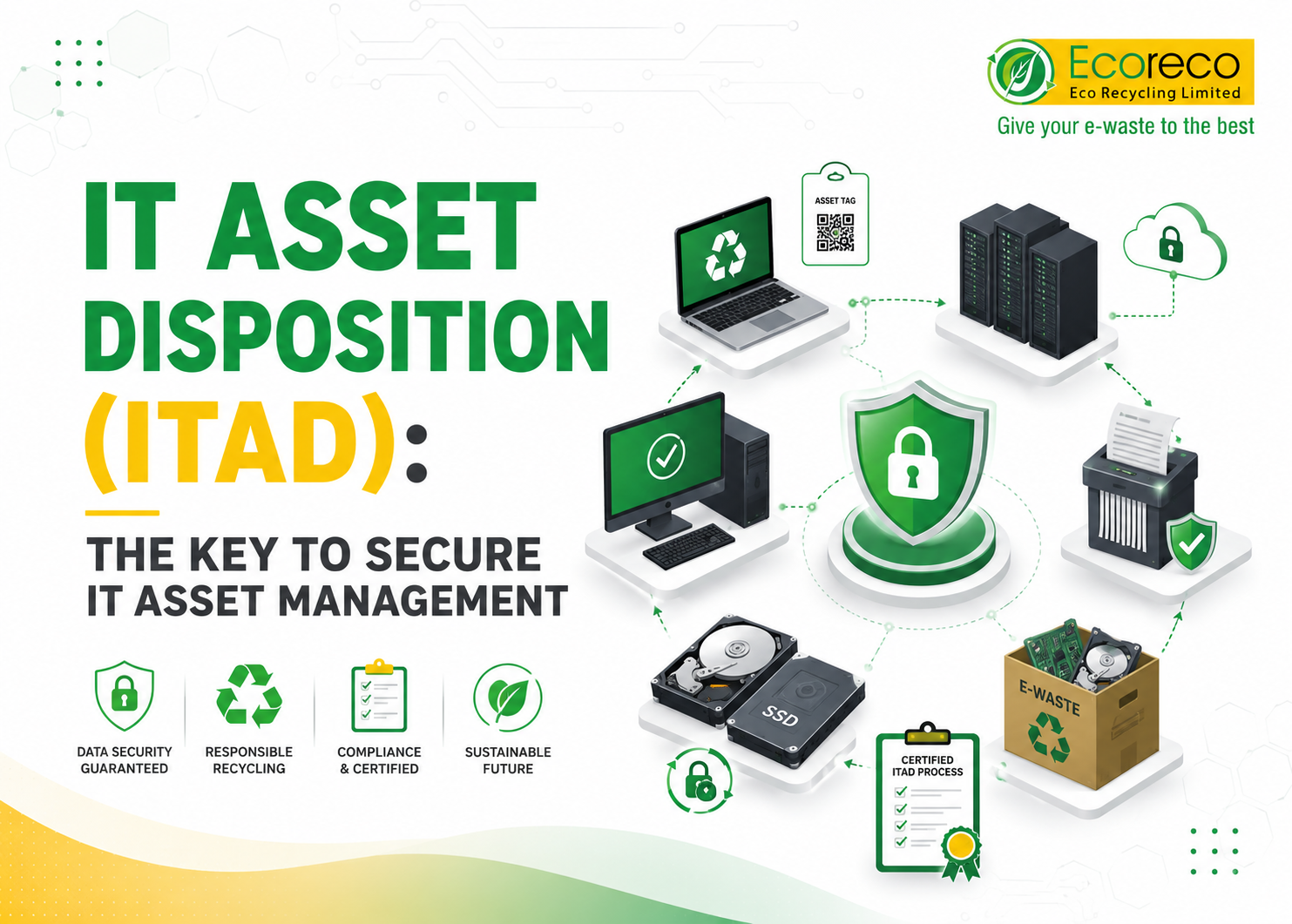
The Mumbai-based company shut down a server room – three departments were required to participate: IT for wiping data as well as procurement to recover the value of hardware, and finally conformity for environmental signature-off. The same procedure is now carried out in a single location, with one vendor that has a single audit trail. This change is in line with the way IT Asset Disposition (ITAD) services are now spread throughout corporate India specifically in Maharashtra’s manufacturing and technology sector.
For a long period, ITAD was treated as an easy task to dispose of equipment that was no longer in use at the lowest expense. Security of data was usually an afterthought sustainability reports were not a regular element of the discussion.
This approach is no longer valid. The Indian E-Waste Management Rules, 2022 are a tightening of the obligations of Extended Producer Responsibility and increased accountability for companies that purchase IT equipment. Additionally SEBI’s Business Resilience and Sustainability Report (BRSR) framework will be instituting the use of certified disposal methods across the technological, BFSI, and manufacturing industries, requiring that the 1,000 top-ranked firms report their ESG performances in full and transparent detail. If you are a business that is located in Pune, Nashik, and Mumbai it is no longer an issue of good intentions. The law imposes compliance requirements with negative consequences for reputation and finances.
This shift in regulations has caused companies to consider an issue they’ve previously resisted: are we able to prove the fate of our old hardware?
Certifiable Data destruction services in India have seen a significant change over the last few times. A traditional method of formatting drives or using basic software to erase data does not work anymore for environments that handle personal identifiable financial information, financial records, health information or other.
Modern standards for data destruction such as NIST 800-88 or the latest IEEE 2883-2022 addresses the particular challenges presented by SSDs as well as NVMe drives. They are an important step in safeguarding data from storage devices that are modern. The certified ITAD companies now provide serialized recording, video-documented destruction as well as chain-of-custody certifications that can withstand the internal audits as well as the scrutiny of regulators.
Companies that do not take the initiative to secure sensitive data are at risk of severe sanctions, including legal actions in the form of lost revenue and damage to their reputation. For companies across Maharashtra and in particular, those working that are involved in BFSI, Pharma as well as IT that are certified Data destruction services in India have become available.
Eco Recycling Limited has designed the data handling process to comply with these standards. It is a guarantee that all devices processed have verified, documented proof of the destruction or sanitation.
One of the most often overlooked aspects to ITAD services is the return of the value of decommissioned assets. Servers, laptops, and other networking devices that are between two and four years old typically have significant value on the secondary market in India’s Tier-2 and Tier-3 cities.
An organized resales program in an ITAD workflow can help organizations reduce disposal costs, recoup working capital and cut down on E-waste while at the same. The providers evaluate each equipment, then refurbish it as needed and resell usable hardware to approved secondary markets. The items that are not resold can be recycled through responsible material recycling to keep components out of the sector of recycling that’s not formal.
The idea of a circular economic system, which means that resources remain in usage for as long as it is popular within ITAD by a renewed emphasis on extending the life span of the most valuable parts. For companies across Maharashtra it is a direct confirmation of the sustainability statements they currently require to prove.
The most advanced ITAD software is now developed using ESG reporting specifications built-in right from the beginning, making sure organizations can measure and report the benefits of their disposal strategies. An organized ITAD workflow produces emissions reduction metrics for waste and carbon offset calculations that are tied to the reuse of equipment as well as certified recycling numbers as an inevitable by-product of their operations.
For companies filing BRSR reports as per SEBI regulations, this already-constructed information trail can ease the requirements for compliance on the internal team and gives verifiable third-party audited proof that investors and regulators are now accustomed to.
Eco Recycling Limited has its outputs for reporting to be in line to BRSR disclosure categories. It assists customers in Maharashtra to translate ITAD operations directly to ESG documents, without the need of needing to do any additional reconciliation.
Controlling the destruction of data, resale and ESG compliance by utilizing different companies results in the need for gaps. The documentation is shared between different teams. The liability is unclear, and the sustainability story is hard to develop in a coherent way.
The clients are now seeking full access to all aspects of the ITAD cycle, right from pick-up through processing and destruction. One ITAD services service provider that handles the three aspects creates an unified audit trail that ensures every step can be traced. In the case of procurement managers as well as IT directors and sustainability executives who are accountable to the same committee in different aspects of the same procedure, the coherence is of real functional value.
Eco Recycling Limited collaborates with organizations in Pune, Mumbai, and Nashik in the development of ITAD programs to address asset value recovery and ESG compliance in a way that is interconnected instead of distinct workstreams.
The issue is not how to choose whether or not to use the certified ITAD services. For listed businesses, BFSI institutions, and tech companies within Maharashtra The regulatory and reputational issue is resolved.
The main issue is whether to handle it as a series of segments or build it into an approach that can produce tangible results across the three dimensions. Organizations that use ITAD as a compliance-checkbox are likely to find it more difficult to adhere to the current reporting standards being enforced. Businesses that view ITAD as a fully operational program will find that compliance is significantly simpler to handle.
If you’re a company that is preparing the time to refresh your hardware or working on an ongoing IT decommissioning work in Maharashtra working with an organization like ours that provides Data destruction services in India along with resales as well as ESG documenting is the fastest route to a true sustainability responsibility.
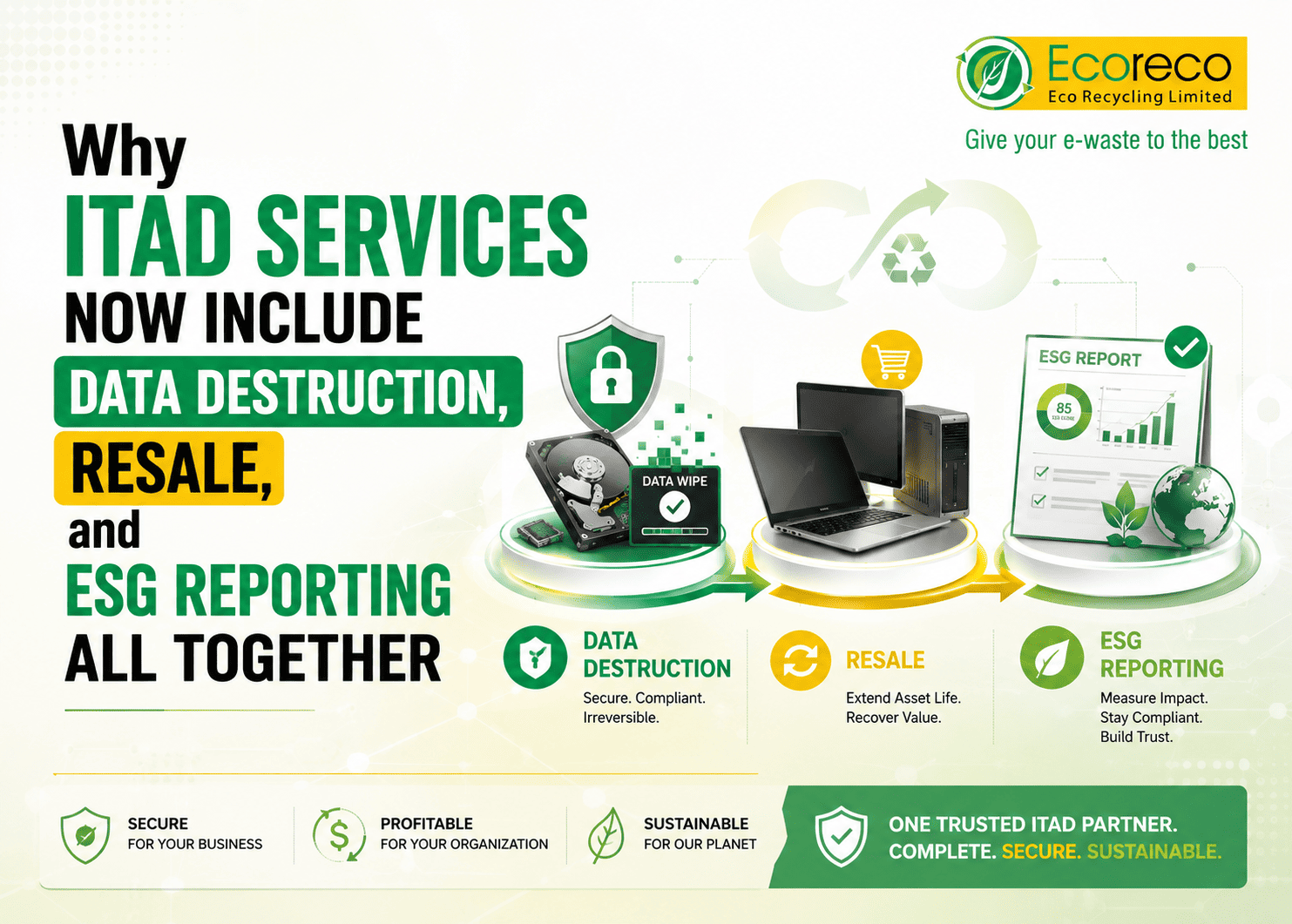
India generates more than 1.6 million tons of electronic garbage every year, which is increasing each year, as companies improve their infrastructure, eliminate old gadgets, and deal with the end of their IT assets on a massive scale. In the majority of organizations, the issue is not about recycling responsibly. Regulation structures, ESG mandates, and increasing environmental responsibility have made Electronic waste recycling required for business rather than a decision.
The more difficult question is what recycling service to trust. Many companies are operating in this area, such as E-Parisaraa, Attero, Karo Sambhav, Namo Electronic Waste, Recycle Karo, and Spas Recycling. Each of them brings something unique to the mix. When businesses evaluate their services on their level of service, recycling infrastructure, data security, and certifications for compliance, the distinctions are clear. That’s why Eco Recycling Limited. is consistently different.
To make any comparison logical, you must understand that the responsible management of electronic waste really requires a certified recycling company.
The approval under India’s E-Waste Management Rules is the essential prerequisite. Beyond that, organizations require experts who can manage a range of sources of waste, which include electronic consumer products, IT hardware, and battery recycling. Security Data destruction services are not a requirement for companies that are preparing to retire laptops, servers, or other storage equipment. Transparency in the reporting process, environmental compliance documentation, and the capacity to handle corporate waste collection on a mass scale are all equally crucial.
Recycling companies that handle large volumes with no accountability are riskier than they appear.
E-Parisaraa, located in Bangalore, is among the oldest authorised processors of electronic waste in India. It has dealt with large quantities of electronic waste and has also developed relationships with various government authorities. However, its coverage and capacity for larger corporations are limited in comparison to companies with an infrastructure that spans across India.
Attero manages one of the largest recycling plants and has been making efforts to recycle lithium batteries, which is a rising need due to the increase in EV use. Its involvement in the subject of battery waste is recognized within the sector. But its main design is heavily focused on consumer recycling, which could limit the range of waste management options it can offer organizations with complicated requirements for the disposal of IT.
Karo Sambhav serves primarily as a Producer Responsibility Organisation, helping manufacturers meet their extensive obligation to be responsible for their products. It has a significant regulatory facilitation function, but it is not an immediate recycler for enterprises’ IT Asset Disposal.
Namo E-waste and Recycle karo are regional market providers and smaller-scale customers. If you are a business that manages multiple locations of E-waste throughout India, the operational capacity and the certified infrastructure of the companies might not be sufficient to meet the requirements of an enterprise.
Electronic waste recycling manages various types of electronic scrap. Still, it is not as prominently displayed in terms of standards for compliance that are publicly documented, data destruction certifications, or massive corporate partnership agreements.
Eco Recycling Limited. has been in operation within the Indian Electronic waste recycling sector since 2005, giving it an advantage that the new entrants can’t duplicate. The longevity of the company translates to an understanding of what companies require from an authorized recycling company for electronic waste, how regulations for compliance have developed, and the best way to manage the sensitive disposal of corporate waste responsibly.
The company’s processing capabilities encompass an array of electronic devices such as smartphones, computers, medical devices, telecom equipment, and batteries. This broadness is important for companies that require a single recycling provider to manage many waste streams, rather than managing multiple suppliers.
In IT departments that are relocating servers, desktops, and storage drives, safe Data destruction services are the most crucial element of the procedure. Eco Recycling Limited. provides certified physical and data destruction with proof of the destruction, allowing compliance and legal departments an audit trail to follow. This kind of safe e-waste disposal isn’t available in all other companies.
Since lithium-ion batteries are increasingly used in the industrial and corporate world, Battery waste recycling is now an essential need. Eco Recycling Limited. manages this area using processes specifically designed to deal with the hazardous materials in batteries responsibly while minimizing environmental impact for companies that produce the waste.
Corporate sustainability teams, as well as ESG auditors, are increasingly required to provide documented evidence that demonstrates accountable IT Asset Disposal. Eco Recycling Limited. It is the company that provides the report framework and certificate required by organizations to show sustainable recycling practices in their sustainability reports for the year.
Beyond compliance, ethical electronic recycling can contribute to a circular economy through the recovery of important materials such as the precious metals of copper, gold, and other precious metals. Eco Recycling Limited. Refinement and recycling processes make sure that the materials are repurposed for productive use instead of settling in waste dumps. If a company can view the environment as a fundamental working principle instead of merely a report-making exercise, it is crucial.
The recycling of electronic waste in India is maturing significantly, and organizations have more choices than they did 10 years ago. This is good news. The mere fact that there is a lot of visibility is not enough to determine a reliable recycler. The authorization, the certified destruction of data and battery waste disposal capabilities with transparent documents, as well as the ability to manage the e-waste of a company at a large scale, are some of the elements that distinguish trusted operators from others.
Eco Recycling Limited. has earned its standing over 20 years of delivering these standards precisely. If you are a business owner who is serious about secure, as well as compliant and environmentally sustainable electronic waste management, this is the name to be taking a look at initially.
Every discarded laptop, broken smartphone, or outdated server holds more weight than most people realise. Not just in terms of the toxic chemicals packed inside, but in terms of what happens to those materials once they leave your hands. The decision of how and where to dispose of electronic waste is no longer a minor administrative task. It is an environmental, legal, and ethical responsibility that organisations and households across India can no longer afford to overlook.
India currently ranks as the third-largest generator of electronic waste in the world. E-waste generation in India surged by over 72 percent in just five years, rising from 1.01 million metric tonnes in 2019-20 to 1.751 million metric tonnes in 2023-24. Those numbers are not just statistics. They represent millions of discarded devices that carry hazardous materials including lead, mercury, and cadmium, all of which pose serious risks to human health and ecosystems when handled carelessly.
Despite the government aiming to achieve 70 percent e-waste collection by FY 2024, less than one-third of all electronic waste generated in the country was being formally recycled as recently as 2022. The gap between what is generated and what is responsibly processed is enormous, and it points directly to the need for certified, accountable electronic waste disposal solutions.
Not all recycling is the same. Only about 10 percent of India’s total e-waste is processed through formal channels with the proper safeguards in place. The remaining bulk flows through unorganised handlers who use rudimentary techniques that release toxic pollutants into the air, water, and soil. Choosing an authorised electronic waste recycling company is the single most critical decision in the entire disposal process.
A certified electronic waste recycling company operates under India’s E-Waste (Management) Rules, 2022, which mandate proper dismantling, material recovery, and data destruction. Under Extended Producer Responsibility guidelines, producers are required to purchase EPR certificates from registered recyclers, making it essential for organisations to work only with verified and compliant recycling partners. For businesses, this also means legal accountability is tied directly to who handles their e-waste.
Responsible electronic waste disposal is a structured, multi-stage process. It begins with secure collection and transportation, moves into safe dismantling of circuit boards and components, and extends to the recovery of valuable materials such as gold, silver, copper, and palladium. At every stage, hazardous materials must be neutralised rather than released into the environment.
Beyond the material side, data security is a major concern that often goes unaddressed. Corporate laptops, servers, and mobile devices contain sensitive organisational data. A reliable electronic waste recycling company provides certified data destruction as part of its process, ensuring that no recoverable information survives the disposal chain. This is a service that IT asset disposal professionals and corporate compliance officers must demand, not simply hope for.
India’s e-waste recycling market was valued at USD 1.60 billion in 2024 and is projected to reach USD 2.80 billion by 2033, driven by rising awareness, stricter government regulations, and increasing investment in formal recycling infrastructure. This growth signals a market maturing toward accountability, making it even more important for waste generators to align with legitimate, future-ready recycling partners today.
When electronic waste ends up in the wrong hands, the consequences extend far beyond a compliance fine. Improper recycling produces toxic byproducts that enter local drainage and water supplies, while burning low-value plastics from e-waste releases fine particles into the air that can travel hundreds to thousands of miles. Communities near unregulated e-waste sites in India have recorded dangerously elevated levels of heavy metal contamination in both groundwater and soil.
For organisations, the reputational risk of being linked to irresponsible e-waste management is equally serious. Corporate sustainability commitments, ESG reporting requirements, and stakeholder expectations all demand transparent, verifiable waste disposal practices. The right electronic waste disposal partner does not just protect the environment. It protects your brand.
When evaluating an electronic waste recycling company, there are several non-negotiable factors to consider. Look for authorisation from the Central Pollution Control Board (CPCB) or the relevant State Pollution Control Board. Verify their EPR compliance credentials. Ensure they provide end-to-end documentation including collection receipts, dismantling certificates, and data destruction reports. Ask about their material recovery and refurbishment processes, and confirm that they do not pass waste downstream to unregulated handlers.
Transparency in the recycling chain is what separates responsible organisations from those simply looking for the cheapest route to disposal.
I have personally seen the difference that choosing a trusted recycling partner makes, both for compliance and peace of mind. Whether managing IT upgrades, office clearances, or end-of-life consumer electronics, the decision starts with who handles the disposal. Eco Reco offers certified, end-to-end electronic waste disposal and recycling services built around compliance, data security, and environmental responsibility.
If responsible disposal of electronic waste matters to your organisation or household, the time to act is now. Reach out to Eco Reco today and take the first step toward e-waste management that is safe, certified, and genuinely sustainable.
A: Electronic waste disposal is the safe discarding or recycling of old electronics. Without proper disposal, toxic materials like lead and mercury can harm the environment and human health.
A: Trashing electronics sends hazardous materials to landfills. A certified electronic waste recycling company like Eco Reco ensures devices are processed safely, recovering valuable materials while protecting the environment.
A: Look for proper certifications, transparent recycling practices, and secure data destruction. Eco Reco checks all these boxes, ensuring your e-waste is handled responsibly.
A: Eco Reco offers drop-off points, scheduled pickups, and bulk collection for businesses and individuals, making electronic waste disposal simple, convenient, and fully compliant.
A: Yes. Eco Reco provides certified data destruction, permanently wiping or physically destroying all data before recycling, and issues a certificate of destruction for your records.
A: Eco Reco accepts smartphones, computers, monitors, printers, tablets, TVs, batteries, and more, ensuring all electronic waste is recycled responsibly, no matter the size or condition.
India’s digital economy is expanding rapidly. Smartphones, laptops, servers, televisions, batteries, and smart devices are replaced faster than ever before. While technology improves productivity and convenience, it also creates one of the fastest-growing environmental challenges in the country: electronic waste, commonly known as e-waste.
Organizations and households often store outdated electronics for years or dispose of them through informal channels without understanding the long-term environmental and data-security consequences. Responsible e-waste recycling is no longer optional; it is now a critical part of sustainable business operations and environmental stewardship.
Companies like Ecoreco have helped establish structured e-waste management systems in India through certified recycling, reverse logistics, data destruction, and asset recovery services.
E-waste refers to discarded electrical and electronic equipment, including:
Many of these devices contain hazardous materials such as lead, mercury, and cadmium. If handled improperly, they can contaminate soil, water, and air.
India is among the world’s largest generators of electronic waste. According to industry and research sources, e-waste generation is increasing every year due to rapid digitization, shorter device lifecycles, and rising consumer demand.
A major concern is that a significant portion of e-waste still flows through the unorganized recycling sector, where unsafe dismantling methods expose workers and the environment to toxic substances.
Improper recycling practices can lead to:
This is why certified recycling partners have become strategically important for businesses and institutions.
Certified recyclers follow scientific recycling and dismantling processes that reduce environmental impact while maximizing material recovery.
Proper recycling helps recover:
This reduces dependence on raw material extraction and supports a circular economy.
Old hard drives, servers, laptops, and storage devices may still contain confidential business or personal information.
Professional recyclers such as Ecoreco provide secure data destruction and sanitization services, including onsite shredding and certified disposal processes.
For enterprises, this is essential for regulatory compliance and cybersecurity risk reduction.
India’s E-Waste Management Rules and Extended Producer Responsibility (EPR) regulations require responsible disposal and traceability of electronic waste.
Authorized recyclers help organizations maintain documentation, compliance records, and environmentally responsible disposal practices.
Not all discarded electronics are fully obsolete. Many devices can be refurbished, repaired, or remarketed through Information Technology Asset Disposal (ITAD) programs.
This enables organizations to:
Ecoreco is recognized as one of India’s early organized e-waste management companies, offering integrated recycling and sustainability services.
Its services include:
The company also operates certified recycling facilities and nationwide collection networks designed to support businesses, institutions, OEMs, and households.
The future of e-waste recycling is shifting toward technology-enabled sustainability. AI-driven classification systems, blockchain-based traceability, smart collection systems, and digital compliance tracking are becoming increasingly relevant in modern recycling ecosystems.
Businesses that adopt sustainable disposal practices today will be better positioned for:
Electronic waste is not just a disposal problem; it is an environmental, operational, and compliance challenge. Responsible recycling protects natural resources, prevents hazardous pollution, secures sensitive data, and supports long-term sustainability goals.
Organizations and individuals must transition away from informal disposal practices and work with certified recycling partners that prioritize transparency, compliance, and environmental responsibility.
As India’s digital infrastructure continues to grow, structured e-waste management will play a defining role in building a cleaner and more sustainable future.
E-waste refers to discarded electronic and electrical devices such as laptops, computers, mobile phones, printers, televisions, batteries, and networking equipment.
Electronic waste contains toxic substances like lead, mercury, and cadmium that can pollute the environment and create health hazards if disposed of improperly.
Certified recyclers ensure environmentally safe disposal, secure data destruction, regulatory compliance, and proper recovery of recyclable materials.
Extended Producer Responsibility (EPR) is a regulatory framework that makes producers responsible for managing electronic waste generated from their products.
Secure data destruction involves sanitizing or physically destroying storage devices to prevent unauthorized data recovery.

All Rights Reserved with Eco Recycling Ltd