
India generates over 1.6 million metric tonnes of electronic waste every year, ranking among the highest producers of e-waste in the world. Despite that volume, only a fraction of this waste is processed through formal, certified recycling channels. The rest finds its way to informal recyclers in urban outskirts, open burning sites, or landfills, where the hazardous materials inside electronic devices, including lead, mercury, cadmium, and flame retardants, enter the soil and water supply with consequences that persist for decades.
The solution to this problem is not simply regulatory. It requires a model where corporate responsibility, community awareness, and professional e-waste recycling infrastructure work together. That is exactly what the collaboration between BookMyJunk, EcoReco Foundation, and Eco Recycling Ltd. represents. This article examines how that model works, why it matters for Indian businesses and households, and what it reveals about the direction corporate e-waste management is heading in Mumbai and beyond.
Why Corporate E-Waste Is Both the Problem and the Opportunity
Every organisation that uses technology generates e-waste. Laptops, desktops, mobile phones, printers, servers, UPS systems, and networking equipment all have a finite usable life. When these assets are retired, the organisation faces a choice: route them through a certified, documented process that ensures data security and environmental responsibility, or take the path of least resistance and hand them to whoever makes the problem disappear quickest.
The path of least resistance is the dominant choice in much of India’s corporate sector, not because organisations are indifferent to the consequences, but because the certified alternatives have not always been convenient, affordable, or well-communicated. Companies often do not know which recyclers hold legitimate authorisations. They do not have internal processes for aggregating and cataloguing end-of-life assets before disposal. And they do not always have a clear understanding of what their legal obligations under India’s E-Waste Management Rules 2022 actually require.
This is where a structured CSR approach to e-waste recycling changes the dynamic. When e-waste collection is positioned not just as a compliance function but as a community impact initiative, engagement from corporations and their employees increases. The waste that would otherwise disappear into informal channels instead enters a documented, certified process that generates real environmental and social benefit.
What BookMyJunk Brings to the CSR Model
BookMyJunk is a technology-driven platform that makes e-waste collection accessible and convenient for both individual households and corporate clients. The core insight behind the platform is that inconvenience is the primary barrier to responsible e-waste disposal in India. If the collection process requires the generator to research certified recyclers, arrange logistics, negotiate pricing, and produce documentation, most people will not do it. But if the same process can be initiated through a phone call or a digital booking, the barrier drops substantially.
For corporate clients, BookMyJunk provides a structured collection service that can accommodate bulk pickups from offices, data centres, and warehouses. The platform coordinates the logistics of aggregating devices from multiple departments or locations, manages the handover documentation, and connects the collected waste to certified downstream recyclers who can process it in compliance with India’s E-Waste Management Rules.
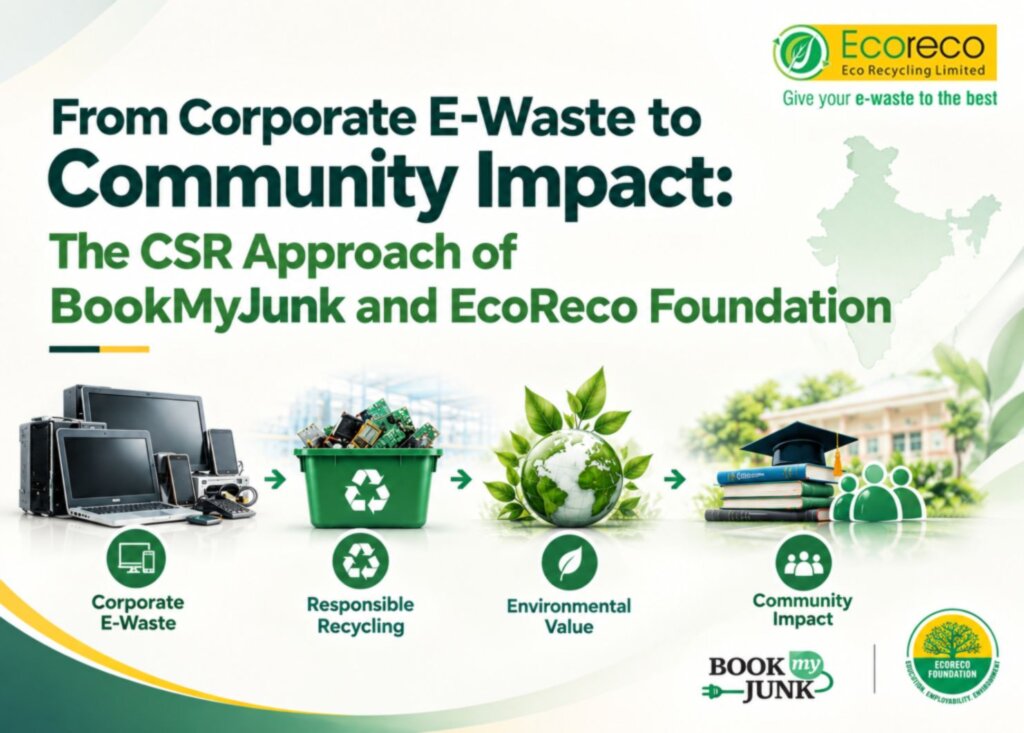
The CSR dimension of BookMyJunk’s model operates through its partnership with the EcoReco Foundation, which channels a portion of the value recovered from recycled electronics into social programmes that benefit communities affected by informal e-waste processing. This creates a link between corporate waste and community benefit that makes the decision to recycle responsibly tangible rather than abstract.
How EcoReco Foundation Translates Recycled Waste Into Social Value
The EcoReco Foundation operates at the intersection of e-waste management and community development. Its work recognises that the communities most affected by India’s e-waste problem are rarely the same communities that generate the waste. Industrial areas on the outskirts of Mumbai, Delhi, and other metros, where informal recycling operations concentrate, carry a disproportionate share of the health and environmental burden created by improperly processed electronics.
EcoReco Foundation’s programmes focus on two connected challenges. The first is environmental education and awareness in communities where informal recycling is practiced, helping informal workers understand the health risks they face and supporting transitions toward safer livelihoods. The second is channelling resources generated through certified e-waste recycling back into these communities through health support, skills development, and livelihood programmes.
When a Mumbai corporation chooses to route its retired IT assets through BookMyJunk and Eco Recycling Ltd. rather than informal channels, the certified processing of that waste generates value, both through recovered materials and through the CSR reporting metrics the corporation can claim. The EcoReco Foundation ensures a portion of that value flows back to communities, closing a loop that informal disposal leaves entirely open.
This model reframes e-waste recycling not just as a compliance requirement or an environmental responsibility, but as a social investment. For companies with active CSR budgets and ESG reporting commitments, this reframing is practically useful because it creates documented social impact that is attributable, reportable, and auditable.
The Role of Eco Recycling Ltd. in Making the System Work
The entire model depends on what happens after the collection. Eco Recycling Ltd. is the certified processing partner that ensures end-of-life electronics are handled in full compliance with India’s E-Waste Management Rules 2022, with the CPCB authorisations and documented processes that certified recycling requires.
As an experienced e-waste company in Mumbai with processing infrastructure designed for the full range of electronic waste categories, Eco Recycling Ltd. handles the technical complexity that the model depends on. Data erasure and certified destruction for devices holding sensitive corporate information. Dismantling and materials recovery that meets the environmental standards required by India’s extended producer responsibility framework. Reporting and documentation that gives corporate clients the evidence they need for compliance records and ESG disclosures.
The collaboration between BookMyJunk, EcoReco Foundation, and Eco Recycling Ltd. is effective precisely because each organisation focuses on what it does best. BookMyJunk removes the logistics barrier through technology and customer experience. EcoReco Foundation creates the community impact layer that gives the model its social dimension. Eco Recycling Ltd. ensures the waste is processed responsibly and compliantly, creating the certified chain of custody that both regulatory compliance and ESG reporting require.
What This Model Reveals About the Future of Corporate E-Waste Management
The collaboration between these three organisations points toward a direction that India’s e-waste management sector needs to move in more broadly. Certified e-waste recycling in India has historically been positioned as a compliance service, something organisations do because they have to, not because they see direct value in it beyond avoiding penalties.
The CSR model changes this positioning by demonstrating that responsible e-waste recycling can deliver value across multiple dimensions simultaneously: regulatory compliance, data security, materials recovery, ESG reporting, employee engagement, and genuine community benefit. Each of these dimensions has value independently. Together they make the case for responsible e-waste management compelling enough to compete with the convenience of informal disposal.
For companies operating in Mumbai and across Maharashtra, the regulatory environment is also tightening. The CPCB is increasing scrutiny of bulk e-waste generators, and the requirement to channel waste through authorised recyclers and maintain documentation of that process is being enforced more consistently than in previous years. The question for most organisations is not whether they will need to formalise their e-waste management approach, but when and how.
The approach modelled by BookMyJunk, EcoReco Foundation, and Eco Recycling Ltd. provides a practical answer to that question: work with partners who have built the infrastructure, the community relationships, and the certified processing capability to make responsible e-waste management genuinely manageable for the organisations that need it.
What Businesses and Households Can Do Right Now
The barrier to participating in certified e-waste recycling is lower than most people assume. For individual households in Mumbai, a single booking through a platform like BookMyJunk arranges collection of end-of-life electronics from the home, with no requirement to transport waste or navigate the certified recycler landscape independently.
For corporate sustainability and IT teams, the starting point is a straightforward audit of what end-of-life assets the organisation is currently holding and how those assets have been disposed of in the past. If the answer involves informal collectors, resale to unverified buyers, or storage rooms full of retired equipment with no disposal plan, the risk profile of the current approach is worth examining against both the regulatory requirements and the ESG expectations the organisation’s stakeholders are applying.
Eco Recycling Ltd. works with organisations across scales to design e-waste management programmes that fit the organisation’s actual asset volumes, data security requirements, and reporting needs. The first step is a conversation about where the current process stands and what a certified, community-linked approach would look like in practice.
Conclusion
Corporate e-waste is not an abstract environmental issue. It is a material flow that currently divides into two paths: one that creates harm through informal processing, and one that creates value through certified recycling linked to genuine community impact.
The collaboration between BookMyJunk, EcoReco Foundation, and Eco Recycling Ltd. demonstrates that the second path is practical, accessible, and increasingly well-structured for both individual households and large corporate generators. The documented recycling chain, the community programmes, and the CSR reporting metrics that this model produces are available to any organisation willing to move its e-waste out of informal channels and into a certified system.
For any Mumbai-based organisation evaluating its approach to e-waste recycling or looking for a certified e-waste company in Mumbai that combines compliance rigour with measurable social impact, Eco Recycling Ltd. and its partners provide a model worth engaging with seriously.
