
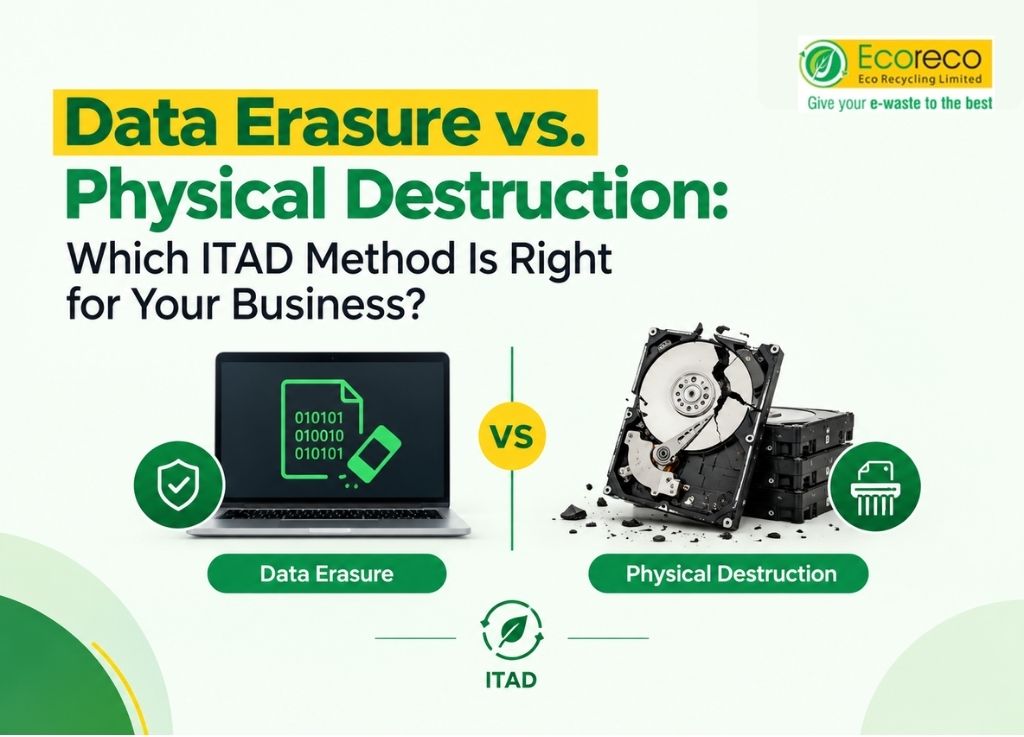
When it’s time to retire old laptops, servers, or storage drives, most organizations eventually run into the same question: should the data be wiped, or should the device itself be destroyed? It sounds like a small operational detail, but the answer actually shapes your risk exposure, your compliance posture, and even how much value you can recover from equipment you’re no longer using.
The confusion here is understandable. Both methods fall under the umbrella of data sanitisation, and both are legitimate approaches used by data destruction services in India every day. But they solve different problems, and choosing the wrong one for your situation can either leave you needlessly destroying equipment that still has resale value or, worse, relying on a method that wasn’t rigorous enough for the sensitivity of what was on that drive. Eco Recycling Ltd. gets asked to walk clients through this exact decision constantly, so let’s break down what actually separates data erasure from physical destruction and how to know which one fits your business.
What Data Erasure Actually Involves
Data erasure is a software-based process that overwrites every sector of a storage device with new data, repeatedly, until the original information is no longer recoverable through any known forensic method. Done properly, certified data erasure follows recognized international standards and produces a verifiable report confirming the wipe was successful, device by device.
The advantage here is significant: erasure doesn’t destroy the physical hardware, which means the device can be resold, redeployed internally, or donated once the wipe is confirmed. For organizations managing large fleets of laptops or servers on a refresh cycle, this preserves real financial value that would otherwise be lost.
Data erasure is generally the right fit when devices are functioning normally, when there’s a genuine possibility of resale or reuse, and when the sensitivity of the data doesn’t demand irreversible physical destruction. It’s also typically faster to execute at scale than physical destruction, since multiple devices can often be processed simultaneously through automated erasure software.
What Physical Destruction Actually Involves
Physical destruction takes a different approach entirely: rather than removing the data, it destroys the storage medium itself, through shredding, crushing, or degaussing, so that data recovery becomes physically impossible regardless of the tools or techniques someone might use.
This method makes sense in situations where the device has failed and can no longer be reliably wiped through software, where regulatory or contractual requirements demand irreversible destruction, or where the data involved is sensitive enough that no risk of recovery is acceptable, even a theoretical one. Financial institutions, healthcare organizations, and government-adjacent businesses frequently default to physical destruction for exactly this reason.
The tradeoff is straightforward: destroyed hardware has no resale value, and depending on the volume involved, this can represent a real financial loss when compared to a properly erased and resold device.
A Direct Comparison to Simplify the Decision
| Consideration | Data Erasure | Physical Destruction |
| Device usability after the process | Reusable, resalable | Destroyed, no reuse |
| Speed at scale | Faster for large batches | Slower, more resource-intensive |
| Best suited for | Functioning devices, resale-eligible equipment | Failed drives, highly sensitive data, strict compliance needs |
| Residual value recovery | High | None |
| Verification method | Digital erasure certificate | Physical destruction certificate |
| Recoverability risk | Effectively zero when properly certified | Zero, by physical impossibility |
How to Decide Which Method Fits Your Situation
Rather than defaulting to one method across your entire organization, the right approach usually depends on a few practical factors:
- Is the device still functional?
A working drive is a candidate for erasure. A failed or damaged drive generally isn’t reliably erasable and should go straight to physical destruction.
- What’s the sensitivity level of the data involved?
Routine business data on a standard office laptop is a reasonable fit for certified erasure. Highly regulated data, financial records, health information, and classified material often warrant the added certainty of physical destruction regardless of cost.
- Do you have a genuine resale or redeployment plan?
If devices are being refreshed on a cycle and there’s a market or internal use for them afterward, erasure protects that value. If the equipment has no further use case, destruction removes the question entirely.
- What do your compliance obligations actually require?
Some industries and contracts specify a particular method outright. Always check before defaulting to whichever is more convenient.
- How many devices are involved, and on what timeline?
Large batches on a tight deadline often favor erasure for speed, while smaller volumes of highly sensitive drives can absorb the slower pace of physical destruction.
Common Mistakes Businesses Make With Data Destruction
- Assuming a factory reset counts as data erasure.
A standard reset doesn’t overwrite underlying data and isn’t equivalent to certified data sanitisation.
- Destroying devices that could have been safely and profitably erased.
Not every situation calls for physical destruction, and defaulting to it out of caution wastes recoverable value unnecessarily.
- Skipping verification and certificates entirely.
Whichever method you choose, always request documented proof, an erasure certificate or destruction certificate, tied to a specific device or serial number.
- Applying the same method to every device regardless of condition.
A blanket policy ignores the reality that failed drives and functioning drives call for genuinely different approaches.
Why the Right Partner Matters More Than the Method Itself
Both data erasure and physical destruction are legitimate, secure methods when executed correctly, but execution is exactly where things go wrong most often. A rushed or improperly verified erasure can leave recoverable fragments behind. A destruction process without proper documentation leaves no audit trail if a compliance question ever arises later.
Eco Recycling Ltd. approaches this by assessing each batch of equipment individually rather than applying one method across the board, matching functional devices to certified data erasure where resale value can be preserved, and reserving physical destruction for failed drives or genuinely high-sensitivity situations where nothing less than irreversible destruction will do. That device-by-device judgment, backed by documented certificates for every unit, is what separates dependable data destruction services in India from a one-size-fits-all approach that either wastes value or takes on unnecessary risk.
Key Takeaways
Data erasure and physical destruction aren’t competing methods, they’re two tools suited to different situations. Erasure preserves value on functioning equipment through verified, standards-based data sanitisation. Physical destruction removes all risk entirely on devices that have failed or carry data sensitive enough to demand it. The right choice depends on your equipment’s condition, your data’s sensitivity, and your actual compliance requirements, not a blanket policy applied without exception.
If your organization hasn’t reviewed how these decisions get made internally, that’s a good place to start. Eco Recycling Ltd. works with businesses across India to assess retired equipment individually and apply the right data destruction method for each situation, rather than defaulting to whichever is easiest.
Frequently Asked Questions
When performed to a recognized data sanitisation standard and verified with a certificate, data erasure is considered secure enough that recovery becomes practically impossible. Physical destruction removes even the theoretical possibility, but properly certified erasure is trusted across most industries for non-critical data.
Yes. That’s one of the main advantages of erasure over destruction. Once a certified wipe is confirmed, the device can be resold, redeployed within the organization, or donated, provided it’s still functioning correctly.
A damaged or failed drive often can’t be reliably wiped through software, since the erasure process depends on the drive being readable and writable. In these cases, physical destruction is generally the safer and more practical option.
This depends on sector-specific regulations and any data handling clauses in your contracts. Financial services, healthcare, and government-linked organizations often have stricter requirements, so it’s worth confirming directly rather than assuming either method is automatically acceptable.
Always ask for a certificate tied to the specific device, either an erasure certificate confirming the wipe method and standard used, or a destruction certificate confirming the device was physically destroyed. This documentation is your audit trail if a compliance question ever comes up later.
