
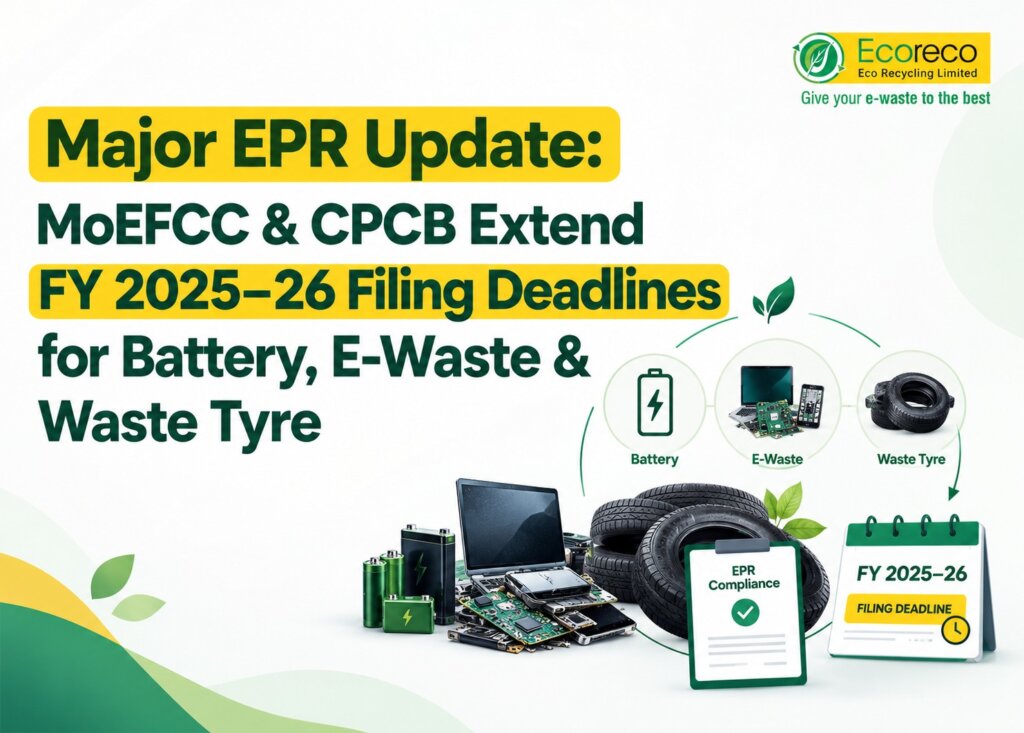
If you are a producer, importer, or recycler operating under India’s EPR framework, this is a development you need to act on immediately. Through Office Memoranda, Notices, and Portal Updates dated 27 August 2026, the Ministry of Environment, Forest and Climate Change (MoEFCC) and the Central Pollution Control Board (CPCB) have officially extended the FY 2025-26 filing timelines across three major waste streams: battery, e-waste, and waste tyre.
This is a significant EPR update that affects a large number of registered producers and recyclers across India. The extensions provide additional time to complete annual and quarterly returns and reconcile compliance data on the respective EPR portals, but they do not reduce the obligation to file. For organisations that have not yet completed their FY 2025-26 compliance data, the revised deadlines are now the operative dates, and missing them carries the same regulatory consequences as missing the original ones.
Here is a clear breakdown of what has changed, what the new deadlines are, and what you should be doing between now and each filing date.
The Three Extended Deadlines: What Has Changed and by How Much
The major EPR update covers three separate waste streams, each with its own portal and its own revised filing deadline. These are not informal extensions or grace periods. They are official communications issued through CPCB notices and portal updates, with links to the relevant official documents provided at the end of this article.
- Battery EPR: Annual Return extended to 30 November 2026. The Battery Waste Management Rules, 2022, require registered producers and importers to file annual returns on the CPCB’s Battery EPR portal. The original FY 2025-26 annual return deadline has been extended to 30 November 2026, giving registered entities additional time to consolidate placement data, reconcile EPR certificates, and complete the online filing.
- E-Waste EPR: Both Annual and Quarterly Returns extended to 30 September 2026. Under the E-Waste (Management) Rules, 2022, producers, importers, and brand owners registered on the CPCB’s E-Waste EPR portal are required to file both annual and quarterly returns. The FY 2025-26 filings for both return types have been extended to 30 September 2026. This applies to all quarterly returns outstanding for FY 2025-26 as well as the annual return for the financial year.
- Waste Tyre EPR: Both Annual and Quarterly Returns extended to 30 September 2026. Similarly, tyre producers and importers registered on the Waste Tyre EPR portal now have until 30 September 2026 to file both their annual and quarterly returns for FY 2025-26.
Why These Extensions Were Issued and What They Signal About Enforcement Direction
Extensions of this nature from MoEFCC and CPCB are not unusual when the portal infrastructure is handling a high volume of concurrent filings or when a significant number of registered entities have outstanding reconciliation issues. The 27 August 2026 communication suggests the authorities identified that a meaningful portion of producers and recyclers were likely to miss the original deadlines without additional time.
What this does not signal is a relaxation of enforcement intent. India’s EPR regulatory posture has been tightening consistently since the 2022 rules came into force. The portal infrastructure is increasingly the primary instrument of compliance tracking, and the CPCB has made clear through previous communications that non-filing and incomplete filing will attract consequences under the Environment Protection Act, 1986.
The practical implication is that this extension is an opportunity to complete filings properly, not a reason to delay further. Producers who use the additional window to consolidate their data, reconcile certificates, and file complete and accurate returns are in a significantly stronger compliance position than those who treat the extension as simply pushing the problem forward.
What Producers and Importers Need to Do Before Each Deadline
The action required differs somewhat depending on which waste streams your organisation is registered under, but the core compliance tasks are consistent across all three.
- Verify your registration status on each relevant portal. If your organisation is registered under more than one EPR framework (for example, both EPR e-waste and EPR battery as is common for electronics importers), confirm that your registration is active and that your login credentials are current on each portal separately. Portal sessions time out, and some accounts may require re-verification if they have been inactive.
- Compile your placement data for FY 2025-26 accurately. EPR annual returns require you to declare the quantity of products placed in the Indian market during the financial year, by category. This number drives your collection target obligation and must reconcile with your EPR certificate holdings. Errors in placement data are one of the most common sources of compliance gaps and are increasingly scrutinised during portal audits.
- Reconcile your EPR certificates against your collection targets. For each waste stream, the quantity of EPR certificates you hold must meet or exceed the collection target calculated from your FY 2025-26 placement data. If there is a shortfall, the extended deadline provides time to procure additional certificates from authorised recyclers before filing. Do not file with a known shortfall and expect to resolve it retroactively.
- Complete quarterly returns before filing the annual return. For EPR e-waste and waste tyres, the portal requires quarterly return data to be complete before the annual return can be filed. If you have outstanding quarterly filings for any quarter of FY 2025-26, these must be completed first. The extension to 30 September 2026 covers both quarterly and annual returns, but the sequence matters.
- Download and retain all filing acknowledgements. Once returns are filed and submitted, download the acknowledgement receipts from each portal and retain them as compliance documentation. These are the primary pieces of evidence of timely filing in the event of any regulatory inquiry.
How Recyclers Are Affected by These Extensions
The deadline extensions are not only relevant to producers and importers. Authorised recyclers who issue EPR certificates also need to ensure their portal data is current and accurate, because producers’ annual returns reconcile against certificate data that the recyclers themselves have filed on the portals.
If a recycler’s certificate issuance records are incomplete or incorrectly entered on the portal, the corresponding producer return will show a reconciliation discrepancy even if the physical recycling was completed correctly. Recyclers should use this window to audit their own portal entries for FY 2025-26 and correct any discrepancies before the September and November deadlines arrive.
Eco Recycling Ltd, as a CPCB-authorised recycler operating across both the EPR e-waste and EPR battery streams, coordinates directly with registered producers to ensure that certificate issuance data on the portals is accurate and reconcilable against producer returns. For producers who rely on Eco Recycling Ltd for their recycling and certificate needs, the extended deadlines provide a cleaner window to complete this reconciliation before filing.
A Practical Timeline for Using the Extended Window Effectively
Given that the two nearest deadlines are 30 September 2026 for e-waste and waste tyres, organisations registered under those frameworks have limited time from the date of this writing. A structured approach to the remaining window is more useful than treating it as open-ended.
For e-waste and waste tyre filers, the period from now through mid-September should be used to complete data compilation, certificate reconciliation, and filing of quarterly returns. The final two weeks of September should be reserved for annual return filing and acknowledgement download, with a buffer for any portal technical issues that arise near the deadline.
For battery filers with the 30 November 2026 deadline, the extended window is more comfortable but should not be used as a reason to delay. Producers who complete their battery annual return in October, rather than lv the final days of November, avoid the portal congestion that typically accompanies last-minute filing surges.
Official Documents and Portal Links
The following official documents confirm the extended deadlines and are available directly from the CPCB portals:
- Battery EPR official notice: https://eprbattery.cpcb.gov.in/upload/adminDoc/BATTERY%20WASTE-08272026172005.pdf
- E-Waste EPR official notice: https://eprewaste.cpcb.gov.in/assets/Notice_regarding_the_extension_for_filing_the_annual_and_quarterly_return_in_E-Waste.pdf
- Waste Tyre EPR official notice: https://eprtyres.cpcb.gov.in/notices/Notice-Extension-of-timeline-for-filing-of-Annual-and-Quarterly-Returns-FY2025-26.pdf
Use This Window Well
This EPR update gives producers, importers, and recyclers legitimate additional time to complete FY 2025-26 filings accurately. The right response is to use that time deliberately: verify registrations, compile placement data, reconcile certificates, and file complete returns well before each deadline rather than at the last possible moment.
Eco Recycling Ltd works with producers registered under both EPR e-waste and EPR battery frameworks to support the compliance process from certificate procurement through to annual return filing. For organisations that need assistance completing their FY 2025-26 returns within the extended timelines, reaching out now rather than closer to the deadlines gives you the most room to resolve any data discrepancies before they become filing problems.
The deadlines have moved. The obligation has not.
